Showing posts with label pit. Show all posts

Thursday, August 16, 2018

Smiley's in Lexington, NC

Smiley’s in Lexington, NC, harkens back to decades ago when excellent pit barbecue was slowly cooked over wood embers before being served to customers sitting inside in a simple concrete block building or outside in their cars waiting for curb service.

The pits in use today are the original ones when the business opened in the 1950s. In fact, little has changed at Smiley’s except for a few name changes. It opened originally as Dan’s before the name was changed to Jay’s and then later to Southern Barbecue. It was renamed as Smiley’s Lexington BBQ in 2002 by Steve Yountz, the current owner, when he bought the business after having been an employee for 27 years. Yountz was inducted into the N.C. BBQ Wall of Fame in 2012.

Smiley's is easy to find on Winston Road.

Smiley’s standing in barbecue folklore is recognized by its being one of only two barbecue pits in Lexington (the self-proclaimed Barbecue Capital of the World) on the Historic Barbecue Trail of the North Carolina Barbecue Society. Even its location is a relic of the past. The building is about nine blocks from the downtown center on the “old” road heading north out of town (now replaced by a modern expressway) that is still called Winston Road, named for the nearby tobacco center before it merged in 1913 with the quiet Moravian town of Salem and changed its name to Winston-Salem. 

Mid-afternoons on a weekdays can be quiet except for occasional takeout orders.

Because so little has changed over the decades at Smiley’s, it’s often underrated and underappreciated by young barbecue fans who are looking something other than great barbecue (such as creative sides and desserts, craft beer, and unusual cocktails). When I was at Smiley’s for a late lunch, it was quiet (unlike two other prominent BBQ places where the parking lots were full when I drove by). I had the indoor area all to myself except for an employee who was also eating.

Red slaw with coarse chopped BBQ in a tray have the signature ketchup colors.

I knew I was in Lexington when the ketchup-colored BBQ on the tray was delivered to my table. I ordered the coarse chopped BBQ and found it extremely satisfying, and it surely didn’t need any extra dip; however, I couldn’t resist the temptation to add more to enjoy the flavors of vinegar, pepper, sugar, ketchup, and salt with the barbecue. Consistent with Lexington style, only pork shoulders are used in making the barbecue at Smiley’s.

Coarse chopped BBQ is a popular choice at Smiley's.

I was surprised when the server offered me a choice of slaw: red or white. I didn’t know that white coleslaw could be served in the city. It seems to be such a break from the traditional Lexington style that a local ordinance should prohibit its availability within city limits. Of course, I ordered red slaw, and it paired well with the barbecue, its companion on the tray. In addition, the hushpuppies were excellent. I was going to eat only a few but couldn’t stop. In a few minutes they had all disappeared. 

True to Lexington style, dip (not sauce) is the name to ask for at Smiley's.

The name of Smiley’s is intriguing. In a history of Lexington style BBQ written in 1996 by John Stogner Jr. and made available online by Southern Foodways Alliance, the name “Smiley” is identified as a nickname for Herman Stamey, one of early barbecue entrepreneurs who operated the business in its early days on Winston Road.

A pig bench is ready for anyone waiting for a takeout order.

Being at Smiley’s was like being in a time capsule. The setting and menu reminded me of decades ago. Fortunately, the barbecue hasn’t changed and is true to its legacy. Let’s hope that Smiley’s continues to preserve its traditions.

The wood pile in the back is proof of the traditional approach at Smiley's.


Tuesday, August 23, 2016

Morphing from a Dairy Center

The Barbecue Center was
once the Dairy Bar.
No trip near, through, or to Lexington, NC, is complete without a stop at one of its legendary barbecue establishments -- with more than 20 places to choose from. In the city that boasts the opening of its first one in 1919, the lineage of pitmasters is very royal.

The Lexington style of barbecue is so well known: pork shoulders cooked slowly over hardwood coals. It is always served with red slaw (coleslaw made with ketchup rather than the traditional mayonnaise base). The meat is usually served chopped, although sliced can be requested, and with a sauce seasoned with vinegar, ketchup, pepper, and other spices.

The wood outside tells you that slow cooking over hardwood coals is still the tradition.

For my most recent foray into Lexington, the destination was the Barbecue Center, which is the oldest barbecue restaurant in Lexington that still cooks on pits. It had its early beginnings as the Dairy Center and was known for its ice cream and banana splits, which seems an unlikely beginning for a legendary barbecue restaurant in Lexington. Barbecue now brings in the customers, but the signature dessert is still a humongous banana split.

The counter, originally in the Dairy Center, was moved to the Barbecue Center's new location when it opened in 1961.

Barbecue was added to the menu to improve business for the Dairy Center in the winter months. Doug Gosnell, who took over the restaurant in 1955, learned how to make pit-cooked barbecue, Lexington-style from the legendary C. Warner Stamey, who trained many other early pitmasters in the Piedmont area of North Carolina.

The dining area of the Barbecue Center is busy throughout the day.

The tray of barbecue that I ordered arrived just as expected: packed with chopped pork and red slaw. They and the hushpuppies were excellent. Rather than end the meal with the mountainous banana split, which reportedly weighs more than three pounds (a table of four usually shares one banana split), I settled for the much smaller and almost as famous banana pudding. 

A tray of barbecue (chopped, course chopped, or sliced) comes with red slaw.

Being able to trace its roots to Stamey places the Barbecue Center at the beginning of Lexington style. By continuing to make excellent barbecue and sides, it has a secure place in preserving Lexington traditions for a long time to come.

Banana splits are still
made at the counter.
Banana pudding is almost as famous as the banana split.


Friday, September 11, 2015

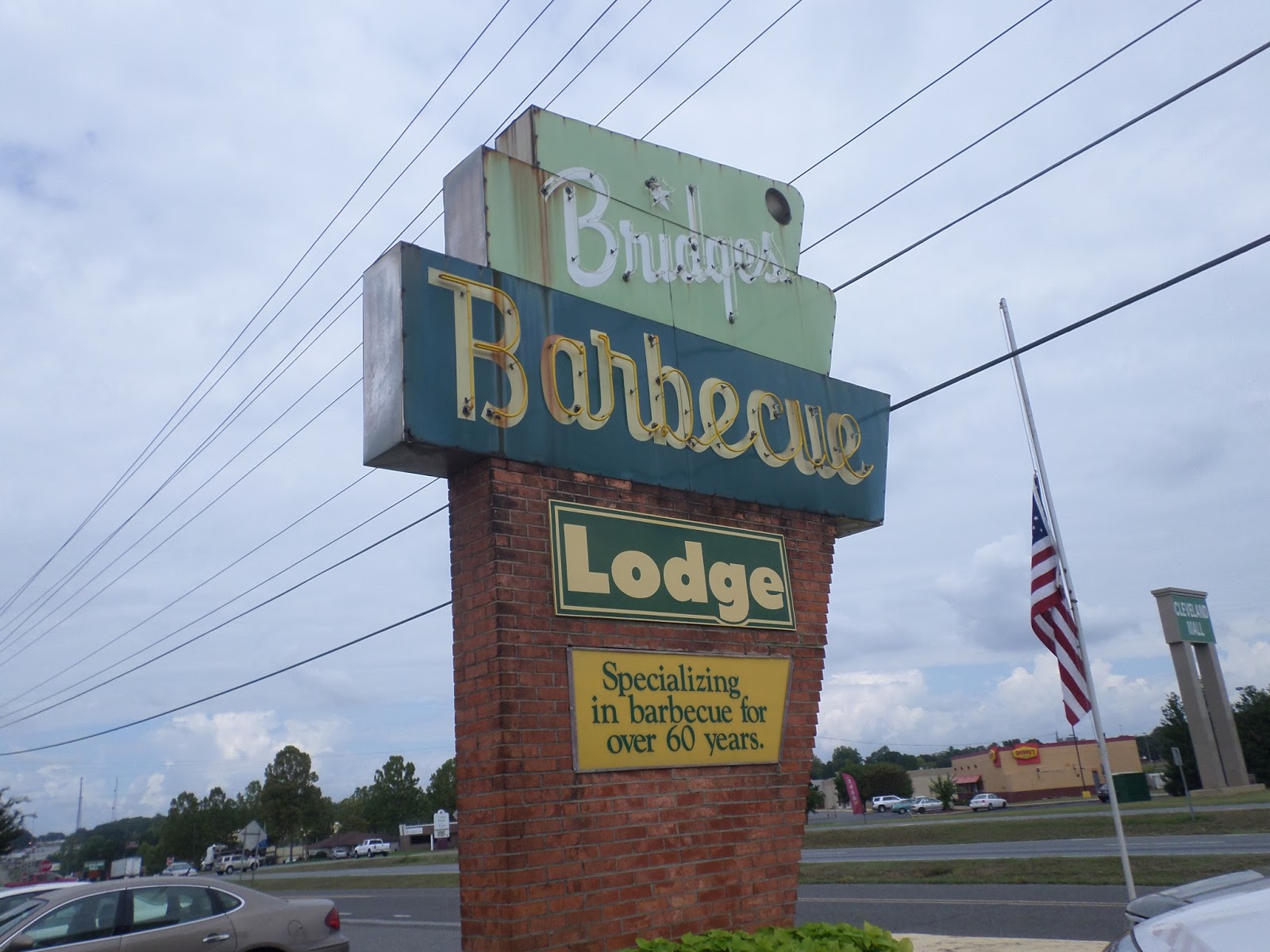
Red Bridges Barbecue Lodge: A Tradition Dating to 1946

The sign in front has been a beacon
for BBQ fans for decades.
Red Bridges Barbecue Lodge in Shelby, NC, has been a place I’ve wanted to visit for a long time. It is one of the top BBQ places in the South and continues to be recognized for its tradition and legacy of serving moist and tender barbecue.

A main stop on the historic barbecue trail of the N.C. Barbecue Society, it ranks high on just about everybody’s list – Southern Living, Southern Foodways Alliance, and barbecue writers such as Randy Moss. In 2015, it won the “Ultimate Barbecue Bracket” competition of Garden & Gun. Magazine articles and photos line its walls among family pictures and scenes of yesteryear. 

Bracket results tell the story.
Because it is set back from U.S. Highway 74 Bypass, I missed it when I drove by the first time. After making a U-turn, I found what everyone has been talking about – the restaurant looks like it’s been frozen since the 1950s in a time warp (you can almost imagine it being on a two-lane road that the bypass was at the time) and the barbecue is still prepared in the same time-honored tradition as it has been for decades.

On the wall is a picture of the restaurant in the "old days" (observed the vintage cars).

After I had ordered lunch, I started taking pictures. My server Diann (who is certified as a barbecue judge by the Kansas City Barbeque Society and has been a member of a competitive cooking team) asked if I wanted to take pictures of the pit. Of course! There’s where I found Dennis at work, guarding the fire and watching over the smoking shoulders. He has a lifetime of experience and learned his skills from his father, who was cooked pork for most of his life.

Pitmaster Dennis, 55, learned the skills
 of of operating a pit from his father.
Red Bridges himself learned the art of cooking pork shoulders slowly over wood coals from Warner Stamey of Greensboro fame. True to “Lexington-style,” he used only shoulders for pork barbecue that he served with the cole slaw variety that is “red.” I obviously had to order pork barbecue for lunch. The easy choice was a jumbo BBQ plate (combination of chopped pork and chicken with a thin stream of sweet sauce on top) that included baked beans and red slaw and was accompanied by a basket of perfectly fried, crunchy hushpuppies. For dessert, I selected banana pudding (always available) over pineapple-coconut cake, the dessert of the day – both made by Diann who makes all the desserts.

"Lexington-style" barbecue always comes with "red" slaw.

Granddaughter Natalie (left) and daughter
Debbie keep Bridges' spirit alive.
The restaurant continues the legacy of Red Bridges, its namesake, who started selling barbecue in 1946. It is now run by second and third generation family members. Granddaughter Natalie said that she began working there when she was 14 or 15. Diann mentioned that grandson Chase makes all the red slaw and never deviates from the family’s recipe.

The restaurant has a steady stream of customers -- new and repeat.

The woodpile is huge -- and neat.
I couldn’t believe how much chopped wood was in back of the restaurant waiting to be turned into hot coals on another day of cooking. The wood was stacked as neatly as a Boy Scout project and all in a single row as long as the restaurant. Next to the woodpile was the remains of an old free-standing pit building that with a little coaxing looks like it could be returned to service with some tender care. I could almost picture coals blazing in the pits.

Banana pudding is always available.
The constant stream of customers coming and going made the restaurant seem like a train station. A line of customers at the cash register waiting to pay their bills seemed to never disappear. The dining area displays a community spirit as several customers greeted each other and the restaurant’s staff, and most tables were noisy with friendly conversation until food was served. It was obvious that a few customers were also first-time visitors as they (like me) were taking pictures.

Watching descendants of Red Bridges work in the restaurant that he and his wife Lyttle started many decades ago was a special experience. Enjoying pork barbecue and red slaw at Red Bridges Barbecue gave me a greater appreciation for the role of “Lexington” style in creating N.C. barbecue traditions and for this particular restaurant’s connection to others that serve barbecue in the Piedmont.
 
About 50 shoulders cooked the day before are ready to be chopped or sliced in the kitchen.


Sunday, February 1, 2015

Mapping a Barbecue Trail

Imagine a state preparing a map of all its barbecue restaurants and making it available at welcome centers and through visitor programs. When I stopped at South Carolina’s welcome center on Interstate 95 after entering from Georgia, I was interested in getting only a few simple brochures and a state highway map.

Which South Carolina map connects to culture and history?

A mouth-watering
sandwich graces 
cover of trail map.
When I arrived at a stack of highway maps, my eyes were immediately attracted to a picture of a mouth-watering barbecue sandwich on the front panel of different map. About the same size as the highway map and folded into similar sections, this one is labeled “South Carolina BBQ Trail Map.” It also proclaims that it is “official” (which is missing from the front of the highway map that indicates “free distribution only”). 

Although the state highway map is a great resource to navigate through South Carolina and includes useful travel information such as road classifications, symbols, distances, and hurricane evaluation routes, it lacks a cultural connection. On the other hand, the BBQ Trail Map highlights the culture of the state as it brags that South Carolina invented barbecue and is the only state to offer the fourofficial sauces – vinegar-pepper, mustard, light tomato, and heavy tomato.

South Carolina offers four different barbecue sauces.

As the trail map describes the state’s sauces, it connects them to cultural history. For example, German immigrants with a taste for mustard who settled in the 1700s are credited with popularizing mustard-style barbecue in the middle of the state. (In fact, South Carolina is the only state where this sauce is found.)

Mustard sauce is popular in the midlands of South Carolina.

The trail map also explains how the roots of barbecue run “five centuries deep” in the state and date to the time when Spanish explorers observed “open pit cooking” by Native Americans on the coast of South Carolina. According to the map, the first pit-cooked barbecue in America was created when the Spanish, who brought hogs on their long voyages for food and even left some on coastal islands of the Southeast, cooked in the style of the American Indians. 

Which sauce would be your favorite?
Although BBQ trail maps of other states are available, in both online and printed versions, South Carolina is the first and only state to prepare a trail map and make it available at its welcome centers. Consider how much its trail map advances its reputation and credibility as a tourist destination, particularly for culinary travelers. Maps of other states, such as North Carolina, have been prepared by associations (trail by NC Barbecue Society) or by entrepreneurs (Great NC BBQ Map by Amanda Fisher and Paul Bright). However, the map of South Carolina includes all establishments and their sauces. It divides the state into three regions – mountains, midlands, and coastal – and lists all barbecue establishments, marks their locations on the map, and identifies which sauces they serve. The S.C. Department of Tourism deserves a round of applause for its initiative.

Finding barbecue in South Carolina is easy with the trail map.

When you travel, don’t travel with only a highway map – also take a map that includes cultural and culinary connections. If you are searching for barbecue, include South Carolina in your journey because it knows how to map a trail.

Pick up a trail map at a S.C. welcome center.

Friday, November 14, 2014

In the Tradition Appreciated by a Community and Beyond

A trip to Hemingway, SC, has been a goal of mine for some time. The destination is Scott’s Variety Store and Bar-B-Que. This business has been a local community favorite for more than four decades because the barbecue that the Scott family serves has no equal. More recently, it has won national acclaim for the “cut, chop, cook” style — cut the wood, chop it up, and slow-smoke whole hogs all night — embraced by Rodney Scott, pitmaster for the family’s business.

The Scott family opened its business in 1972; the weathered church pew out front is used frequently by customers.

The tin-roofed store, which opened in 1972, once focused on dry goods and included a pool hall before the business swung decidedly to barbecue. Initially, whole hogs were smoked on only Thursdays. My, how times have changed. Selling the area’s best barbecue is now the goal, although the variety store still has a few items on its shelves. Some shelves are empty, but customers rarely notice because they are here for barbecue.

The menu board lists barbecue from a sandwich to a whole hog.

Scott is admired for his skills in the pits. However, before cooking the hogs, he also cuts all the wood himself with a chainsaw. With smoldering oak and hickory coals burning brightly in each pit, Scott monitors hogs weighing up to 150 pounds as they are smoked and mops them with peppery vinegar. The master of the pits has been cooking whole hogs since he was 11.

The cut hardwood behind the store is ready to be chopped; the telltale sign of smoke lets you know that the burn barrels are active.

Lots of customers take orders to go by the half pound and more. The to-go business is easy to understand. There’s no place inside to sit and eat. A weathered church pew on the front porch is about the only place someone can sit and eat on the premises. That’s where I sat and enjoyed pulled pork served with two slices of bread in a Styrofoam clamshell. The simplicity of the container matches the simplicity of the pulled pork barbecue prepared so deliciously.

Hardwood breaks down into coals as it's burned in five-foot barrels.

While I was there, I was able to visit the pits, which consist of two long concrete bunkers. Each one is fed hot coals from the burn barrels to cook hogs suspended above the heat by chicken wire. No other customers seemed interested in checking out the pits, a sign that they were locals and considered the pit area so functional with nothing to admire. However, the salvaged industrial piping and junked truck axles in the burn barrels seemed to me as artistic as any treasured folk art.

The pit area constantly stays busy.

The customers also seemed unimpressed to be ordering barbecue prepared by someone who has received so much attention. In July 2011, Time magazine heralded Scott for personifying “everything people admire about barbecue.”

Grocery items are still on the shelves for sale but more space is being taken over to document the recognition of Rodney Scott's pitmaster skills.

Two year earlier, on June 9, 2009, The New York Times exposed Scott, then 37, to the world in an article by John T. Edge, a food writer and director of the Southern Foodways Alliance. In the following year, SFA produced the documentary “Chop/Cut/Smoke” about Scott’s approach to whole hog cooking. Edge also extended the recognition of Scott in an article for Saveur on how barbecue is being preserved as an art form.

A plaque commemorates the initial showing of the "Cut/Chop/Cook" documentary by the Southern Foodways Alliance.

Rumors that Scott is planning a “city” restaurant in Charleston with his barbecue have started to circulate. I can’t imagine it would ever compete with the charm of the family’s variety store in Hemingway. Let’s hope that the barbecue and the approach for preparing it don’t change either.

Hot coals are added to the pits regularly as hogs are smoked.