Showing posts with label barbeque. Show all posts

Saturday, June 1, 2019

Four Generations of Creating a Legacy and Still Serving

J.S. Pulliam Barbeque in Winston-Salem, NC, has been serving barbecue for a long time. Started in 1910, Pulliam is amazing because its longevity extends so long. Even more amazing is that Pulliam has created its own flavor profile that separates it from the two primary barbecue styles of North Carolina: eastern and Lexington (or western).

J.S. Pulliam Barbeque stays busy after opening at 10 a.m. on Tuesdays through Saturdays.

The barbecue is minced — not chopped or pulled. Because Pulliam’s is only 2½ miles from the T.W. Garner plant on Indiana Road where Texas Pete, a nationally leading Louisiana-style hot sauce, was born in 1929 (almost two decades after Pulliam began his business) and is still produced, it’s not surprising that the barbecue it is flavored with a hot sauce, which makes it distinct from eastern N.C. (pepper-vinegar) and Lexington style (vinegary with ketchup) barbecue. Even the white slaw that accompanies the sandwich is sharp, not sweet. 


The barbecue sandwich is top with slaw and dressed with Ed's Hot Sauce.

The hot sauce is named for Big Ed who concocted it in 1945. (Five-ounce bottles are sold for $2.95 each.) The distinctive flavor is a big hit with regular customers who appreciate its uniqueness. Tourists, on the other hand, who expect a traditional N.C. flavor often react with surprise on social media. Of almost 50 reviews on TripAdvisor, most rate the restaurant excellent or very good, but one rating is poor and two are terrible (the lowest rating —  the minced BBQ with hot sauce must have been a shock).

The menu has everything anyone would want.

Pulliam makes all barbecue, sauce, and slaw on site. The menu is simple and limited: barbecue sandwich, hot dog, snacks, and drinks. Both the sandwich and hot dog are served wrapped in waxed paper. Barbecue can also be ordered by the pound as well as by the cup (half pint and one pint). Pulliam is unusual because the barbecue sandwich can also be ordered with cheese. Don’t expect a lot of sides with a sandwich. If you want something extra, you can choose from small racks of chips or pies. The only beverages are bottles and cans of soft drink, with Cheerwine prominently displayed, kept in old-time coolers.

Customers line up to pay after ordering.

The restaurant isn’t recognized on the historic N.C. Barbecue Trail developed by the N.C. Barbecue Society because it doesn't cook with wood, but it predates most establishments on it. Although the restaurant is named for its barbecue and customers come specifically for it, it’s more renowned for hot dogs. In 2011 Rachel Ray Magazine and Reader’s Digest proclaimed Pulliam’s hot dog to be the best in the South. In 2015 MSN News ranked it in the Top 50 of “America’s Best Hotdogs.” In 2018 People magazine, with the editors of Food & Wine, named it the best one in North Carolina. 


In an earlier location decades go, Pulliam was a popular lunch spot.

In addition to the sign that says the business opened in 1910, the best clue that Pulliam has been in business a long time is the small space inside: there are no places to sit and eat. Everyone stands. As Mark Flynt, the owner, told Wake Forest University students in 2015, “If you can stand up, you can eat more.” Customers line along a wall to enjoy their lunch, although a few take their food to go. While I was there with my brother, two city police officers walked behind the counter where they stood and ate their lunches. In the “old days,” picnic tables outside offered a brief respite to sit and eat, but they have been long removed. However, the “Drink Cheerwine” sign still adorns the front, although it is more faded. 


Snacks, coolers, and memorabilia line the wall.

John S. Pulliam, the founder, opened the business in 1910 in its original location on North Liberty Street in Winston-Salem. He sold the business in 1958 to Richard (“Big Ed”) Flynt, his first cousin, who began working for Pulliam at age 10 and continued to work there before becoming the owner. Flynt continued the tradition of specializing in barbecue and hot dogs to satisfy the working class on the city’s north side. The nondescript black-and-white striped building on Old Walkertown Road is the business’s third location, where it’s operated by Flynt’s son Mark. Big Ed’s granddaughter Caitlyn Flynt Mordock is waiting to take over from her father. “When he retires, I’ll run the business,” she told me.

Caitlyn Flynt Mordock began helping her father cook when she was 5.

Loyal customers clearly also come here for the atmosphere, which includes feeling like you are among family. I enjoyed mingling with the regulars as we all stood and ate barbecue. (However, next time I might order a hot dog.)

Big Ed's Hot Sauce
The cookhouse in back is quiet after the pigs are cooked.

Saturday, August 6, 2016

Pigs and Pedals Revisted

Returning to Asheboro, NC, to judge has been a priority since 2014 when I participated in the inaugural Pigs and Pedals cookoff. Because family obligations prevented me from attending in 2015, I was interested this year in seeing how the event had changed since its inception.

In its first year, the cookoff was well planned, organized and executed. For 2016, Pigs and Pedals was again a superior experience. A few changes had been made since the initial cookoff. Judging is now conducted in The Exchange, an attractive event space in the middle of the downtown area and very convenient to the cooking teams. The number of cooking teams also increased to the maximum that the event space can accommodate: 47.

The Smokehouse Mafia, last year's Grand Champion, sets up early.

The surprise for me was an assignment as table captain, which meant that I would not be judging and evaluating barbecue entries. It was my first time as a table captain although I had been certified early last year and had volunteered at other events. The primary duties are to assist the contest representatives of Kansas City Barbeque Society by coordinating activities at a judging table (there were eight this year), serving the judges and collecting their evaluations.

Piggy cupcakes made by a local bakery greet judges as the arrive in The Exchange.

The six judges at the table where I was assigned had a wide range of experience. Three were master judges (more than 30 contests), one was participating for only his third event, and one was recently certified and judging for the first time. Contest organizers attempt to include new judges at events and place them at tables where they can learn from experienced judges.

The Exchange, an event location, is now the venue for all judging activities.

Although I prefer to judge, I willingly had volunteered to assist as a table captain when I registered. I will continue to volunteer in more than only the capacity of judge, although the rewards of being a judge and evaluating barbecue entries are clearly the motivation for judges to participate and spend the time required to drive and attend.

Pigs and Pedals remains one of my favorite barbecue contests and I hope to attend future cookoffs – as a judge or in another capacity.

Saturday, June 18, 2016

Cooking with a Team

The thrill for some barbecue fans is being a judge at a cookoff. For others, it’s taking on the challenging work of a cooking team. Sometimes the interests combine, and a cook wants to be certified as a judge, or a judge joins a cooking team to experience a cookoff from a different perspective.

Amanda Reed, her husband Jim, and best friend Kendra Battasta (left to right) show me the cookoff from a team's perspective.

In Apex, NC at the Peak City Pig Fest, I had the opportunity to join Coastal Smoke, a team from Wilmington, NC. It has competed at events sanctioned by the Kansas City Barbeque Society for about three years and successfully competed even earlier at community cookoffs.

Amanda and Kendra continue setup activities by placing a cooker in position.

Last year at the Smoke on the Harbor BBQ Throwdown in Mount Pleasant, SC, I met Amanda Reed, the head cook for Coastal Smoke. When I asked if I could join her team at an event in 2016, she was more than gracious and agreed that I could join her at the Pig Fest. Cooking with a team is a KCBS requirement for certification as a master judge, which I hope to gain when I have completed other requirements.

Amanda injects a pork butt with a solution of apple juice and vinegar.

For the Pig Fest, Amanda arrived about noon to set up and begin preparations. Because I wanted to see the cooking team in action from start to finish, I also arrived at noon. I was amazed at the constant motion of the team on the first day. So many steps – setup, meat inspection, cooks’ meeting, meat preparations -- have to be completed early to be ready for the quick pace of simultaneous actions on Saturday.

Pork butts are checked on a cooker.

After spending nine hours on site on Friday, I left for the evening (and a comfortable, uninterrupted sleep). Amanda with her husband Jimmy and best friend Kendra Baratta continued with other activities that shortened their sleep considerably. (Although I briefly thought about staying with them, I long ago gave up “all nighters” and don’t get up in the middle of the night for anything.) 

Kendra watches as Amanda puts chicken pieces on a cooker.

Amanda, on the other hand, slept very little. Around 3 a.m., she started the fire so that the charcoals would be ready to smoke and provide residual heat when she placed the meats on the cookers. The brisket and two of four pork butts went on the cookers at 5 a.m. At 7 a.m., the other two pork butts were placed on the cookers. These two would provide the “money muscle” (a small strip of loin meat opposite the blade bone side that is very tender) for the pork entry.

After slow cooking for several hours, the ribs are sliced for the turn-in box.

On Saturday I returned to the team site just before 8 a.m. (I could tell that Amanda and the others hadn’t enjoyed much sleep.) I watched most of the preparations for the two remaining meat categories: ribs and chicken. The ribs went on the cooker at 8 a.m. and finally the chicken at 10 a.m.

The chicken looks so good as it is arranged in the turn-in box.

So that the meats would be ready at the contest turn-in times (beginning at noon for chicken and continuing to 1:30 p.m. for brisket, the last one), each was prepared in advance – liquid injections, sauces, rubs. For example, the pork butts were injected with a solution of 3 parts apple juice and 1 part vinegar with a little sugar and salt. Even before arriving at the contest site, Amanda had prepped the chicken pieces by removing the bones, some skin and fat.

Kendra turns in chicken, the first entry, exactly at noon to Doug Reid, the KCBS rep.

When the turn-in times arrived, I was surprised how calm the team was. Everything was going just like clockwork. Kendra was the “runner” and took each entry for turn-in at the designated time after Amanda had completed the final stages. Before a turn-in was ready, she had picked the best pieces, cuts, or slices from everything that had been cooked, which was three or four times what was needed for turn-in. For example, to select at least 6 pieces of chicken for the entry, 19 had been cooked.

Rib are perfectly placed in the turn-in box for a high appearance score.

When the last entry was turned in, there was a brief sigh of relief before starting the final actions: cleaning and packing for the journey home – and waiting (more than 3 hours) for the awards ceremony. The results were bittersweet. The scores for chicken, ribs, and brisket were lower than hoped for, but Coastal Smoke placed among the top 10 teams in the pork category (even at turn-in, we thought that the pork was the best of the four entries submitted).

The pork entry, with money muscle lining the center, is ready for turn-in.

Looking back on the weekend activities, I have much more appreciation for a cooking team. The investment of time, money, and effort is substantial. Few people, particularly the public that arrives mid-day on Saturday, realize the amount of work involved. For me, the weekend was great. Because I had judged at the Peak City Pig Fest last year, seeing the event from the perspective of a cooking team was rewarding. If I ever spend time with a cooking team again, I can only hope that they are as congenial as Coastal Smoke


Note: To see an album with more pictures of my cooking experience with Coastal Smoke, click here.

Saturday, September 12, 2015

It's Still a Favorite

The Shindig began in 2006.
Fiddle-N-Pig Shindig in Fort Mill, SC, is becoming an annual destination, and I returned for the third consecutive year. From a judge’s perspective, this year’s event seemed like the ones in the past – efficiently run with great barbecue. However, the space for the cooking teams and the music performers was significantly improved at Anne Springs Close Greenway where the event is held. 

Bluegrass musicians performed on
the stage of thee new amphitheater.
Rather than being tightly compacted in a lawn next to the historic Dairy Barn, the cooking teams had more roomy space that seemed almost twice as large as before and took advantage of an additional area made available by relocating the amphitheater and the stage for musicians. The amphitheater was redesigned to take advantage of a nearby natural slope shaded by huge trees. A newly constructed wooden stage was much more attractive than the flatbed trailer that had been used.

People's choice contest was held indoors.
Although stormy weather was threatening for most of the day, it didn’t dissuade a crowd of bluegrass music and barbecue lovers from attending. The people’s choice competition among the cooking teams was again a main event, although this year it was moved inside the Daily Barn to avoid any potential rain (which never came).


Hands of guests are stamped with a pig design as proof of paid admission.

Walking a Swine Line won the
people's choice award.
The judges again assembled on the top floor of the historic Dairy Barn, which provides a scenic setting and ample spacing. With a total purse of $10,200 in prize money, Fiddle-N-Pig attracted 29 cooking teams. A group of 36 judges plus a complement of 6 table captains were needed to score the entries. At the table where I was a judge, the beef brisket and chicken were uniformly excellent; the pork and ribs had much more variability that was also reflected in their scores.

The Backwoods BBQ team won
the grand champion prize.
Smoke billows out of the Backwoods BBQ cooker.

MacDonald welcomes judges as
the Reids watch.
The event was efficiently run because the organizer again was Mina McLean MacDonald. She has planned the Fiddle-N-Pig competitions sanctioned by the Kansas City Barbeque Society. KCBS reps again this year were Doug and Susan Reid, who are not only experienced but superior in their skills for managing competitions.

Returning to Fiddle-N-Pig gave me the opportunity to explore more small towns nearby, this time over the border in North Carolina –- Kings Mountain, Pineville, and Waxhaw. In addition, because Shelby is also close, I stopped at the famous Red Bridges Barbecue Lodge for lunch and thoroughly enjoyed the food prepared by such a historic barbecue restaurant. Being there calibrated my taste buds to be ready to judge at the Shindig.

The Hog Wild team prepares its entries.

Fiddle-N-Pig is a great event in a scenic park-like setting. If I’m lucky, I’ll return again.

The historic Dairy Barn, built in 1947, is where the judges meet.


Saturday, June 6, 2015

Traveling to the Bull City


Durham, NC, is not that far from my home. When I learned about the Bull City Barbecue Classic Cookoff, I was interested in participating for several reasons. Being at the event would give me the opportunity to experience an event that is still developing, work with several highly regarded barbecue experts, evaluate the value that a sanctioning organization provides, and develop more completely my judging skills.

Cooking teams set up on the grounds of the Durham County Stadium.

First, the event is still in its infancy. It started in 2012 with five cooking teams and three judges. Led by Renee Brown, the contest organizer, the cookoff has attracted more cooking teams in each subsequent year. This year 20 teams signed up to compete (and 19 did). For judges, Renee had put out a call in her network and recruited 19, a few who had been judges for her last year. Even as the cookoff has grown, it still limits teams to cooking two meats (pork ribs and barbecue), unlike other competitions that typically also include chicken and beef brisket.

Smokin' Joe's BBQ was one of the 19 teams competing for contest awards.

Bob Garner, BBQ expert,
judges one of the ribs.
Next, I recognized several names in the “barbecue world” or media who had committed to judge and whom I would enjoy getting to know. One was Bob Garner, author of several books about North Carolina barbecue and traditional cooking, who is also a well-known pitmaster and connoisseur of N.C. barbecue. Another was Graham Wilson, who organizes the Peak City Pig Fest annually in Apex, NC, and in four short years has taken that event from being a dream to becoming one of the top N.C. contests sanctioned by Kansas City Barbeque Society. In addition, Anthony Wilson, news anchor and reporter for WTVD, the ABC TV affiliate in central N.C., was returning as a judge in Durham.

Anthony Wilson (right) returned to the cookoff again this year as a judge.

Another intriguing aspect of the Bull City Cookoff is that it is not sanctioned by any professional barbecue society such as KCBS, although Brown eventually hopes to make the transition to a sanctioned contest. Because all events that I have attended have been KCBS-sanctioned, being in Durham gave me the opportunity to see how judges perform who haven’t completed a uniform training program or don’t share a set of formally published rules. Although the judges did well, I easily recognized the value that a sanctioning organization provides.

Coookoff judges take their responsibilities very seriously.

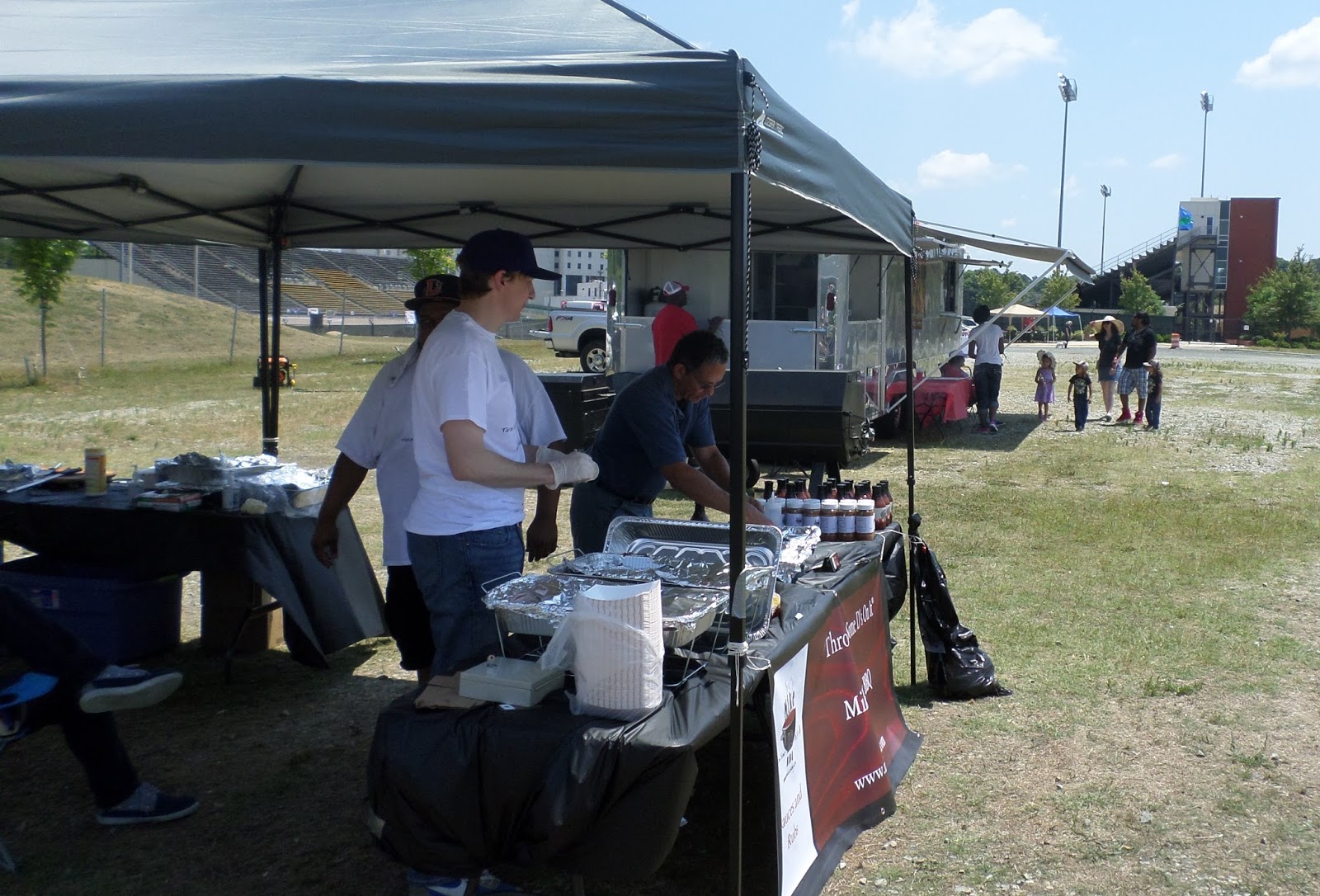
Because the cookoff is not sanctioned, it attracted a wide variety of cooking teams. Some were had never competed before, and their equipment was quite basic. Others had very expensive setups, vans, and trailers; they also displayed trophies to show off their past successes. As the public entered, some teams were well-prepared to sell their barbecue and sauces, while other teams looked on and observed how they could improve their operation the next time that they competed.

Smoking Dave's shows off racecar,
trophies, and new trailer.
People Choice's trophy went again
to Smoking Dave's, also the winner
in 2012, 2013, and 2014.

The cookoff also helped develop my table captain skills. Several days before the event, Brown had asked if I would explain the procedures to the judges at the start of the competition and serve as table captain as the samples were distributed to judges for evaluation. Although a table captain at a KCBS-sanctioned event serves only six judges, two volunteers helped me stay on schedule.

A cooking team keeps the grill hot with barbecue to sell to the public.

The Bull City event achieved the purpose of a cookoff: encourage teams to compete and promote barbecue as a culinary technique and sport. I look forward to watching as the cookoff continues to grow and eventually transitions to a formally sanctioned contest.

The line formed early for people interested in attending the cookoff;
admission was $5 per person.

Saturday, November 15, 2014

Another Throwdown on the Charleston Harbor

Charleston is such a favorite place that I returned for another Smoke on the Harbor BBQ Throwdown. My experience in 2013 created many fond memories, and last year’s event continued to be unsurpassed throughout 2014 as I participated as a judge at other events.

Perfect weather drew a large crowd again to the Throwdown.

The competition this year was again a great event: superior location, large crowd, perfect weather, excellent organization, superior cooking teams and tasty meat. The only surprise: No team could surpass Killer B’s again this year. The winner of the 2013 contest repeated as grand champion, and its score this year was even higher than in 2013.

Cooking teams certainly know how to travel in style.

The public again showed up in droves and lingered for hours. A huge crowd enjoyed the music, food, and sampling. In addition to admission fee (which was cut in half with a donation to the local food bank), sampling tickets sold for $1. Sampling of pork butts cooked by teams was available after 1 p.m. However, for hours well before the public began arriving at 11 a.m., spirals of smoke rose from the cooking area.

No Throwdown can be planned without signs pointing to BBQ.

Although each team had received eight butts to prepare barbecue for the public, several teams ran out of samples by mid-afternoon – an indication of everyone’s interest in evaluating the skills of the cooking teams and voting for a favorite in the People’s Choice Award.

Samples of cooked pork are served to the public who vote for the People's Choice Award.

After all the votes were counted, the favorite barbecue team and the winner of the People’s Choice Award was Swig & Swine, a team from Charleston. Because it’s a full-service catering company as well as a restaurant, name recognition may have helped it in garnering the most votes.

Winner of the People's Choice was the appropriately named Swig & Swine team.

Dates for the fourth annual throwdown, which again will be sanctioned by the Kansas City Barbeque Society, have already been set for 2015 (the weekend of Nov. 12-14), and several cooking teams were discussing plans to return. With a total cash prize purse of $6,150, this event will continue to be popular in the Southeast. I hope to be with them again as a judge.

I hope to see this sign again next year.

Saturday, November 16, 2013

Barbecue on the Charleston Harbor

Imagine planning a party. What setting would you want? When a barbecue competition was planned in South Carolina, the organizers took advantage of the spacious scenery of Lookout Pavilion that is part of the Charleston Harbor Resort and Marina, a fashionable property that proclaims itself a “waterfront sanctuary.” Charleston, “known as the place where history lives,” is a great venue for a barbecue throwdown.


Rows of cooking teams were quiet until the gates opened for the public.

On the banks of the Charleston Harbor at Patriots Point in Mount Pleasant, the pavilion is a great venue for cooking teams, judges, musicians, vendors, and the general public. It’s the best setting and most scenic location of any barbecue competition that I’ve attended. The area where the judges meet overlooks Cooper River (which forms the Charleston peninsula with Ashley River), the ferry to Fort Sumter, and several U.S. Navy warships.

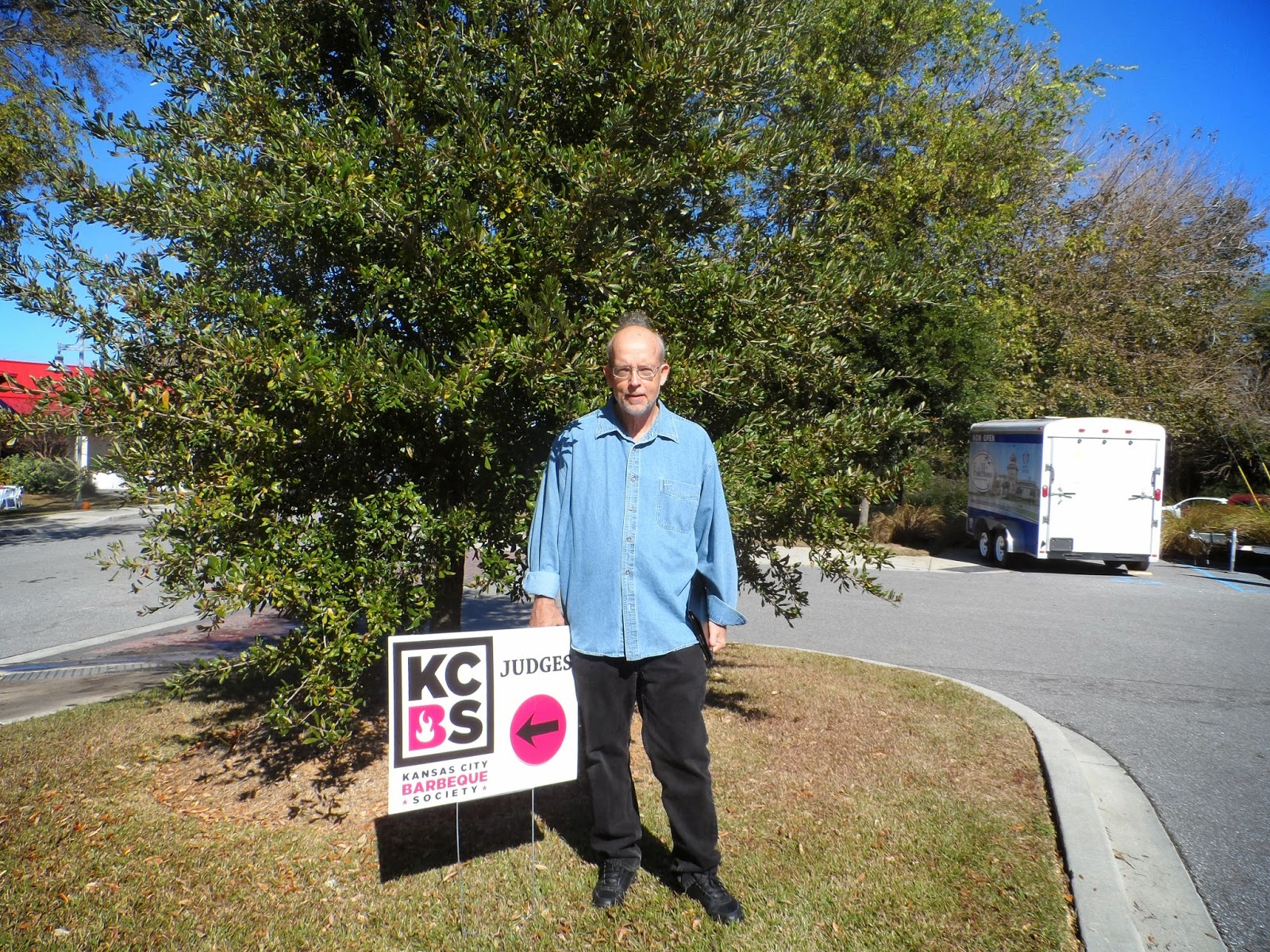
Even the judges got a sign showing where to report.
Appropriately named Smoke on the Harbor BBQ Throwdown, the event attracts competitive cooking teams from throughout the Southeast, although most are from South Carolina. The governor even issues a state proclamation that the throwdown celebrates the barbecue traditions of the Palmetto State and that competitors are vying to be designated the S.C. state barbecue champion.


Begun in 2012, the event each year also hosts a food drive with the Lowcountry Food Bank. As the public observes the teams competing for prizes, the local food bank gains extra attention and recognition. For the 2013 event, the contest was sanctioned for the first time by the Kansas City Barbeque Society, which requires the categories of beef brisket, pork, pork ribs, and chicken. KCBS sanctioning also attracts judges (and is the reason that I applied to judge), and the 2013 event appealed more widely to cooking teams compared to the 2012 event, which was sanctioned by the smaller Southern BBQ Network, and the competition categories were limited to pork butts, pork ribs, and chicken wings.

Killer B's won as the overall champion and received designation as the state champion,
The size of the crowd that attends is almost overwhelming for the space, and almost everyone brings a donation of canned goods because it cuts in half the price for public admission. The public begins arriving as early as 11 a.m. on Saturday as the teams are finalizing preparations to turn in cooked meats for judging. As usual for a KCBS-sanctioned event, the first category of chicken is due at noon, and the other categories are turned in at 30-minute intervals.

Teams were well-prepared before turn-in times.

The staff of the resort and marina did a superb job in organizing the event. They have been planning special events since 1997, and challenges of hosting events such as the Charleston Wine and Food Festival have certainly honed their planning skills. Because the throwdown is so well organized and the location so scenic, I hope to return next year.

Tables were set up to garner votes in the people's choice category.