Showing posts with label certified. Show all posts

Saturday, February 24, 2018

Holding a Summit for Whole Hog Contest Training

When the N.C. Pork Council began the Whole Hog Barbecue Series in 1985, it established the procedures for sanctioning contests and certifying judges. For each contest, all judges must be trained and approved by the NCPC. To enhance how the series is conducted, the NCPC held its first Whole Hog Barbecue Summit, what promises to be an annual event, in 2018.

The summit was initially planned as a refresher for currently certified judges as well as an opportunity for anyone interested in becoming a sanctioned judge. Previously a judge could be certified by shadowing a training judge during a contest to observe the judging process and learn how the scoring criteria are applied. Now attending a summit is a requirement for initial certification as is the requirement to shadow cooks during a contest to understand the cooking process from a competitor’s perspective. To maintain certification, a judge also needs to attend a summit every five years (a new requirement). In addition, attending a summit is a prerequisite for becoming a master judge, a new category being created by the NCPC.

Brownie Futrell, a veteran judge, explains several rule changes being implemented in 2018.

Held in the spacious Lenoir County Livestock Arena in Kinston, NC, the 2018 summit was attended by cooks, judges, and contest organizers. What was started as an opportunity to train judges expanded into an opportunity to help cooks and event organizers in preparing for contests because the NCPC realized that all participants could benefit from receiving the same information. The summit also provided an opportunity to announce several rule changes and changes to the scoring criteria being implemented this year.

A panel of training judges -- Brownie Futrell, Dave Cowley, Lubin Prevatt and Charlie Martin -- answer questions asked by attendees.

A major component of the summit was a chance to observe veteran judges as they evaluated pigs cooked for demonstration purposes by four competitors and listen as they discussed their reasons for determining the scores that they assigned. To make the judging activities at the summit as realistic as possible, the cooks included past winners of the Whole Hog Barbecue Championship, the culmination of the series each year. In the series, winners of regional contests advance to the championship and compete for the honor of being proclaimed the state champion and admitted into the Whole Hog Hall of Fame.

Kevin Peterson (Showtime Legit BBQ), winner of the 2017 state championship, was one of the competitors cooking at the Summit.
The day of learning at the summit included ample time for fellowship. The camaraderie evident at the summit shows the close bond that the Whole Hog Barbecue Series has developed among cooks and judges. I enjoyed the chance to talk informally with cooks whom I’ve judged at contests but didn’t have adequate time to talk to because the judging schedule follows a very tight timeline. I also was able to talk to judges whom I’ve worked with and others that I hope to meet soon at future contests.

Chris Fineman, 2016 Whole Hog Barbecue Champion, shows off the pig that he cooked for the Summit before the judges arrive to evaluate.
No one left the summit empty-handed. Judges received an official nametag to wear at contests, and everyone received a Whole Hog Series apron. The best part of the summit was that everyone also left with a better understanding of the scoring criteria and judging process.

Summit attendees watch judging activities on a large screen as others crowd around a cooker as veteran judges explain the scoring criteria.

Saturday, April 1, 2017

A New Cookoff to Start a Tradition

Duplin County in North Carolina is well known for its wines, history, museums, and festivals. After having its first whole hog cookoff that promises to be an annual tradition, the county -- big in square miles (ninth largest in the state) but small in population (58,000) -- will also be known for its competition-quality barbecue.

Showtime's Legit, the first team to be judged, awaits arrival of the judges.

The Duplin County Events Center, which hosts a variety of tourism and agricultural events, is the home to concerts, competitions, shows, tournaments, exhibitions, and other activities. The N.C. Muscadine Festival, which has been held annually each fall since 2005, was the first major event held at the center. To balance the schedule by holding a major event in the spring, a whole hog cookoff has been added. Although excellent barbecue is enticement enough to attract a sizable crowd, the organizers have also included bluegrass music and craft beer sampling. The event’s name says it all: Blue, Brew, and Cue Festival.

A pig looks perfectly prepared before the judges begin their inspection.

Because the organizers achieved sanctioning by the N.C. Pork Council for the festival, they were assured that the event would attract competitive cooks. Although the cooks want to earn bragging rights as finalists and win a festival trophy, they also want to qualify for the annual statewide championship held later in the year. When at least 10 cooks participate in a local contest sanctioned by the Pork Council, the finalists are eligible to advance and compete in the championship.

I check a temperature gauge as part of the evaluation.

For the inaugural cookoff, 20 competitors registered. Many cooks earned high scores – an indication of how competitive an inaugural contest can be. Although a few novices to the Whole Hog Barbecue Series were competing in a sanctioned event for the first time, several had been competitors in past years and achieved success in those contests. At least one competitor -- Roy Parker -- had won the annual Whole Hog Barbecue Championship (2006), and he clearly was confident. When I visited his site with the other judges for this festival, I thought the skin crispness -- one of the scoring criteria of a cookoff -- of his pig was excellent.

After judges walk away from a cooker, the pig is in shambles from the inspection.

The pigs were provided by Smithfield, a festival sponsor, to the cooks the evening before judging was conducted. Although they varied in weight from about 94 to 116 pounds, they were uniformly moist after having been cooked overnight, a phenomenal accomplishment for the cooks because contest rules prevent them from injecting the pigs or adding any sauce.

I enter the scores for one team before leaving its site.

For the contest, I teamed up with two long-term judges, Charlie Martin and Timmy Evans. Martin had been a judge at the Newport Pig Cookin’ Contest in 2016 and was one of the judges whom I shadowed as part of my certification by the Pork Council.

After the pigs are judged, meat from the cookers is brought in bins to festival volunteers who prepare for selling barbecue plates to the public.

For a first-time event, the Blue, Brew, and Cue Festival was well planned and organized. The combination of music, beer, and barbecue is a winner and should serve as a strong foundation for future cookoffs. Duplin County should soon be able to add excellent barbecue to its other tourism credentials – how appropriate for the county that has more hogs than any other in the United States. 

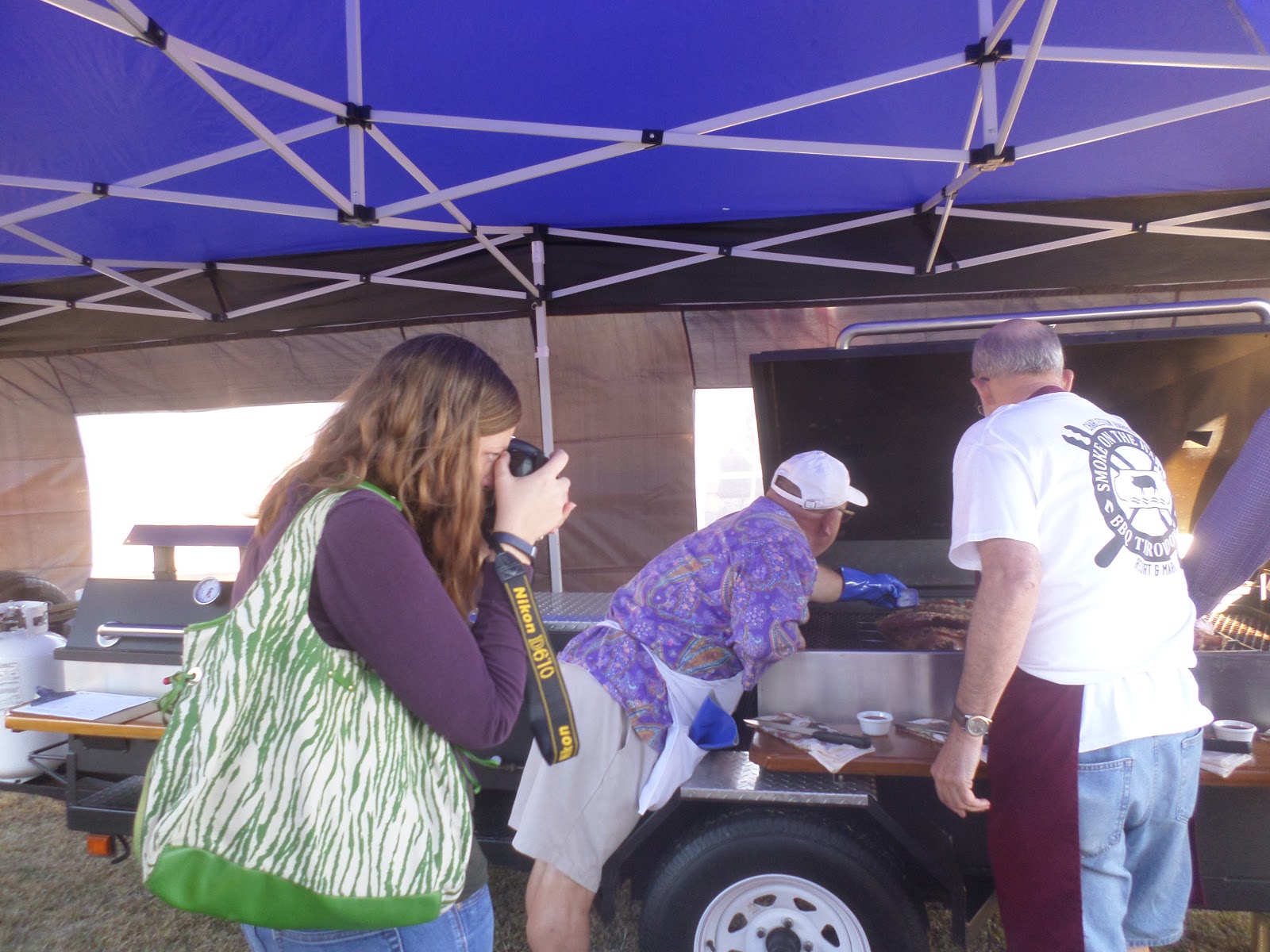
Photographer Katherine Clark takes pictures as I and the other judges evaluate a pig.

Note: During the judging process, I was followed by photographer Katherine Clark, who took pictures to accompany an article that I had written for OutreachNC magazine.

Saturday, April 2, 2016

Shadowing Judges at a Whole Hog Cookoff

For some time, I’ve wanted to judge barbecue cooked in the “whole hog” style and add those skills to my credentials as a judge. The opportunity developed quickly when a training judge invited me to shadow him at a contest sanctioned by the North Carolina Pork Council.

Cooking whole hog has been part of the barbecue history and heritage in North Carolina for more than 300 years. To determine the best whole hog cooks, the N.C. Pork Council conducts a series of events from March through September in its Whole Hog Barbecue Series, which celebrates the history and artistry of whole hog cooking. Top finishers in each event are invited to compete in the fall in a Whole Hog Championship, which the Pork Council has conducted since 1985.

Chief cooks listen as Jim Bristle, contest president, explains procedures at organizational meeing.

At each event, judges certified by the Pork Council evaluate all the cooked pigs. The evaluation criteria are very specific, and a standard scoring sheet provides consistency and uniformity. More than taste is important. One significant criterion of judging a cooked pig is color, which should be golden brown. In addition to appearance and brownness, the pig is scored for skin crispness, meat and sauce taste, moisture, and completeness.

When a pig is not perfectly golden brown, points are deducted for charred areas.

For an event to be sanctioned by the Pork Council, at least 10 cooks need to participate. At the Newport Pig Cookin’ Contest in 2016 where I shadowed a training judge, 77 cooks participated (and more than 100 have participated there in previous years). Judging began promptly at 8 a.m. and lasted well past noon because the judges had so many pigs to evaluate. As a result, Newport, the longest-running and largest whole hog cookoff in North Carolina, is an excellent preparation for judging future events.

Judges conduct a thorough evaluation of each cooked pig.
Each team cooks a “whole hog,” which is split down the middle without head and feet. It weighs about 100 pounds, although I did see a couple that were much larger (114 pounds). At Newport, most teams cook with propane gas, although some traditional cooks use wood or charcoal.

The crowd enjoys barbecue by center stage in the Newport Community Park.

Watching the four judges poke, prod, flip, taste, and evaluate 77 cooked pigs gives me more experience than I expected and is a great starting point for future events. In addition, seeing the dedication and enthusiasm of the cooks gives me a greater appreciation for their importance in a barbecue competition. Now that I’m certified, I’m now looking forward to my first judging opportunity at a “whole hog” cookoff.

A young cook, hopeful of winning the $100 prize for best cook under the age of 18, watches as the judges evaluate his cooked pig.

Note: A related article that I wrote about the Newport Pig Cookin' was later published on line by the North Carolina Folklife Institute.