Showing posts with label master judge. Show all posts

Saturday, August 4, 2018

Returning to Asheboro

Pigs and Pedals in Asheboro, NC, continues to impress me as a top-notch and well-organized event. Now in its fifth year, it has improved each year and succeeded in bringing crowds into the downtown area on the first weekend in August.

Cooking teams set up in downtown Asheboro near the park stage.

In addition to the barbecue competition, the festival again this year included a show of antique cars that kept the crowds busy looking at the historic vehicles on display before they voted in the people’s choice contest for one of the 20 cooking teams that participated. Music and other entertainment acts were also featured on the park stage.

Judges listen as contest organizers explain procedures.

For the second time, a kids’ barbecue competition was part of the weekend and added a youthful component to the cookoff. In addition, a new event was a “pig” eating contest — the winner ate the most cupcakes decorated with pig “faces” in five minutes.

Judging took place in The Exchange, a banquet facility, while the car show was occurring outside.

For the barbecue cookoff, 48 teams vied for top honors and a share of the $12,000 in prize money. Rather than being a judge this year, I was asked to be a table captain, which means presenting and distributing barbecue entries to the judges at the table where I was assigned and then collecting their scores after they had evaluated the entries. Although I missed being a judge, I did sample several entries and compared my judgments with the scores turned in. I was also shadowed by a “new” table captain who had just been certified after completing the required training and was able to answer her questions as we performed our tasks.

BBQ samples were prepared for the people's choice contest.

In addition to several master judges, the table included the pitmaster for Speaks for Itself, a competition cooking team that enters about eight contest annually. He is certified and judges at about three other events each year to experience how entries are judged and to hone his competitive skills. Because events sanctioned by the Kansas City Barbeque Society use a “blind judging” process, judges do not know which teams they evaluate. However, being both a judge and cook may explain the success that his team achieved at the Jiggy with the Piggy cookoff in Kannapolis in 2017 when it placed third out of 75 teams in the pork category and won fourth place overall.

Pigs and Pedals keeps downtown Asheboro busy during the first weekend in August.

Working with the table of judges and a new table captain was a refreshing change of pace and made Pigs and Pedals an enjoyable experience again this year.

Saturday, April 15, 2017

Judging in a Fire Museum

As unlikely as a fire museum is for being the site of serious barbecue judging, it works just fine for the annual Firehouse BBQ Cookoff in Kings Mountain, NC. For more than twenty years, the firefighters of this small city (population just over 10,000) have organized a celebrated barbecue cookoff.

An antique fire truck is on display at the museum where the judges met.

As one of the first events each year, the contest brings out teams who are starting their competitive schedule for the year. Because the cookoff was one of the first held in North Carolina sanctioned by the Kansas City Barbeque Society, it has attracted very experienced cooking teams for several years. An additional enticement for the pitmasters is that the cookoff is one of the 11 events in the Old North State BBQ series, which offers additional prizes in addition to the prize money awarded in the contests.

Cooking teams set up in the interior of the Deal Park walking track.

At this year’s cookoff, 49 teams competed. In addition to attracting very competitive cooking teams, the Firehouse BBQ Cookoff also brings in very experienced judges. For this year, many judges were master judges, and a few had even participated at more than 100 contests.

Muttley Crew placed first in the ribs category, which propelled it to a top 10 finish.

The Historical Kings Mountain Fire Museum, which opened in 1976 and illustrates the colorful history of firefighting equipment over several decades, has hosted the competition for 21 years. The cooking teams set up in the interior of the Deal Park walking track, which is adjacent to the museum.

A large sign makes sure that the cooking teams know the turn-in times.

After conducting a barbecue cookoff for more than two decades, the firefighters know what they are doing. The event is well planned and organized, and it will be the place to be in April for both cooking teams and judges for years to come.

All is quiet at the turn-in table until the teams bring their chicken entries, the first category to be judged.

A box of large trophies is ready for the awards ceremony.

Saturday, August 6, 2016

Pigs and Pedals Revisted

Returning to Asheboro, NC, to judge has been a priority since 2014 when I participated in the inaugural Pigs and Pedals cookoff. Because family obligations prevented me from attending in 2015, I was interested this year in seeing how the event had changed since its inception.

In its first year, the cookoff was well planned, organized and executed. For 2016, Pigs and Pedals was again a superior experience. A few changes had been made since the initial cookoff. Judging is now conducted in The Exchange, an attractive event space in the middle of the downtown area and very convenient to the cooking teams. The number of cooking teams also increased to the maximum that the event space can accommodate: 47.

The Smokehouse Mafia, last year's Grand Champion, sets up early.

The surprise for me was an assignment as table captain, which meant that I would not be judging and evaluating barbecue entries. It was my first time as a table captain although I had been certified early last year and had volunteered at other events. The primary duties are to assist the contest representatives of Kansas City Barbeque Society by coordinating activities at a judging table (there were eight this year), serving the judges and collecting their evaluations.

Piggy cupcakes made by a local bakery greet judges as the arrive in The Exchange.

The six judges at the table where I was assigned had a wide range of experience. Three were master judges (more than 30 contests), one was participating for only his third event, and one was recently certified and judging for the first time. Contest organizers attempt to include new judges at events and place them at tables where they can learn from experienced judges.

The Exchange, an event location, is now the venue for all judging activities.

Although I prefer to judge, I willingly had volunteered to assist as a table captain when I registered. I will continue to volunteer in more than only the capacity of judge, although the rewards of being a judge and evaluating barbecue entries are clearly the motivation for judges to participate and spend the time required to drive and attend.

Pigs and Pedals remains one of my favorite barbecue contests and I hope to attend future cookoffs – as a judge or in another capacity.

Saturday, June 18, 2016

Cooking with a Team

The thrill for some barbecue fans is being a judge at a cookoff. For others, it’s taking on the challenging work of a cooking team. Sometimes the interests combine, and a cook wants to be certified as a judge, or a judge joins a cooking team to experience a cookoff from a different perspective.

Amanda Reed, her husband Jim, and best friend Kendra Battasta (left to right) show me the cookoff from a team's perspective.

In Apex, NC at the Peak City Pig Fest, I had the opportunity to join Coastal Smoke, a team from Wilmington, NC. It has competed at events sanctioned by the Kansas City Barbeque Society for about three years and successfully competed even earlier at community cookoffs.

Amanda and Kendra continue setup activities by placing a cooker in position.

Last year at the Smoke on the Harbor BBQ Throwdown in Mount Pleasant, SC, I met Amanda Reed, the head cook for Coastal Smoke. When I asked if I could join her team at an event in 2016, she was more than gracious and agreed that I could join her at the Pig Fest. Cooking with a team is a KCBS requirement for certification as a master judge, which I hope to gain when I have completed other requirements.

Amanda injects a pork butt with a solution of apple juice and vinegar.

For the Pig Fest, Amanda arrived about noon to set up and begin preparations. Because I wanted to see the cooking team in action from start to finish, I also arrived at noon. I was amazed at the constant motion of the team on the first day. So many steps – setup, meat inspection, cooks’ meeting, meat preparations -- have to be completed early to be ready for the quick pace of simultaneous actions on Saturday.

Pork butts are checked on a cooker.

After spending nine hours on site on Friday, I left for the evening (and a comfortable, uninterrupted sleep). Amanda with her husband Jimmy and best friend Kendra Baratta continued with other activities that shortened their sleep considerably. (Although I briefly thought about staying with them, I long ago gave up “all nighters” and don’t get up in the middle of the night for anything.) 

Kendra watches as Amanda puts chicken pieces on a cooker.

Amanda, on the other hand, slept very little. Around 3 a.m., she started the fire so that the charcoals would be ready to smoke and provide residual heat when she placed the meats on the cookers. The brisket and two of four pork butts went on the cookers at 5 a.m. At 7 a.m., the other two pork butts were placed on the cookers. These two would provide the “money muscle” (a small strip of loin meat opposite the blade bone side that is very tender) for the pork entry.

After slow cooking for several hours, the ribs are sliced for the turn-in box.

On Saturday I returned to the team site just before 8 a.m. (I could tell that Amanda and the others hadn’t enjoyed much sleep.) I watched most of the preparations for the two remaining meat categories: ribs and chicken. The ribs went on the cooker at 8 a.m. and finally the chicken at 10 a.m.

The chicken looks so good as it is arranged in the turn-in box.

So that the meats would be ready at the contest turn-in times (beginning at noon for chicken and continuing to 1:30 p.m. for brisket, the last one), each was prepared in advance – liquid injections, sauces, rubs. For example, the pork butts were injected with a solution of 3 parts apple juice and 1 part vinegar with a little sugar and salt. Even before arriving at the contest site, Amanda had prepped the chicken pieces by removing the bones, some skin and fat.

Kendra turns in chicken, the first entry, exactly at noon to Doug Reid, the KCBS rep.

When the turn-in times arrived, I was surprised how calm the team was. Everything was going just like clockwork. Kendra was the “runner” and took each entry for turn-in at the designated time after Amanda had completed the final stages. Before a turn-in was ready, she had picked the best pieces, cuts, or slices from everything that had been cooked, which was three or four times what was needed for turn-in. For example, to select at least 6 pieces of chicken for the entry, 19 had been cooked.

Rib are perfectly placed in the turn-in box for a high appearance score.

When the last entry was turned in, there was a brief sigh of relief before starting the final actions: cleaning and packing for the journey home – and waiting (more than 3 hours) for the awards ceremony. The results were bittersweet. The scores for chicken, ribs, and brisket were lower than hoped for, but Coastal Smoke placed among the top 10 teams in the pork category (even at turn-in, we thought that the pork was the best of the four entries submitted).

The pork entry, with money muscle lining the center, is ready for turn-in.

Looking back on the weekend activities, I have much more appreciation for a cooking team. The investment of time, money, and effort is substantial. Few people, particularly the public that arrives mid-day on Saturday, realize the amount of work involved. For me, the weekend was great. Because I had judged at the Peak City Pig Fest last year, seeing the event from the perspective of a cooking team was rewarding. If I ever spend time with a cooking team again, I can only hope that they are as congenial as Coastal Smoke


Note: To see an album with more pictures of my cooking experience with Coastal Smoke, click here.

Saturday, June 20, 2015

The Peak of Good Judging

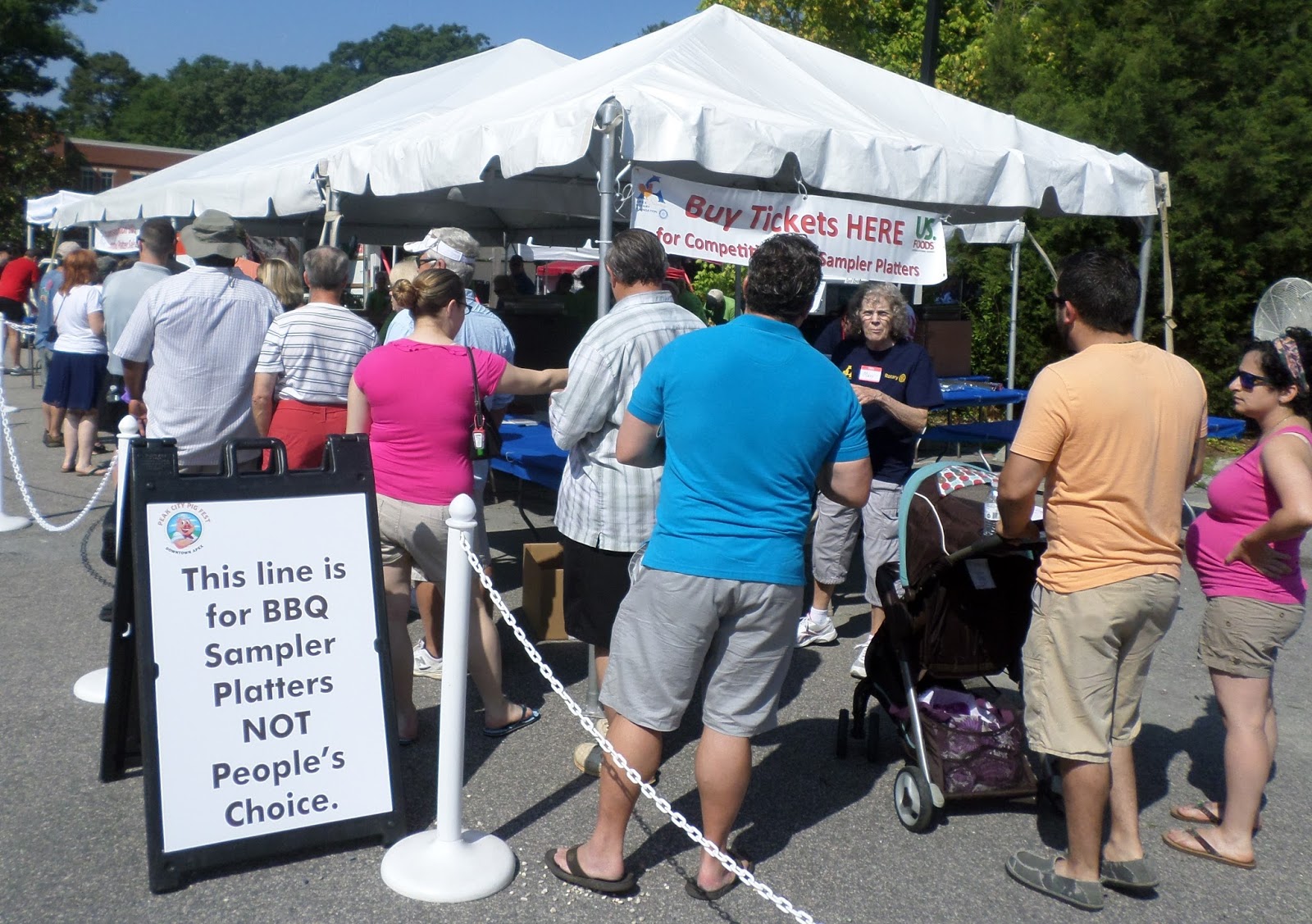
Judging at the Peak City Pig Fest in Apex, NC, has been a goal since I was first certified as a judge. The classes that I attended for being both a judge and table captain were conducted by the Apex Sunrise Rotary Club, the organization that organizes the Pig Fest, and I wanted to participate in the club’s signature event.

Even though the Pig Fest was established as recently as 2012, it has quickly become one of the popular barbecue competitions on the East Coast. The Rotary Club, which has only 28 members, takes barbecue seriously — half the members are certified judges — and considers the Pig Fest as its signature event for good reason. It raises about $20,000 annually for local charities, which is usually donated to two worthy causes such as Western Wake Crisis Ministry (which provides emergency financial aid and food to families in a crisis) and Operation Coming Home (which builds homes for disabled veterans).

The grand champion wins $2,000.

The cooking teams were vying for a first place prize of $2,000 and competing for $9,000 in total prize money. The Pig Fest also has been proclaimed a N.C. state championship by the governor (although more than one state championship may be held). Because the Pig Fest doesn’t charge for parking or admission and is held in the historic downtown section of Apex, it’s very popular. More than 20,000 visitors attend. Most adults are interested in the pork barbecue prepared by the cooking teams that is sold by the plate with slaw and bread, but the kids are also interested in pig races that are held every two hours on Saturday.

More than 1,200 platters (200 more than last year) of pork barbecue are sold.

The Pig Fest is named for Apex, which has a nickname of Peak City and is known as the “peak of good living.” When the railroad station at Apex was chartered in 1854, it was the highest point on the route between Richmond, Va., and Jacksonville, Fla. Proof of its high point (although only 499 feet above sea level) occurs when it rains. Water on one side of Salem Street (the main street) flows to the Neuse River, and water on the other side to a different river basin, the Cape Fear River.

Salem Street (the main street of Apex), known historically for its elevation, is now legendary for its Pig Fest.

At the Pig Fest, I met Bill Jones of Richmond, Va., who may set the record for judging contests in one year. Jones is a master judge — meaning that he has judged at 30 contests, cooked with a competition team, and passed a qualifying exam. He told me that he had applied to 38 events in 2015 and has been accepted so far at 28. Jones enjoys picking locations outside of his home state — Wisconsin, Vermont, Mississippi — and making an adventure of visiting new areas. He is inspiring for how much he enjoys being a judge.

Judges relax before the cooking teams begin to turn in their best barbecue.

The number of cooking teams was capped at 48 because the space available could not accommodate more. Typically, a contest needs a similar number of judges. However, more than 150 applied to the Pig Fest that needed 48 judges and 8 table captains. Terry Winebrenner, Chairman of Judging, culled through the applications to select a range of experience and background.

Cooking teams set up in 'Hog Heaven" in a parking lot on the west side of Salem Street.

For each table, which consists of a table captain and six judges, Winebrenner selected a master judge, a judge from out-of-state, and a newly certified judge. Letting new judges participate is important to the Kansas City Barbeque Society so that they can gain experience. As planned by Winebrenner, new judges have a chance to ask questions and work with experienced judges, such as Bill Jones.

Trophies await the judges' scores for best chicken, ribs, pork, and brisket.

In the two previous years, I had applied to judge but wasn’t selected (too many applications). In fact, the first event that I applied to judge after I had completed the judges’ class (with almost 100 others) was the Peak Fest, which was overwhelmed with more applications than it could accept. Fortunately this year my application was accepted, and I enjoyed sitting at the table where Winebrenner was the captain.


The Pig Fest was a great experience — the barbecue was excellent, the event is expertly run, and the setting in an old historic downtown is picturesque. Because the event was organized by the club that conducted my initial training, being a judge was even more special. Being in the Peak City is the peak of good judging.