Showing posts with label shoulder. Show all posts

Friday, April 2, 2021

Looking for Smoke and Finding Barbecue

A pulled pork sandwich by pitmaster Joe Kelso.

[Note: This post, prepared originally for Sandhills Magazine and published in its April-May 2021 issue, is hosted on the magazine's website, with excerpts and a link to the website posted here.]

When family members and guests visit from out-of-state and want to taste authentic N.C. barbecue, where do you take them? The choices are more numerous than you may realize. Do you want to impress, go to a casual Sandhills spot, take a short road trip to a legacy location, search for one of the ubiquitous barbecue food trucks, or visit a competitive cookoff? 

The Impressive 


Nothing is more impressive than watching small planes land and take off on an active runway next to where you are enjoying hickory-smoked barbecue slowly cooked over hot coals. Head to Carthage where Pik-n-Pig, located at Gilliam-McConnell Airport, has created a dedicated following for its pulled pork that is smoked for up to 10 hours. Although the meat is served naturally moist, you can enhance the flavor with a homemade hot-spicy (vinegar-based) sauce or a sweet honey sauce (that is tomato-based). The sides are excellent, but make sure to save room for banana pudding. 

Because some out-of-towners want to combine barbecue with a craft beer (or two), Pinehurst Brewing Company in the century-old steam plant building is a favorite destination to impress. Smoked over hickory and oak coals, its pulled pork shoulder pairs well with its signature barbecue sauces, which include a creative blueberry habanero, as well as its distinctive beers.


Continue reading at Sandhills Magazine and also see an earlier post about pitmaster Joe Kelso and Smok'n Joe's BBQ that are mentioned later in this post ...

Friday, October 5, 2018

Southern Smoke in Garland, NC

Southern Smoke in Garland, NC, is quickly gaining a following. It’s popular not because it is listed on a historic barbecue trail — it’s been in business only eight years — but because its excellent barbecue is smoked in the traditional way over hardwood coals.

By 1:30 p.m., customers are usually no longer standing in line but late arrivals are disappointed if all the barbecue has been sold.

Opened in 2010 by Matthew and Jessica Register, Southern Smoke has brought new life to the small town of Garland, home to fewer than 700 residents, in Sampson County. It is open only two days, Thursdays and Fridays. Business is brisk when the doors open at 11:30 a.m. (and customers start gathering much earlier). When all the barbecue is sold, the lights are turned off until the next business day. Most people “in the know” plan to arrive at least by 12:30 p.m.

Cut oak and a smoker are all that's needed to make customers happy.

When I stopped on a drive from Wilmington, NC, I didn’t arrive until 1:30 p.m. The pile of cut oak wood (next to the famous smoker Jezebel) on the side of Southern Smoke let me know that I had arrived at an authentic barbecue pit. Arriving that late saved me from having to stand in line as is usual for regular customers. Although I was worried that I was too late, I was still in time for barbecue, but the ribs, beans and pies were already sold out. The mac and cheese, which was still available, was a fine complement on the barbecue tray I ordered (with an additional side of coleslaw), but next time I’ll arrive early enough to enjoy some homemade pie. The sweet cornbread, however, made up for the missing pie. 

The hand-chopped barbecue, with two homemade sauces, goes well with sides and cornbread.

Although Southern Smoke cooks only pork shoulders to make its barbecue, the flavor is true to the tradition of eastern North Carolina with a moist, tangy vinegary-pepper taste. Two sauces — Two Brothers (named for the Registers’ sons), a traditional eastern N.C. sauce, and Sweet Grace (named for their daughter), a Memphis-style sauce — are homemade and let you flavor the barbecue to your preferences.

Matthew Register, the pitmaster (right), takes a break from kitchen duties to pose for a photo. 

My wife and I were greeted at the counter by Matthew’s parents, who enjoy their role in serving customers as they arrived. Although Matthew took time for a picture, it was obvious he and others on the staff were busy in the kitchen. Most of the business is takeout, and my wife and I were the only ones to eat on site while we were there.

A large chalkboard lists the menu of the day.

The space inside is too limited for any tables and chairs. Although two picnic tables are out front, we ate in the shaded backyard where the South Supper Series is held. While enjoying our lunch, we looked around at the interesting displays and artifacts — including a hollowed-out classic car that serves as a bar.

An antique Ford Fairlane finds a new purpose as a bar.

The following that Southern Smoke has is well-justified, and I now consider myself one of the admirers. Excellent barbecue smoked over oak coals is definitely a reason to drive to Garland. Next time I’ll arrive early and join in the conversation with other customers waiting in line.

The shaded backyard is an inviting place to enjoy barbecue smoked slowly over oak coals.

Signs in downtown Garland help BBQ fans find their destination.

Thursday, September 27, 2018

Smokehouse at Pinehurst Brewery

Most barbecue restaurants I visit are usually historic or legendary. However, for the Smokehouse at Pinehurst Brewery, I wanted to visit before it opened and earned its reputation.

The new brewery occupies the historic steam plant building.

A few days before it opened to the public, I had an opportunity to have lunch as well as take a tour. Beer lovers will appreciate the 10-barrel microbrewery, the focal point of the taproom. More interesting to barbecue fans will be the smokehouse for the restaurant.

The brewery combines old and new architectual features.

Meats -- pork shoulder, beef brisket, chicken, and sausage -- smoked on site with local oak, hickory, and pecan woods are the primary menu items to be enjoyed as sandwiches or plates. They are complemented by four signature sauces: eastern N.C. (spicy vinegar and pepper), western N.C. (sweet and tangy), S.C. mustard, and blackberry habanero. Smoked mashed potatoes, baked beans, coleslaw, mac ‘n’ cheese, and collard greens are among the sides.

A plate of ribs comes with cornbread and two sides (collards and mac 'n' cheese were my choices).

For the Smokehouse at Pinehurst Brewery, another reason to visit is to see its facilities, which occupy the old steam plant for the Village of Pinehurst. Built in 1895, it was decommissioned in 1998 after providing power and heat for homes, businesses and hotels of the village for decades.

Four sauces are available to add flavor to the smoked meats.

The building was fully renovated, but the original brick, façade and steel windows have been kept. Old piping and other artifacts reclaimed in 2016 by Black Dog Savage, an architectural salvage company, are displayed as artwork.

Black Dog Savage saves original features of the steam plant in 2016.
Having another barbecue restaurant that cooks meat slow and low over wood is much appreciated. Even though it’s brand new, it will soon become a destination. The smoked barbecue by itself is reason to visit, but the craft beer and scenic setting are additional enticements.

Original fixtures of the steam plant add to the interior decor.

The smokehouse uses oak, hickory, and pecan wood.

A new smokehouse was built next to the brewery, which occupies the old steam plant building.

Monday, February 20, 2017

Curling Whiffs of White Smoke

As you approach the original Little Richard’s Lexington BBQ [now known as Real Q -- see note below] in Winston-Salem, NC, it’s easy to notice the curling whiffs of white smoke spiraling from the smokestacks. It’s a good sign. Barbecue is being cooked in the traditional manner – over hot wood coals.

Spiraling smoke tells you how Little Richard's cooks its pork shoulders.

Little Richard’s takes its name from founder Richard Berrier who got his start in the barbecue business when he was 13. It cooks pork shoulders – the Lexington style, hence the use of Lexington in its name – with hickory wood on an open pit for up to 10 hours. Then they’re hand-chopped as the restaurant’s dip (sauce) is added.

The parking lot fills quickly when Little Richard's opens.

When I arrived for lunch several minutes before noon on a Monday, the restaurant was busy. Only two tables were available. Glancing at the other tables, I saw that most customers had a BBQ tray (a cardboard boat loaded with chopped barbecue and slaw) or a BBQ sandwich. Even a small tray, which also comes with hushpuppies or a roll, was more than enough for lunch.

My tray was packed with adequate servings of slaw and barbecue.

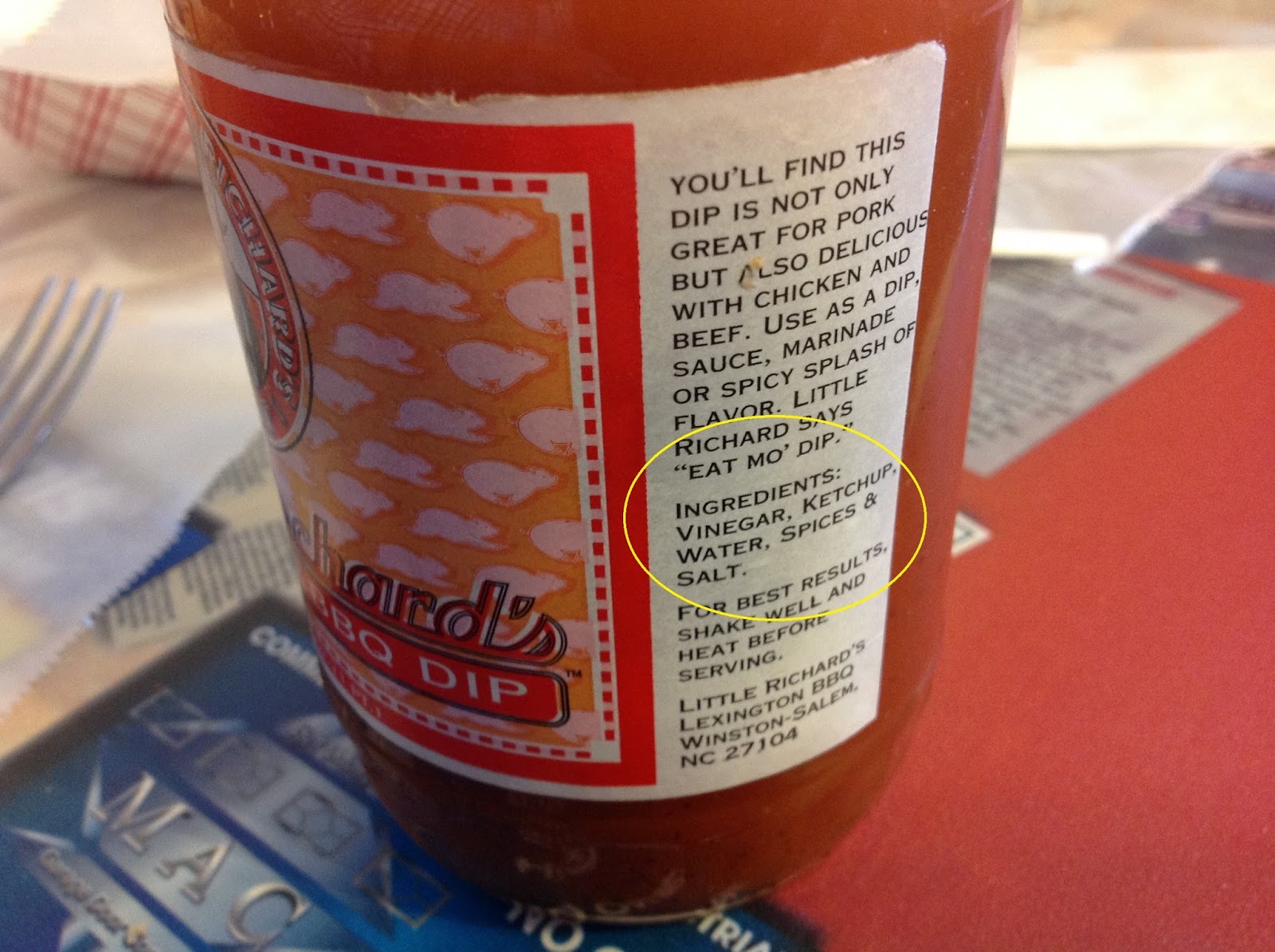
Although the chopped pork was moist and delicious without needing any extra sauce, I was captivated by the tangy flavor of Little Richard’s own house dip and kept adding more and more to my boat as I ate the barbecue. The dip, mixed every morning, is Little Richard’s select combination of vinegar, ketchup, water, spices, and salt. It is thin and vinegary with a consistency similar to sauces in eastern North Carolina.

The dip recipe is a secret, but the ingredients are listed on the bottles.

True to Lexington style, Little Richard’s offers a vinegary red slaw, which gets its characteristic color from ketchup, with its BBQ plates, trays, and sandwiches. The menu lists “slaw,” with no description -- the implicit understanding is that the mayonnaise-based coleslaw of eastern N.C. barbecue traditions isn’t available because it’s not Lexington style.

Soon after I arrived for lunch, every table was occupied.

The original location, a destination on the historic N.C. Barbecue Trail, opened more than 25 years ago (a second location is also available -- surprisingly and somewhat confusing, several other barbecue restaurants in the area are also named Little Richard’s but are not connected).

The wood pile in back is Little Richard's proof that it cooks its pork slowly over hot coals.

By serving delicious barbecue that is cooked slowly with hickory wood, Little Richard’s is easily achieving its goal of “Eat Mo’ Pig.”

"Eat Mo' Pig" is an appropriate motto.


Note: The name of the restaurant was changed to Real Q in early 2018 to distinguish it from other area restaurants with the name of Little Richard's that are operated by former partners of owner Richard Berrier.

Sunday, September 25, 2016

Whole Hog Judging in Western New York

Judging whole hog cookoffs is a great way to taste and evaluate excellent barbecue. Participating at events in a variety of locations opens a door to experience regional differences and styles in whole hog cooking.

Butts & Beans BBQ was one of the whole hog contestants.

Because I traveled to at Oinktoberfest for the cookoff sanctioned by Kansas City Barbeque Society, I took advantage of the opportunity to judge the festival’s whole hog competition on the next day. Being from North Carolina carries a lot of credibility at whole hog contests because the state has a well-recognized tradition of excellent whole hog cooking, particularly in its eastern areas that have a rich colonial past. In fact, the contest coordinator mentioned at the judges’ meeting that my home is North Carolina and asked me to give some examples of N.C. whole hog events.

Nancy Muller, contest official, discusses procedures with judges.

Of course, one example that I had to use is Newport Pig Cookin’ where 77 contestants competed this year and often more than 100 cooks participate. In contrast, at Oinktoberfest, only eight teams competed, and only seven turned in samples (one disqualified itself because the pig was undercooked); in 2015, only four competed.

Not much meat is left on the pig cooked by Butts & Beans after the cuts from the five sections have been made.

At Oinktoberfest, in addition to a smaller number of cooking teams, I expected to see other differences compared to events conducted by state and national sanctioning groups, such as the N.C. Pork Council. The biggest difference is that at Oinktoberfest the entire pig is not evaluated (only cuts from a pig), and no evaluation is made at a cooking site. Instead, cooks submit samples of cuts from five sections: shoulder, loin, ribs, belly/bacon, and ham. An hour before turn-in, an observer (known as the Hog Patrol) is at a site to confirm that the cuts are made in the correct sections.

A member of the Hog Patrol is ready to observe as cuts from the five sections are made.

Also at Oinktoberfest, the rules require cooking with only wood or charcoal, the “traditional” way but also more difficult to control temperature and flareups than when using gas. As a result, most pigs were charred and their brownness, moisture, and skin crispness -- major criteria of N.C. whole hog cookoffs – were less than satisfactory. Another difference is that Oinktoberfest contestants can use injections, which are prohibited in North Carolina. In addition, contestants had to provide their own hog. Perhaps to reduce expenses, many purchased a hog slightly more than the minimum weight, 40 pounds (a much lower weight than at past Oinktoberfests and significantly lower than at many events where pigs average over 100 pounds). However, the small size limits the areas to select meat. The ribs, in particular, were small and not very meaty.

Cooking a whole hog is a lot of delicate work and timing.

Judges at Oinktoberfest were all certified KCBS judges, who are trained to evaluate chicken, ribs, pork, and brisket. They used the same criteria – appearance, taste, and tenderness -- of KCBS for these meat categories to evaluate the samples turned in and to determine a composite score for each contestant. The judging was “blind” – judges did not know the contestants they were evaluating (unlike at most whole hog events, where judges visit sites and determine scores before leaving them).

The Tranquil Carnivores team prepares samples for turn in.

Judging at Oinktoberfest gives me a greater appreciation for national, regional, and state organizations that sponsor and sanction barbecue competitions, particularly whole hog cookoffs, and that provide a uniform approach to achieve in a high degree of consistency among events. A lot of insight and experience is needed to develop effective rules and to establish meaningful criteria. Oinktoberfest can be commended for bringing whole hog competition to western New York, and it will be a more effective contest as it matures and encourages more competitors to participate in whole hog cooking.

Finding the best cuts helps to achieve a higher score.

Saturday, August 27, 2016

Legacy of Lexington Style

Old-fashioned at Stamey's means Lexington style.
When people want traditional “Lexington style” barbecue of North Carolina, they often travel not to Lexington but to Greensboro. The Gate City is the home of Stamey’s, which traces its roots to 1930 and was founded by the legendary C. Warner Stamey, who taught the Lexington style to other early pitmasters.

Stamey himself learned in Lexington how to make pit cooked barbecue from early entrepreneurs Jess Swicegood and Sid Weaver when he was a high school student there in the 1920s. After moving back to his hometown of Shelby, he made and sold barbecue before returning to Lexington in 1938 when he bought Swicegood’s business. He renamed it Stamey’s where he continued to develop his reputation as a barbecue pitmaster and promoter.

A photo of the founder watches over the entrance that includes several vintage photos of the business and a waiting bench.


Greensboro has two Stamey’s locations, the second one opening in the 1970s. The original one, which I visited, was opened by Stamey in 1953 as a drive-in after he had moved from Lexington. Across the street from the Greensboro Coliseum, it was replaced with a new structure in 1979 and has been operated continuously by a member of the Stamey family, currently Chip Stamey (grandson of the founder).

Tables in the dining area turn over frequently because orders are taken and served promptly.

Adhering to the style promoted by the founder long ago, the pitmasters still cook only pork shoulders and only over hardwood coals. Although Stamey’s claims a “secret” sauce, the secret is not well kept because it has provided the recipe – equal amounts of ketchup and apple cider vinegar with sugar, salt, black and red pepper -- to the Cooking Channel. Ketchup in the sauce keeps Stamey’s true to the Lexington style and separates it from the style of eastern N.C. where the sauce has no tomato (and whole hogs rather than only shoulders are cooked).

Lexington style is barbecue (using only pork shoulders) with hushpuppies and red slaw.

The chopped barbecue that I ordered came from the kitchen already adequately sauced, so I added no more at the table. The plate included red slaw (coleslaw made with Stamey’s sauce, not mayonnaise) and crisp hushpuppies (reportedly popularized as a side on barbecue plates when Stamey began serving them decades ago after seeing them served at local fish restaurants). The Brunswick stew that I also ordered was a colorful complement to the red slaw.

Brunswick stew comes with the requisite amounts of vegetables.

Credited with spreading “Lexington style” in the western half of North Carolina, Stamey nurtured several protégés such as Alston Bridges, Red Bridges, John Stogner, Doug Gosnell, and Wayne Monk. Even though I’ve been to Lexington and also eaten “Lexington style” in other cities such as Winston-Salem and Shelby, I felt closer to the tradition by being in Stamey’s and at its first location in Greensboro. The way the servers greet customers and take orders shows they know that they are preserving a legacy.

The carry-out counter stays busy throughout the day.


Thursday, March 5, 2015

Barbecue Served with Recipes That Grandma Hill Created

Pork shoulders cook slowly over hardwood coals in the kitchen of Hill's Lexington Barbecue.

A trip to Hill’s Lexington Barbecue in Winston-Salem, NC, is a trip back to the 1950s. The food, hospitality, and atmosphere harken back to an earlier time and a slower pace. Drive-ins were family-owned. Another decade would be needed before McDonalds, Hardees, and similar places would open.

A traditional wood burner, this stack at Hill's was brought in from Asheboro, NC.

Imagine Winston-Salem, NC, in 1951, when Hill’s opened as a drive-in on Patterson Avenue, then U.S. 52 heading north to Mt. Airy and south to the Twin City. At that time the restaurant was outside city limits – a time and place I remember as a child because my dad was its mail carrier on his motor route and let me join him delivering the mail on summer days in the mid-1950s (without U.S. Postal Service approval or knowledge, of course). Today, although within city limits, Hill’s is now bypassed by the limited-access U.S. 52 that rises high above on an elevated road soon to be Interstate 74. 

Hardwood is burned until coals are ready for the smoker.

In 1951, the city population was around 90,000, and the dedicated customer enjoyed a scenic drive to Hill’s on a curvy, two-lane U.S. 52 at slow speeds. Today, U.S. 52 is the fast road north in a city of almost 250,000. Many wonderful places with cultural and historic connections are now missed by some travelers who are totally unaware they exist simply because highways have been redesigned and “improved” to move us at faster speeds. Although a new customer has to look for the overhead billboard to know which exit to take, long-term customers know exactly where on Patterson Avenue Hill’s is located.

Long-term customers arrive early for favorite seating in the dining areas,

The dining areas are typically filled with repeat customers who also know that the menu still reflects good value and a cooking method known as Lexington style.  The pork is prepared from only hog shoulders and cooked slowly over hardwood coals. Although it’s served in one of four ways -- chopped, pulled, sliced, and blocked -- it comes with only one kind of slaw – red – the only kind served with Lexington-style barbecue.

Lexington-style barbecue is always served with "red" slaw.

When I ordered a pulled pork tray for lunch, the server was careful to explain that it came with red slaw just in case I was not familiar with it. Unlike traditional coleslaw, no mayonnaise is in the vinegary red slaw, which gets its characteristic color from ketchup. The pulled pork with a thin but peppery sauce I enjoyed was tender and full of smoky flavor. With the red slaw, it’s a perfect lunch – with hushpuppies, of course.

The server brings more than enough hushpuppies to a table while the orders are being prepared.

The original small drive-in has been gone a long time. Although a larger building replaced it more than 40 years ago, the best recipes – banana pudding, slaw, hushpuppies, and sauce – are still the original family ones. The Hill family, with the third generation now operating the restaurant, has been wise in not modernizing or updating them.

A portrait of Edna Hill, wife of the founder, guards the entrance -- a good reason not to change a recipe, particularly the one for banana pudding.

The sign in front proclaims Hill’s to be “The Original Lexington Barbecue” for two good reasons. Founder Joe Allen Hill came to Winston-Salem from Lexington with the dream of cooking pork “Lexington-style” here and opened the first restaurant in the city to have “Lexington barbecue” in its name. More importantly, although other establishments in Lexington, NC, were in business when Hill opened this restaurant, he’s the first to name his “Lexington barbecue.”

Hill's is the original Lexington Barbecue for two good reasons.

Take a journey back to the 1950s – only the prices have changed (and modestly at that). The hospitality, atmosphere, recipes, and food at Hill’s remain the same. Even the mail boxes on the side of the road look like they are just as original.

The best finish for a meal at Hill's is its famous banana pudding, always served warm.

Notes

  1. An earlier post, prepared for the N.C. Folklife Institute that focuses on memory and changing cultural experiences and also discusses the traditions of Hill’s, is online at the Institute’s NCFood blog.
  2. The restaurant was permanent closed in January 2020 after being in business 68 years.

Tuesday, June 25, 2013

Ridgewood Barbecue: A Tennessee Tradition

Ridgewood Barbecue is a popular
destination in eastern Tennessee
.
Smoked ham, thinly sliced, is not the typical barbecue. To find it, you have to head to eastern Tennessee to a regional restaurant known as Ridgewood Barbecue.

When I was in the Bristol area for a field trip conducted by Southern Foodways Alliance, the hickoried sandwiches of Ridgewood were served as supper in the infield of Bristol Motor Speedway. As part of the evening program, Larry Proffitt, the surviving son of parents who started the business, discussed his family’s barbecue business and Ridgewood’s traditions.

Larry Proffitt serves 
barbecue for supper.


The origin of Ridgewood Barbecue dates to 1948 when Proffitt’s father Jim and partners opened Ridgewood Inn. When the business changed its operations to barbecue in 1952, it was renamed Ridgewood Barbecue and operated by the Proffitt family.
With a pit made out of cinder blocks, father Jim began smoking hams – not shoulders or whole hogs – because as Larry says, “Even a country boy knows that shoulders go into sausage.”  After being smoked for hours, the meat is chilled overnight. Then it is sliced very thin to be ready for customer orders. As customers arrive, it is heated on a griddle with a tomato-based sauce and then piled high on sandwiches or platters.

Smoked ham slices are heated on a griddle for platters and sandwiches.
Although I missed an excursion to the restaurant with him, I created my own Ridgewood experience by going there for lunch after the field trip was over. Ridgewood certainly has a style of its own. The thinly sliced ham is definitely different than the pulled or chopped pork that a barbecue aficionado typically encounters, and the homemade sweet and tangy sauce adds an extra dimension to separate Ridgewood’s barbecue from others.

Hams are smoked next to the restaurant.

Larry Proffitt worked in the family business with his brother Terry as they grew up. Although Larry graduated from pharmacy school and owns a drug store in the area, he and his daughter Lisa (who is a nurse) now continue as owners and operators of the family business. For their dedication in carrying on this regional tradition, we are very much in their debt.

I was able to visit the area where the hams are smoked.