Showing posts with label moisture. Show all posts

Saturday, October 22, 2022

Whole Hog Cookoff in Fuquay-Varina, NC

A perfectly cooked whole hog is in shambles after the judges complete their evaluations.

A small whole hog cookoff sometimes can be a great format. Judges can allocate all the time needed to fully evaluate each site and not be in a rush, and each team knows that their participation is vital. With just seven teams competing, the American Legion Whole Hog Cookoff in Fuquay-Varina, NC, was the smallest event where I have judged.

The site of a cooking team waits for the judges to arrive.

American Legion Cookoff 


The cookoff was the fourth competition conducted by American Legion Post 166. Its previous events had a few more competitors, but this one still was helpful for building community interest in the event and supporting local programs. After judging activities were completed, plates of chopped barbecue plates were sold to the public for $10 each as a fundraiser. With music playing throughout the afternoon, the scene was quite festive.

Because the cookoff was only days before Halloween, spooky decorations decorate several cooking sites.

Sanctioned by N.C. Pork Council, the event is part of the Whole Hog Barbecue Series that celebrates the history and artistry of whole hog cooking and supports communities and nonprofits. Each year more than 130,000 people attend cooking contests in the series and enjoy the barbecue prepared by the cooking teams. 

After the judging is over, each team prepares their barbecue for the fundraiser. 

Judging at Whole Hog Cookoffs


For each site, each judge completed a culinary scoresheet. The criteria include appearance, color, skin crispness, moisture, meat and sauce taste, and completeness of the cooking site. In addition, the judges verify that each pig is fully cooked and the meat can be served to the public. Although at some contests a team is often disqualified for undercooked meat, at this contest all teams successfully met this requirement. 

Scoresheets are prepared before the judging activities begin.

Unfortunately for the teams, at least 10 cooks need to participate for the winner in the contest to be eligible to compete in the Whole Hog Barbecue Championship held in Raleigh at the end of the competition season. If the minimum participates, then the winner qualifies for the next state championship. 

Cooking teams set up the night before the day of the contest.

I was able to judge because I was the replacement for a judge who was recovering from COVID, another sign that the pandemic still has not subsided. I was eager to judge because my last whole hog cookoff had been more than three years ago; the pandemic caused the cancellation of several cookoffs and even one state championship.

Sauces are judged with the meat.

Cookoff Sponsor


Chartered in 1922, the post has a significant legacy that stretches over a century of being a supportive member of the community. With an energetic membership base, the post was already looking forward to a chili cookoff only a week away before the whole hog contest had ended. 

All the funds raised by the post are given back to the community. Its projects include scholarships for children, aid and assistance to local needy veterans and their families, and financial support for community programs and projects.
 
 A table of trophies is ready for the awards ceremony.

Because American Legion Post 166 contributes so much to its local community, being involved in one of its programs is an honor for me. I hope to return again.

Saturday, April 8, 2017

Improving an Agricultural Celebration by Adding a Whole Hog Cookoff

Homegrown in the Park, an annual festival in Burlington, NC, was begun by the Farm Bureau of Alamance County as a way to “bring the farm to the city” by holding a farm day in a city park. Previously, the bureau had offered tours of neighboring farms to educate the public about local agriculture.

Several teams created an inviting atmosphere at their cook sites that added to the ambiance of the festival.

The county has become increasingly urban, led by the growth of Burlington, its largest city, and Graham, the county seat. In recent decades, the population of the county has grown by as much as 20 percent. Farms have been lost as new residential areas have been created. Because many residents live in the county but work elsewhere, it is often described as a “bedroom community,” and appreciating its agriculture is important because the number of its farms have declined by 70 percent over the last century.

Impressive trophies were taken home by the finalists.

In its first three years, the festival drew increasingly large crowds by offering educational exhibits and displays to celebrate local agriculture -- music and free food were additional enticements to attend. For its fourth year, the festival was expanded to include a whole hog cookoff, and sanctioning by the N.C. Pork Council was obtained so finalists could advance and compete in the state championship, the culmination of the Whole Hog Barbecue Series.

Barbecue chopped by a team after being judged was served on plates to the public.

The whole hog cookoff seems to be exactly what the festival needed to complete its celebration of the county’s agricultural traditions and heritage. Barbecue from the cookoff is served to the public, and nothing brings out a crowd like excellent barbecue cooked by competitive teams. For its first cookoff, the festival attracted 14 teams. Although several had not competed in the Whole Hog Barbecue Series before, they all produced superior barbecue. The three other judges and I were impressed with how most pigs were scored high in areas of skin crispness, brownness, moisture, and appearance.

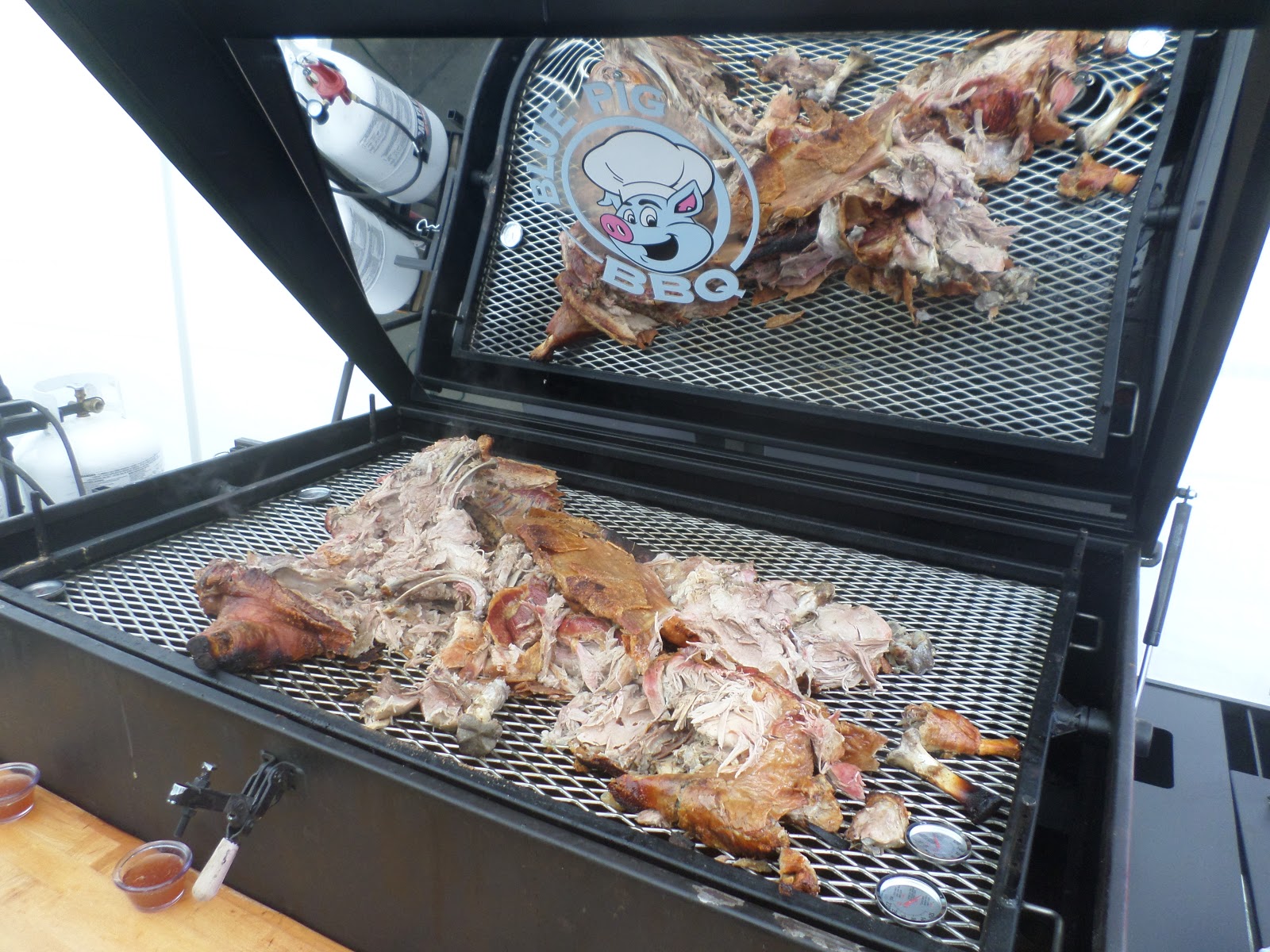
The pig cooked by Blue Pig BBQ, now in shambles after being judged, took home first-place honors.

With a whole hog cookoff now a major part of the festival, Homegrown in the Park is guaranteed to continue to grow and attract large crowds as its organizers and sponsors celebrate local agriculture.

Sunday, September 25, 2016

Whole Hog Judging in Western New York

Judging whole hog cookoffs is a great way to taste and evaluate excellent barbecue. Participating at events in a variety of locations opens a door to experience regional differences and styles in whole hog cooking.

Butts & Beans BBQ was one of the whole hog contestants.

Because I traveled to at Oinktoberfest for the cookoff sanctioned by Kansas City Barbeque Society, I took advantage of the opportunity to judge the festival’s whole hog competition on the next day. Being from North Carolina carries a lot of credibility at whole hog contests because the state has a well-recognized tradition of excellent whole hog cooking, particularly in its eastern areas that have a rich colonial past. In fact, the contest coordinator mentioned at the judges’ meeting that my home is North Carolina and asked me to give some examples of N.C. whole hog events.

Nancy Muller, contest official, discusses procedures with judges.

Of course, one example that I had to use is Newport Pig Cookin’ where 77 contestants competed this year and often more than 100 cooks participate. In contrast, at Oinktoberfest, only eight teams competed, and only seven turned in samples (one disqualified itself because the pig was undercooked); in 2015, only four competed.

Not much meat is left on the pig cooked by Butts & Beans after the cuts from the five sections have been made.

At Oinktoberfest, in addition to a smaller number of cooking teams, I expected to see other differences compared to events conducted by state and national sanctioning groups, such as the N.C. Pork Council. The biggest difference is that at Oinktoberfest the entire pig is not evaluated (only cuts from a pig), and no evaluation is made at a cooking site. Instead, cooks submit samples of cuts from five sections: shoulder, loin, ribs, belly/bacon, and ham. An hour before turn-in, an observer (known as the Hog Patrol) is at a site to confirm that the cuts are made in the correct sections.

A member of the Hog Patrol is ready to observe as cuts from the five sections are made.

Also at Oinktoberfest, the rules require cooking with only wood or charcoal, the “traditional” way but also more difficult to control temperature and flareups than when using gas. As a result, most pigs were charred and their brownness, moisture, and skin crispness -- major criteria of N.C. whole hog cookoffs – were less than satisfactory. Another difference is that Oinktoberfest contestants can use injections, which are prohibited in North Carolina. In addition, contestants had to provide their own hog. Perhaps to reduce expenses, many purchased a hog slightly more than the minimum weight, 40 pounds (a much lower weight than at past Oinktoberfests and significantly lower than at many events where pigs average over 100 pounds). However, the small size limits the areas to select meat. The ribs, in particular, were small and not very meaty.

Cooking a whole hog is a lot of delicate work and timing.

Judges at Oinktoberfest were all certified KCBS judges, who are trained to evaluate chicken, ribs, pork, and brisket. They used the same criteria – appearance, taste, and tenderness -- of KCBS for these meat categories to evaluate the samples turned in and to determine a composite score for each contestant. The judging was “blind” – judges did not know the contestants they were evaluating (unlike at most whole hog events, where judges visit sites and determine scores before leaving them).

The Tranquil Carnivores team prepares samples for turn in.

Judging at Oinktoberfest gives me a greater appreciation for national, regional, and state organizations that sponsor and sanction barbecue competitions, particularly whole hog cookoffs, and that provide a uniform approach to achieve in a high degree of consistency among events. A lot of insight and experience is needed to develop effective rules and to establish meaningful criteria. Oinktoberfest can be commended for bringing whole hog competition to western New York, and it will be a more effective contest as it matures and encourages more competitors to participate in whole hog cooking.

Finding the best cuts helps to achieve a higher score.

Saturday, April 2, 2016

Shadowing Judges at a Whole Hog Cookoff

For some time, I’ve wanted to judge barbecue cooked in the “whole hog” style and add those skills to my credentials as a judge. The opportunity developed quickly when a training judge invited me to shadow him at a contest sanctioned by the North Carolina Pork Council.

Cooking whole hog has been part of the barbecue history and heritage in North Carolina for more than 300 years. To determine the best whole hog cooks, the N.C. Pork Council conducts a series of events from March through September in its Whole Hog Barbecue Series, which celebrates the history and artistry of whole hog cooking. Top finishers in each event are invited to compete in the fall in a Whole Hog Championship, which the Pork Council has conducted since 1985.

Chief cooks listen as Jim Bristle, contest president, explains procedures at organizational meeing.

At each event, judges certified by the Pork Council evaluate all the cooked pigs. The evaluation criteria are very specific, and a standard scoring sheet provides consistency and uniformity. More than taste is important. One significant criterion of judging a cooked pig is color, which should be golden brown. In addition to appearance and brownness, the pig is scored for skin crispness, meat and sauce taste, moisture, and completeness.

When a pig is not perfectly golden brown, points are deducted for charred areas.

For an event to be sanctioned by the Pork Council, at least 10 cooks need to participate. At the Newport Pig Cookin’ Contest in 2016 where I shadowed a training judge, 77 cooks participated (and more than 100 have participated there in previous years). Judging began promptly at 8 a.m. and lasted well past noon because the judges had so many pigs to evaluate. As a result, Newport, the longest-running and largest whole hog cookoff in North Carolina, is an excellent preparation for judging future events.

Judges conduct a thorough evaluation of each cooked pig.
Each team cooks a “whole hog,” which is split down the middle without head and feet. It weighs about 100 pounds, although I did see a couple that were much larger (114 pounds). At Newport, most teams cook with propane gas, although some traditional cooks use wood or charcoal.

The crowd enjoys barbecue by center stage in the Newport Community Park.

Watching the four judges poke, prod, flip, taste, and evaluate 77 cooked pigs gives me more experience than I expected and is a great starting point for future events. In addition, seeing the dedication and enthusiasm of the cooks gives me a greater appreciation for their importance in a barbecue competition. Now that I’m certified, I’m now looking forward to my first judging opportunity at a “whole hog” cookoff.

A young cook, hopeful of winning the $100 prize for best cook under the age of 18, watches as the judges evaluate his cooked pig.

Note: A related article that I wrote about the Newport Pig Cookin' was later published on line by the North Carolina Folklife Institute.