Showing posts with label Lexington. Show all posts

Thursday, August 16, 2018

Smiley's in Lexington, NC

Smiley’s in Lexington, NC, harkens back to decades ago when excellent pit barbecue was slowly cooked over wood embers before being served to customers sitting inside in a simple concrete block building or outside in their cars waiting for curb service.

The pits in use today are the original ones when the business opened in the 1950s. In fact, little has changed at Smiley’s except for a few name changes. It opened originally as Dan’s before the name was changed to Jay’s and then later to Southern Barbecue. It was renamed as Smiley’s Lexington BBQ in 2002 by Steve Yountz, the current owner, when he bought the business after having been an employee for 27 years. Yountz was inducted into the N.C. BBQ Wall of Fame in 2012.

Smiley's is easy to find on Winston Road.

Smiley’s standing in barbecue folklore is recognized by its being one of only two barbecue pits in Lexington (the self-proclaimed Barbecue Capital of the World) on the Historic Barbecue Trail of the North Carolina Barbecue Society. Even its location is a relic of the past. The building is about nine blocks from the downtown center on the “old” road heading north out of town (now replaced by a modern expressway) that is still called Winston Road, named for the nearby tobacco center before it merged in 1913 with the quiet Moravian town of Salem and changed its name to Winston-Salem. 

Mid-afternoons on a weekdays can be quiet except for occasional takeout orders.

Because so little has changed over the decades at Smiley’s, it’s often underrated and underappreciated by young barbecue fans who are looking something other than great barbecue (such as creative sides and desserts, craft beer, and unusual cocktails). When I was at Smiley’s for a late lunch, it was quiet (unlike two other prominent BBQ places where the parking lots were full when I drove by). I had the indoor area all to myself except for an employee who was also eating.

Red slaw with coarse chopped BBQ in a tray have the signature ketchup colors.

I knew I was in Lexington when the ketchup-colored BBQ on the tray was delivered to my table. I ordered the coarse chopped BBQ and found it extremely satisfying, and it surely didn’t need any extra dip; however, I couldn’t resist the temptation to add more to enjoy the flavors of vinegar, pepper, sugar, ketchup, and salt with the barbecue. Consistent with Lexington style, only pork shoulders are used in making the barbecue at Smiley’s.

Coarse chopped BBQ is a popular choice at Smiley's.

I was surprised when the server offered me a choice of slaw: red or white. I didn’t know that white coleslaw could be served in the city. It seems to be such a break from the traditional Lexington style that a local ordinance should prohibit its availability within city limits. Of course, I ordered red slaw, and it paired well with the barbecue, its companion on the tray. In addition, the hushpuppies were excellent. I was going to eat only a few but couldn’t stop. In a few minutes they had all disappeared. 

True to Lexington style, dip (not sauce) is the name to ask for at Smiley's.

The name of Smiley’s is intriguing. In a history of Lexington style BBQ written in 1996 by John Stogner Jr. and made available online by Southern Foodways Alliance, the name “Smiley” is identified as a nickname for Herman Stamey, one of early barbecue entrepreneurs who operated the business in its early days on Winston Road.

A pig bench is ready for anyone waiting for a takeout order.

Being at Smiley’s was like being in a time capsule. The setting and menu reminded me of decades ago. Fortunately, the barbecue hasn’t changed and is true to its legacy. Let’s hope that Smiley’s continues to preserve its traditions.

The wood pile in the back is proof of the traditional approach at Smiley's.


Saturday, April 29, 2017

Judging in the Barbecue Capital of the World

If a city can claim to be the capital of barbecue, it is Lexington, NC. It proclaims to have more barbecue restaurants per person than any other city, and its own barbecue style is recognized worldwide. For many years its barbecue festival has attracted thousands and been one of the country’s most popular food events. When Lexington began holding a barbecue cookoff, I had to be a judge.

Full-size ornamental pigs, such as this one in front of the historic courthouse, throughout Lexington proclaim the city as the Barbecue Capital of the World.


In addition to celebrating barbecue, the BBQ Capital Cookoff is helping to revitalize the historic train depot area of Uptown Lexington. Where textile, furniture, and other manufacturing activities once dominated the city’s center, dilapidated and vacant structures are being removed or renovated to serve new retail, restaurant, entertainment, and other mixed-use purposes. Held in the district on the grounds of the new city amphitheater, which opened just days before the 2017 cookoff, the contest has become a signature event for Uptown Lexington and its proceeds are reinvested into the Uptown district.

The city newspaper promotes the cookoff on its front page.

The cooking teams spread out on the grassy areas next to the amphitheater, and the judges met in the historic depot by tracks still active. The quietness of the judging process was intermittently interrupted by the sounds of six trains -- a passenger train heading north from Charlotte and five freight trains, all heading south – rumbling by on an adjacent track.

Banners about the cookoff adorn Main Street in Uptown Lexington.

Since it began in 2011, the cookoff has continued to gain local interest and enthusiasm. The event has usually included two days of music that now can be showcased professionally on the stage of the new amphitheater. Last year, a motorcycle ride to raise awareness about autism was rescheduled to be the first official event of the cookoff, and this year the ride began and ended at the cookoff location. In addition, another new attraction was added: a car show (with 15 trophies).

The smokestack of the former Dixie Furniture Co. overlooks antique vehicles participating in the car show.

The contest attracted an eclectic assortment of judges. A couple were novice judges; one was participating in his 100th event; several others had already judged at more than 100 (one at 126). One judge was scheduled to judge at 30 contests this year. The entries of the 38 teams at the cookoff were unusually superior, perhaps because experienced teams were enticed to compete by almost $16,000 in prize money.

Piggy charts guided judges to the right seats.

When I first attended the barbecue festival 10 years ago, Lexington instantly became one of my favorite destinations. Plus two of my favorite barbecue restaurants -- Lexington #1 and The Barbecue Center – are among the 16 in the city that preserve the heritage of cooking pork shoulders slowly over hickory coals. 
Cooking teams set up on grassy areas in the depot district where manufacturing business once stood.

The cookoff similarly honors the city’s barbecue traditions. Although Lexington is only one of the 25 places where I’ve been judge at a cookoff, it’s definitely a favorite.

Mcadoo Heights BBQ took home the trophy for the Grand Champion.

Monday, February 20, 2017

Curling Whiffs of White Smoke

As you approach the original Little Richard’s Lexington BBQ [now known as Real Q -- see note below] in Winston-Salem, NC, it’s easy to notice the curling whiffs of white smoke spiraling from the smokestacks. It’s a good sign. Barbecue is being cooked in the traditional manner – over hot wood coals.

Spiraling smoke tells you how Little Richard's cooks its pork shoulders.

Little Richard’s takes its name from founder Richard Berrier who got his start in the barbecue business when he was 13. It cooks pork shoulders – the Lexington style, hence the use of Lexington in its name – with hickory wood on an open pit for up to 10 hours. Then they’re hand-chopped as the restaurant’s dip (sauce) is added.

The parking lot fills quickly when Little Richard's opens.

When I arrived for lunch several minutes before noon on a Monday, the restaurant was busy. Only two tables were available. Glancing at the other tables, I saw that most customers had a BBQ tray (a cardboard boat loaded with chopped barbecue and slaw) or a BBQ sandwich. Even a small tray, which also comes with hushpuppies or a roll, was more than enough for lunch.

My tray was packed with adequate servings of slaw and barbecue.

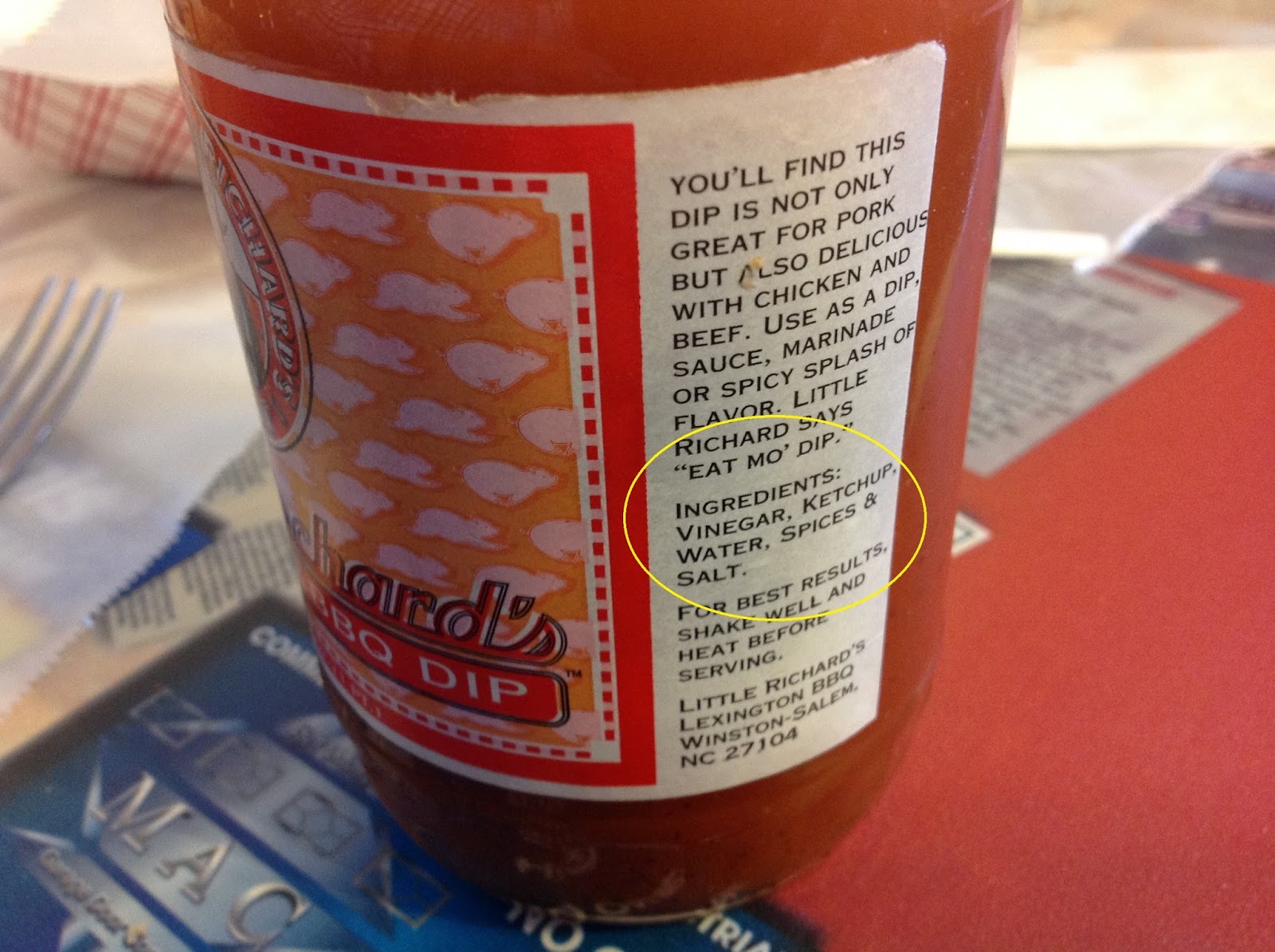
Although the chopped pork was moist and delicious without needing any extra sauce, I was captivated by the tangy flavor of Little Richard’s own house dip and kept adding more and more to my boat as I ate the barbecue. The dip, mixed every morning, is Little Richard’s select combination of vinegar, ketchup, water, spices, and salt. It is thin and vinegary with a consistency similar to sauces in eastern North Carolina.

The dip recipe is a secret, but the ingredients are listed on the bottles.

True to Lexington style, Little Richard’s offers a vinegary red slaw, which gets its characteristic color from ketchup, with its BBQ plates, trays, and sandwiches. The menu lists “slaw,” with no description -- the implicit understanding is that the mayonnaise-based coleslaw of eastern N.C. barbecue traditions isn’t available because it’s not Lexington style.

Soon after I arrived for lunch, every table was occupied.

The original location, a destination on the historic N.C. Barbecue Trail, opened more than 25 years ago (a second location is also available -- surprisingly and somewhat confusing, several other barbecue restaurants in the area are also named Little Richard’s but are not connected).

The wood pile in back is Little Richard's proof that it cooks its pork slowly over hot coals.

By serving delicious barbecue that is cooked slowly with hickory wood, Little Richard’s is easily achieving its goal of “Eat Mo’ Pig.”

"Eat Mo' Pig" is an appropriate motto.


Note: The name of the restaurant was changed to Real Q in early 2018 to distinguish it from other area restaurants with the name of Little Richard's that are operated by former partners of owner Richard Berrier.

Friday, February 17, 2017

Returning to a Classic in Lexington, NC


Soon after I moved back to North Carolina, a day trip to Lexington was high on my to-do list. The purpose, of course, was to enjoy barbecue at one of the city’s dozen classic establishments.

Plenty of wood is ready for slow cooking pork shoulders.

Of all cities in the state (and the South), Lexington is probably the one most closely identified with barbecue. Visit NC, managed by a state agency to promote tourism, recognizes the barbecue legacy of the city by featuring a “barbecue tour” of it < https://www.visitnc.com/trip-idea/lexington-barbecue-tour >, and its legendary barbecue festival attracts thousands of spectators each October.

A pig in the Pig in the City art initiative greets customers as they arrive.

Even the city’s official website pays homage to the city’s barbecue heritage < http://www.lexingtonnc.net/>, and many businesses participate in the Pigs in the City art initiative, which places life-size pigs painted and decorated artistically around the city.

A barbecue tray with slaw is served in a cardboat boat, typical for Lexington-style restaurants.

Because Lexington Barbecue Restaurant (sometimes called “Lexington #1” or “The Honey Monk” by the locals) was the first place where I ate barbecue in Lexington, it’s always a place to stop when I’m in the area as I was recently. Very little changes here. Although it has expanded from a small café to the large white building it now occupies, it has always served excellent pit-cooked barbecue since being opened in 1962 by Wayne Monk (hence, its alternate names of “The Monk” and “The Honey Monk”). Monk, who worked under the legendary Warner Stamey of Greensboro, was 26 when he built the first building and opened the business.

The white building is the current home, long ago replacing the small cafe built in 1962.

Located on appropriately named Smokehouse Lane, Lexington Barbecue cooks pork shoulders slowly and fresh daily over oak or hickory coals for about ten hours. The result is always superior barbecue – well worth the drive and the logical starting point for enjoying barbecue in the “barbecue capital.” USA Today has listed it in the top 10 best Southern barbecue spots, and Southern Living magazine has identified it as the favorite barbecue place of its readers in North Carolina.

The line of customers waiting for tables on a Friday night seems to never end.

Barbecue is served chopped, sliced, or coarse chopped. Plates, trays, and sandwiches come with “red” slaw, traditional for Lexington-style. Returning to Lexington Barbecue reminded me of my first visit – the simplicity of the restaurant; the friendliness of the wait staff; the authentic preservation of its style; and the excellent barbecue, slaw, and hushpuppies. No wonder that it continues to receive high praise and recognition even with all the other nearby barbecue restaurants.

A young fan declares Lexington Barbecue, also known as Honey Monk ("Hnemonk"), is the best. 

Saturday, August 27, 2016

Legacy of Lexington Style

Old-fashioned at Stamey's means Lexington style.
When people want traditional “Lexington style” barbecue of North Carolina, they often travel not to Lexington but to Greensboro. The Gate City is the home of Stamey’s, which traces its roots to 1930 and was founded by the legendary C. Warner Stamey, who taught the Lexington style to other early pitmasters.

Stamey himself learned in Lexington how to make pit cooked barbecue from early entrepreneurs Jess Swicegood and Sid Weaver when he was a high school student there in the 1920s. After moving back to his hometown of Shelby, he made and sold barbecue before returning to Lexington in 1938 when he bought Swicegood’s business. He renamed it Stamey’s where he continued to develop his reputation as a barbecue pitmaster and promoter.

A photo of the founder watches over the entrance that includes several vintage photos of the business and a waiting bench.


Greensboro has two Stamey’s locations, the second one opening in the 1970s. The original one, which I visited, was opened by Stamey in 1953 as a drive-in after he had moved from Lexington. Across the street from the Greensboro Coliseum, it was replaced with a new structure in 1979 and has been operated continuously by a member of the Stamey family, currently Chip Stamey (grandson of the founder).

Tables in the dining area turn over frequently because orders are taken and served promptly.

Adhering to the style promoted by the founder long ago, the pitmasters still cook only pork shoulders and only over hardwood coals. Although Stamey’s claims a “secret” sauce, the secret is not well kept because it has provided the recipe – equal amounts of ketchup and apple cider vinegar with sugar, salt, black and red pepper -- to the Cooking Channel. Ketchup in the sauce keeps Stamey’s true to the Lexington style and separates it from the style of eastern N.C. where the sauce has no tomato (and whole hogs rather than only shoulders are cooked).

Lexington style is barbecue (using only pork shoulders) with hushpuppies and red slaw.

The chopped barbecue that I ordered came from the kitchen already adequately sauced, so I added no more at the table. The plate included red slaw (coleslaw made with Stamey’s sauce, not mayonnaise) and crisp hushpuppies (reportedly popularized as a side on barbecue plates when Stamey began serving them decades ago after seeing them served at local fish restaurants). The Brunswick stew that I also ordered was a colorful complement to the red slaw.

Brunswick stew comes with the requisite amounts of vegetables.

Credited with spreading “Lexington style” in the western half of North Carolina, Stamey nurtured several protégés such as Alston Bridges, Red Bridges, John Stogner, Doug Gosnell, and Wayne Monk. Even though I’ve been to Lexington and also eaten “Lexington style” in other cities such as Winston-Salem and Shelby, I felt closer to the tradition by being in Stamey’s and at its first location in Greensboro. The way the servers greet customers and take orders shows they know that they are preserving a legacy.

The carry-out counter stays busy throughout the day.


Tuesday, August 23, 2016

Morphing from a Dairy Center

The Barbecue Center was
once the Dairy Bar.
No trip near, through, or to Lexington, NC, is complete without a stop at one of its legendary barbecue establishments -- with more than 20 places to choose from. In the city that boasts the opening of its first one in 1919, the lineage of pitmasters is very royal.

The Lexington style of barbecue is so well known: pork shoulders cooked slowly over hardwood coals. It is always served with red slaw (coleslaw made with ketchup rather than the traditional mayonnaise base). The meat is usually served chopped, although sliced can be requested, and with a sauce seasoned with vinegar, ketchup, pepper, and other spices.

The wood outside tells you that slow cooking over hardwood coals is still the tradition.

For my most recent foray into Lexington, the destination was the Barbecue Center, which is the oldest barbecue restaurant in Lexington that still cooks on pits. It had its early beginnings as the Dairy Center and was known for its ice cream and banana splits, which seems an unlikely beginning for a legendary barbecue restaurant in Lexington. Barbecue now brings in the customers, but the signature dessert is still a humongous banana split.

The counter, originally in the Dairy Center, was moved to the Barbecue Center's new location when it opened in 1961.

Barbecue was added to the menu to improve business for the Dairy Center in the winter months. Doug Gosnell, who took over the restaurant in 1955, learned how to make pit-cooked barbecue, Lexington-style from the legendary C. Warner Stamey, who trained many other early pitmasters in the Piedmont area of North Carolina.

The dining area of the Barbecue Center is busy throughout the day.

The tray of barbecue that I ordered arrived just as expected: packed with chopped pork and red slaw. They and the hushpuppies were excellent. Rather than end the meal with the mountainous banana split, which reportedly weighs more than three pounds (a table of four usually shares one banana split), I settled for the much smaller and almost as famous banana pudding. 

A tray of barbecue (chopped, course chopped, or sliced) comes with red slaw.

Being able to trace its roots to Stamey places the Barbecue Center at the beginning of Lexington style. By continuing to make excellent barbecue and sides, it has a secure place in preserving Lexington traditions for a long time to come.

Banana splits are still
made at the counter.
Banana pudding is almost as famous as the banana split.


Friday, September 11, 2015

Red Bridges Barbecue Lodge: A Tradition Dating to 1946

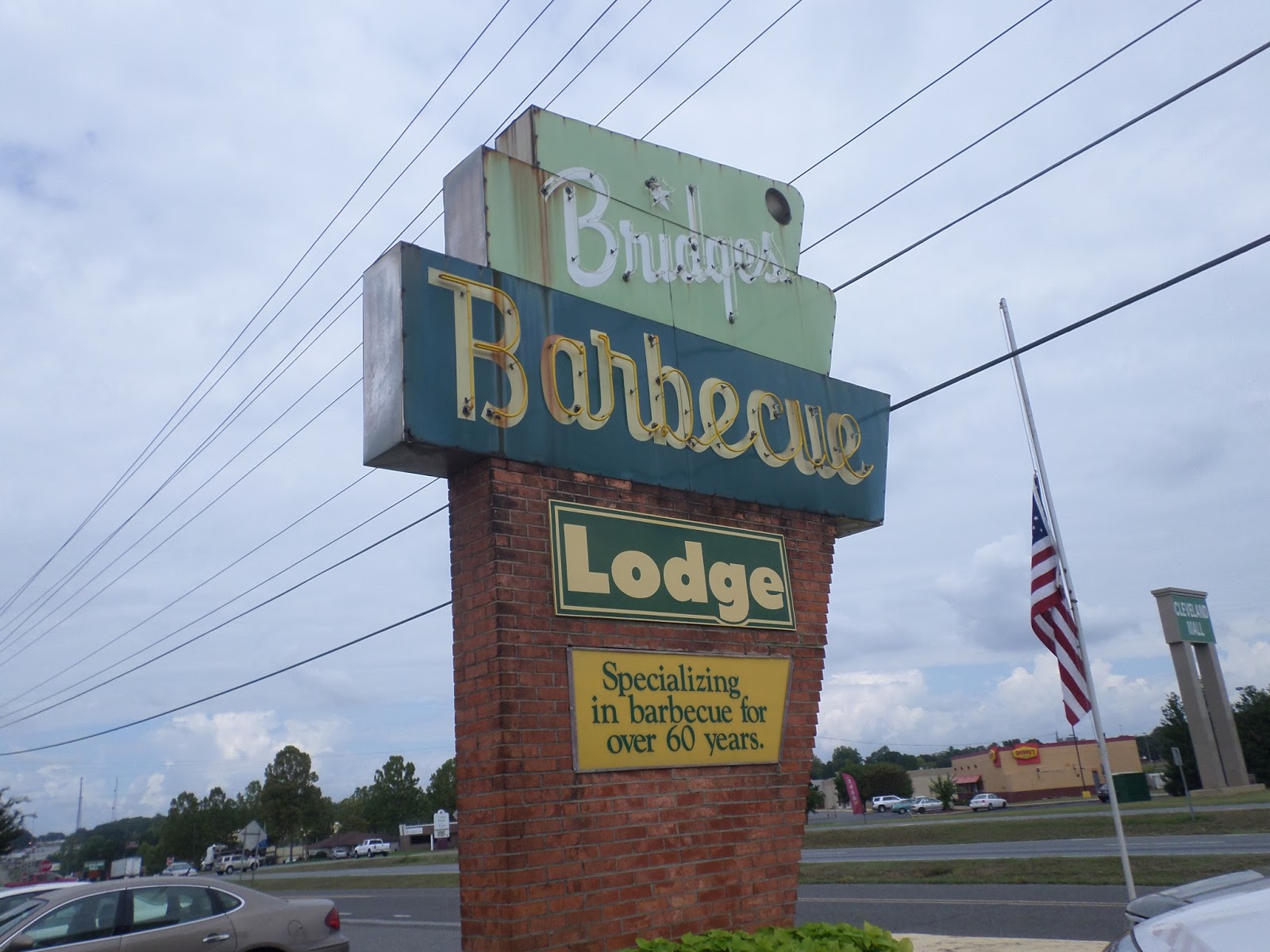
The sign in front has been a beacon
for BBQ fans for decades.
Red Bridges Barbecue Lodge in Shelby, NC, has been a place I’ve wanted to visit for a long time. It is one of the top BBQ places in the South and continues to be recognized for its tradition and legacy of serving moist and tender barbecue.

A main stop on the historic barbecue trail of the N.C. Barbecue Society, it ranks high on just about everybody’s list – Southern Living, Southern Foodways Alliance, and barbecue writers such as Randy Moss. In 2015, it won the “Ultimate Barbecue Bracket” competition of Garden & Gun. Magazine articles and photos line its walls among family pictures and scenes of yesteryear. 

Bracket results tell the story.
Because it is set back from U.S. Highway 74 Bypass, I missed it when I drove by the first time. After making a U-turn, I found what everyone has been talking about – the restaurant looks like it’s been frozen since the 1950s in a time warp (you can almost imagine it being on a two-lane road that the bypass was at the time) and the barbecue is still prepared in the same time-honored tradition as it has been for decades.

On the wall is a picture of the restaurant in the "old days" (observed the vintage cars).

After I had ordered lunch, I started taking pictures. My server Diann (who is certified as a barbecue judge by the Kansas City Barbeque Society and has been a member of a competitive cooking team) asked if I wanted to take pictures of the pit. Of course! There’s where I found Dennis at work, guarding the fire and watching over the smoking shoulders. He has a lifetime of experience and learned his skills from his father, who was cooked pork for most of his life.

Pitmaster Dennis, 55, learned the skills
 of of operating a pit from his father.
Red Bridges himself learned the art of cooking pork shoulders slowly over wood coals from Warner Stamey of Greensboro fame. True to “Lexington-style,” he used only shoulders for pork barbecue that he served with the cole slaw variety that is “red.” I obviously had to order pork barbecue for lunch. The easy choice was a jumbo BBQ plate (combination of chopped pork and chicken with a thin stream of sweet sauce on top) that included baked beans and red slaw and was accompanied by a basket of perfectly fried, crunchy hushpuppies. For dessert, I selected banana pudding (always available) over pineapple-coconut cake, the dessert of the day – both made by Diann who makes all the desserts.

"Lexington-style" barbecue always comes with "red" slaw.

Granddaughter Natalie (left) and daughter
Debbie keep Bridges' spirit alive.
The restaurant continues the legacy of Red Bridges, its namesake, who started selling barbecue in 1946. It is now run by second and third generation family members. Granddaughter Natalie said that she began working there when she was 14 or 15. Diann mentioned that grandson Chase makes all the red slaw and never deviates from the family’s recipe.

The restaurant has a steady stream of customers -- new and repeat.

The woodpile is huge -- and neat.
I couldn’t believe how much chopped wood was in back of the restaurant waiting to be turned into hot coals on another day of cooking. The wood was stacked as neatly as a Boy Scout project and all in a single row as long as the restaurant. Next to the woodpile was the remains of an old free-standing pit building that with a little coaxing looks like it could be returned to service with some tender care. I could almost picture coals blazing in the pits.

Banana pudding is always available.
The constant stream of customers coming and going made the restaurant seem like a train station. A line of customers at the cash register waiting to pay their bills seemed to never disappear. The dining area displays a community spirit as several customers greeted each other and the restaurant’s staff, and most tables were noisy with friendly conversation until food was served. It was obvious that a few customers were also first-time visitors as they (like me) were taking pictures.

Watching descendants of Red Bridges work in the restaurant that he and his wife Lyttle started many decades ago was a special experience. Enjoying pork barbecue and red slaw at Red Bridges Barbecue gave me a greater appreciation for the role of “Lexington” style in creating N.C. barbecue traditions and for this particular restaurant’s connection to others that serve barbecue in the Piedmont.
 
About 50 shoulders cooked the day before are ready to be chopped or sliced in the kitchen.