Showing posts with label Raleigh. Show all posts

Friday, April 17, 2026

Sam Jones Knows Eastern Carolina BBQ

The chopped pork sandwich is served with slaw on a potato bun. Photo: Sam Jones BBQ.

Any barbecue fan who visits Raleigh, NC, usually asks about Sam Jones BBQ because the owner/pitmaster is so well known in food circles. Jones descends from a family that has prepared whole-hog BBQ the right way — cooked slow over a wood-fueled pit – since grandfather Pete Jones opened a restaurant in 1947 at age 17.

Chopped—not pulled—is the Jones family way. Photo: Sam Jones BBQ.

The grandson of the founder of the legendary Skylight Inn in Ayden, NC, Sam Jones has not fallen far from the family tree, although he has taken his family’s barbecue skills into two other cities — first to Whiteville in 2015 and next to Raleigh in 2021. Even before venturing into these two locations, Jones was named “one of the top pitmasters in the South” by Southern Living magazine back in 2012.

An old auto body shop was transformed into a BBQ destination. Photo: Sam Jones BBQ.

In Raleigh, Jones converted an old auto body shop into a smokehouse and dining room. His team cooks 180-pound hogs in a wood-fired pit for 16 hours every day. The BBQ is seasoned just right, not overly sauced, and chopped (not pulled) with crunchy bits of skin. In addition to chopped pork BBQ, Jones also serves smoked spare ribs, turkey, and chicken.

A traditional Jones family tray of chopped BBQ also comes with a side (here sweet slaw) and cornbread. Photo: Visit Raleigh Insider.

One family tradition that often meets with mixed reviews from first-time customers is the cornbread, which follows the original recipe that dates to 1830 from Skylight Inn. (Some diners skip it and order the sweet potato muffin instead.) Long-term diners consider it an essential part of the full Jones family experience. The cornbread, unsweetened and dense, is made with little more than cornmeal mix and water. A thin slab with crisp edges and a chewy texture, it is a marked contrast to sweeter Southern cornbread that is fluffy or cakey.

The cornbread is unsweetened and dense.

The sides are as good as the BBQ. Sweet slaw, mac ‘n’ cheese, collard greens, and baked beans are popular choices. The best advice is not to leave without trying the banana pudding. Alone, it makes a trip to Sam Jones BBQ worthwhile.

Don't leave without a serving of banana pudding.

A third-generation pitmaster, Jones knows how to serve eastern N.C.-style BBQ. His perfectly smoked, chopped whole hog barbecue continues a time-honored family tradition. chopped pork with slaw on a potato bun.

Sam Jones is a third-generation pitmaster. Photo: Sam Jones BBQ.

Friday, April 5, 2024

90 Years and Counting: Continuing the Barbecue Tradition at Holland’s Church

The quiet, rural community around Holland's Church knows where to find excellent barbecue. 

When a community has been fixin’ barbecue for 90 years, it has to be good. Located nine miles south of downtown Raleigh, NC, near the intersection of two historic roads, Old Stage and Ten-Ten, Holland’s Church has been doing just that for nine decades. 

The popular barbecue is served in clamshell boxes with potatoes, coleslaw, and hushpuppies.

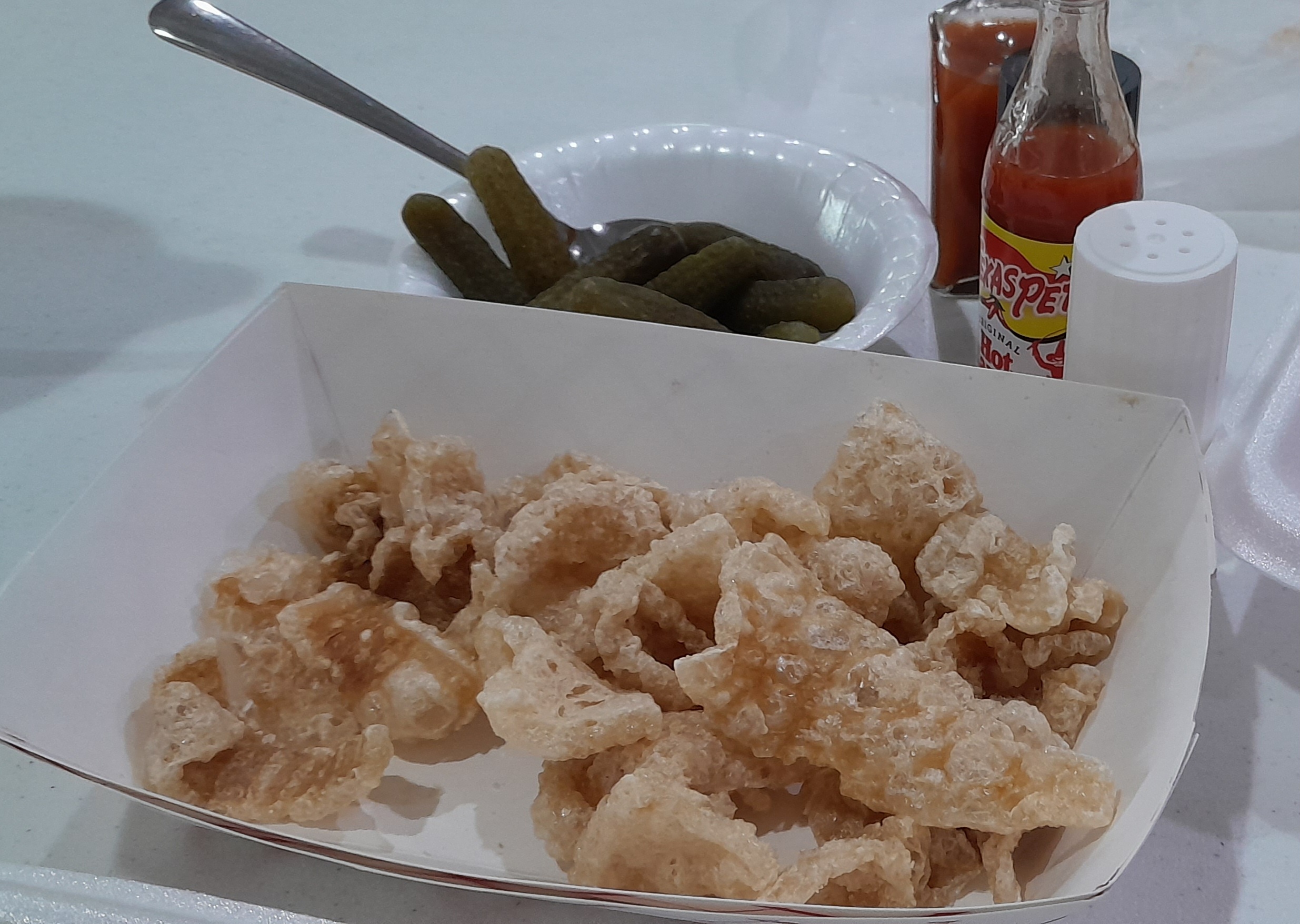
The church serves its barbecue, potatoes, coleslaw, and hushpuppies in a clamshell box, and runners carry the boxes to tables as people arrive. (There is no standing in line.) Tea (sweet) and water are the beverages. Homemade desserts (pies and cakes) available by the slice are on another table. To-go plates can also be bought as well as containers of barbecue and freshly made pork skins. 

The efficient kitchen crew prepares the clamshell boxes quickly.

Until recently, the barbecue dinner was served family style. After paying at the door, people were seated at tables where bowls of barbecue, coleslaw, potatoes, and hushpuppies were placed, and they were joined by other community members. Everyone could eat as much as they liked.

Runners carry the clamshell boxes to tables as customers arrive.

Preparing barbecue plates has been a tradition at the church for several generations. Every April and November, the church’s members renew their long-standing ritual. However, the church was 122 years old before it began contributing annually to the region’s barbecue culture. 

The dessert table adds an extra sweetness to the day.

This Methodist congregation was established in 1812. Holland’s Church quickly became the center of a community in southern Wake County that was generally isolated from other pockets of population and the evolving city of Raleigh (established as the county seat and state capital only a few years earlier in 1792). This location was being settled before railroads were built in the area.

The eat-in area begins to fill up when the serving line opens at 11 a.m.

In fact, the church predates two major railroads built in the state. The North Carolina Railroad, which connected cities in the Piedmont to those on the Atlantic coast, was chartered in 1849 by the state legislature and opened for operation in 1851. The Chatham Railroad, connecting Chatham County (west of Wake) to Raleigh, opened in 1869.

Trays of pork skins are available at each table.

The church is named for William Holland, who was born in Chester, England, in 1750 and immigrated to Wake County. Before dying on December 4, 1809, the former English schoolmaster had prepared a will that provided $400 “to build a good Methodist Meeting House, that may have a partition at one end thereof for a classroom.” Holland is buried in the church’s cemetery.

The to-go line stays busy throughout the day.

The church was used as a school, a tribute to Holland’s desire that the church include an “educational enterprise.” Believed to be the first school in the county outside the city of Raleigh, this use signified “its established position in the life of the community,” according to the historical text “Early Methodist Meeting Houses in Wake County, North Carolina” by G. Franklin Grill, a church historian. 

Hushpuppy batter is ready for frying at the prep area outside the church.

Nothing in historical records indicates when Holland’s Church also became the center of barbecue excellence. To celebrate the 90th anniversary, the church offered a free plate to anyone who was 90 or older. Imagine being 90 years old and having been part of this barbecue tradition for decades. It would be a life worth living.

Saturday, June 9, 2018

Whole Hog Cookoff in an Urban Park

Music played throughout the day on the stage of Midtown Park at North Hills.

Imagine green space encircled by cooking teams competing in a whole hog cookoff. Now place that scene in a dense urban area with high-rise commercial and residential buildings towering over the teams. You are now in Raleigh, NC, for the Fourth Annual Kickin’ It Country Whole Hog Cookoff in Midtown Park at North Hills.

Cooking teams set up between Midtown Park and the commercial and residential buildings of North Hills.

If I was much younger, North Hills would be the place where I would spend time (and money), and many younger people do just that. It’s an innovative hub of activities that offers many ways to shop, eat, play, work, and live.

High-rise residential buildings surrounding Midtown Park overlook the cooking teams.

A mixed-used development, North Hills includes stores, restaurants, entertainment, commercial offices, residential units, and even a continuing care retirement community. For one day each year, the play area of Midtown Park is the home to a popular whole hog cookoff.

Lee Meeks (left), John Gibbons (obscured), and I evaluate skin crispness at a cooker.

For the fourth annual rendition of the cookoff, 15 teams registered. They included past annual state champions, winners at other regional events, and even a newcomer or two. All showed the superior skills needed to compete in a whole hog contest, and judging their pigs accurately required concentration and diligence.

John Gibbons (left), Lee Meeks (right), and I finish our evaluation at a site.

For the judging, I worked with John Gibbons of Holly Springs and Lee Meeks of Newport. They both brought to the cookoff a deep appreciation for the skills that a successful cooking team must possess as well as an thorough understanding of the scoring criteria established by the North Carolina Pork Council, which sanctions this and all other whole hog cookoffs that culminate in the Whole Hog Barbecue Championship each year.

Lee Meeks (right) and I evaluate moisture as pitmaster Chris Fineran (left) looks on.

The top three winners in the Fourth Annual Kickin’ It Country Cookoff were Kevin and Dana Peterson of Showtime’s Legit BBQ (first place); Chris Fineran and Steve Sumner of Beach Boys BBQ (second); and Ernest Twisdale, Stephen Twisdale, and George Collins of Grill Father Cooking Team. Each is now qualified to advance to the championship cookoff next fall and compete for the honor of being proclaimed the state champion and admitted into the Whole Hog Hall of Fame.

John Gibbons (right) and I complete our scoring sheets at a site.

However, the Hall of Fame already includes the lead pitmasters of these three teams. Kevin Peterson was the 2017 state champion; Chris Fineran, 2016; and Ernest Twisdale, 2015. In addition, Roy Parker, pitmaster of Old Hickory, the fourth place team, was admitted in 2006 when he won the state championship that year. These credentials and the high scores they earned this year show how very competitive the cookoff was.

John Gibbons (left), Lee Meeks (center), and I relax after all the scoring sheets have been completed.

In fact, the scores for the top three winners were exceptionally high. The highest score that a team can earn from one judge is 360 points. The top team scored 1,010 out of a possible 1,080 points. Only 10 points separated the top three teams, and the fourth and fifth place teams themselves were only a few points behind the leaders.

Kevin Peterson of Showtime's Legit BBQ accepts the first-place trophy from Ashley Stallings, cookoff organizer.

Midtown Park at North Hills is the place to be on the first Saturday each June. The barbecue cookoff competition is superior, and after the judging is over, the barbecue is served as a fundraiser for a major local charity. For the other 364 days of the year, North Hills is still the place to be for shopping, eating, playing, working, and living.

Proceeds from BBQ plates sold after judging activities ended benefit the Raleigh Police Memorial Foundation.

Sunday, July 13, 2014

Sampling and Learning at a Grilling Class

Would you take a barbecue grilling class at a restaurant owned by a highly regarded chef and graduate of the prestigious Culinary Institute of America? When I had the opportunity to participate, the decision to sign up was easy (although it was also sweetened by a discounted registration fee). The class indicated the growing interest in personal grilling.

Lots of food on the grills were ready for tasting when the class began

The class was held at Backyard Bistro, a family-owned restaurant in Raleigh, NC, well known for several signature dishes, including beef brisket slow roasted for 12 hours over hickory wood and St. Louis-style pork ribs dry-rubbed and also slow roasted. Three stations had been set up outdoors just outside the restaurant’s patio area: one was a custom-built open grill heated with charcoal briquettes, and another was a clamshell cooker fired by gas. The most intriguing grill had been made out of a trashcan for demonstrating smoking techniques.

The simplest grill is made out of a
trashcan.

The class was more a sampling class than a cooking class, although a chef at each station explained the advantages and disadvantages of the setup and heat source. The class favorite was clearly the homemade trashcan grill, and the distinctive smoke flavor imparted to food cooked in it attracted the most attention.

Smoking box with hickory wood inside
the trashcan grill.

The chef indicated that the trashcan grill had been built for less than $50 in supplies, including L-brackets, temperature gauge, circular steamer grates, and a smoking box for holding wood. At the bottom of the trashcan, holes had been drilled to let in air that kept charcoal embers slowly burning to heat and smoke hickory wood pieces in the smoking box set on the coals.

Ribs prepared in the trashcan grill
were extremely flavorful.

Food smoked in the trashcan is
ready for sampling.
Lots and lots of food items were grilled during the two-hour class: scallops, swordfish, shrimp, steak, beef brisket, chicken, pork ribs, and Portobello mushrooms. Veggies included corn, blanched potatoes, summer squash, and zucchini. In addition, pineapple basted in a mixture of brown sugar, butter, and cinnamon was on the grill to show how fruit can be part of a barbecue event.

The class was brief, and its instruction was basically only an introduction for someone interested in starting to grill. Anyone with grilling experience wouldn’t gain much except for enjoying the food that had been cooked.  In fact, some seemed interested in only eating. However, the chefs did offer suggestions practical for the backyard griller:
  • Don’t pre-soak wood being used to impart a smoky flavor to avoid smoldering it and changing the smoke flavor that would be otherwise produced. 
  • Use a smoking box for the wood (rather than placing the wood directly on the coals) so that the smoke is gradual. 
  • Sear meat on a hot cooking area initially to lock in flavor and juices. 
  • Move the meat after searing to a low heat area so that cooking continues slowly. 
One of the vehicles in
 Backyard Bistro's fleet
The class attracted more than 40 participants because Backyard Bistro is also acclaimed as a regional caterer. It has a fleet of “flame-wrapped vehicles and grills” for cooking on site. Its 40-foot “Big Rig” has four 3-by-5 feet grills (large enough to cook a whole 125-pound pig each) and has fed as many as 8,000 people with 16 buffet lines going at once. Joe Lumbrazo, head chef and owner, has been selected to cook for the governor at political events. What better crew of professional chefs to observe?

Joe Lubrazo discusses meat and vegetables cooked on gas-fired grill.

The buffet enjoyed
at the end of the class.
The class was entertaining and provided information about grilling techniques and fuel sources. Watching the chefs demonstrate their pride and skill in preparing exceptional food on a grill obviously motivated the participants to improve their grilling techniques.


Grilled Pineapple 


Although no recipes were provided as part of the class, this recipe is a good one for grilling pineapple.

1 fresh pineapple, peeled, cored, and sliced into one-inch rings
¾ cup dark brown sugar
1 tablespoon honey
¼ teaspoon ground cinnamon
3 tablespoons melted unsalted butter

Directions
1. Mix honey, butter, brown sugar, and cinnamon in bowl.
2. Add pineapple to bowl and spoon mixture over pineapple rings.
3. Place pineapple rings and mixture in plastic bag that can be resealed.
4. Seal bag and press to continue coating each ring.
5. Marinate overnight (but not less than 30 minutes)
6. Preheat an outdoor grill for medium-high heat and lightly oil the grate.
7. Grill pineapple for approximately 3 minutes per side. Remove when grill marks appear (and be careful to avoid burning sugar on pineapple).

Note: Makes about 12 servings.

Grilled pineapple that I prepared several days after the class using this recipe.