Showing posts with label Brunswick stew. Show all posts

Saturday, March 24, 2018

Giving Back at Urbanna

Bill Jones, contest organizer and OBR
lead for Virginia, serves Brunswick
stew on Friday to early arrivals.
BBQ Gives Back is appropriately named. Held in Urbanna, Virginia, the cookoff generates funds for Operation BBQ Relief (OBR) and also supports a local food bank.

OBR is a group of volunteers who respond to disasters throughout the United States and feed victims and first responders. All net proceeds of the event are donated to OBR, and a voluntary collection of funds for OBR is also held. Last year, in its inaugural event, the contest contributed $6,500 to OBR.

In addition to the meats the teams cook for the contest, each competing team cooks a pork butt that is provided to the Team Thanksgiving Food Bank, based in Churchview, Va. After the contest was held in March last year, 500 pounds of cooked meat were donated to the food bank that it then gave to families in need through September 2017 without its having to buy any additional meat. The contest also held a voluntary collection of dry and canned goods, and cooking teams and judges willingly contributed.

The recreation center at Bethpage was the site of judging activities.

Although the purpose of the cookoff is to “give back,” the focus of each cooking team is on preparing winning barbecue. In the contest’s second year of being sanctioned by the Kansas City Barbeque Society, 75 teams competed for a total of $11,000 in prize money. Held at the Bethpage Camp-Resort on the shores of the Rappahannock River, the contest has ample room for the cooking teams. Because so many teams were competing, 11 tables of judges were need to evaluate all the entries. It’s one of the largest cookoffs that I’ve attended.

Judges relax inside the recreation center before the first entries arrive.

Urbanna, a historic colonial port town, brags that it has more boats than people and that it is the home of Virginia’s Oyster Festival each November. It has gained also a reputation as the site in March where barbecue cooks and judges demonstrate their generosity and community spirit.

Awards await the winning teams.

BBQ Gives Back is fittingly named. Everyone enjoys participating in an event with such a noteworthy purpose. Being able to judge great barbecue is also a benefit for the judges.

Bethpage Camp-Resort is popular with both cooking teams and judges.

Saturday, March 3, 2018

Still Serving Like It’s the 1950s

When you walk into Parker’s Barbecue in Wilson, NC, you are met as soon as you pass through the front door -- sometimes by a greeter, frequently by two, and often by a whole host of friendly faces, including young men wearing 1950s-style paper hats who as servers will wait on you soon.

Parker's in Wilson, NC, is a destination for barbecue lovers.

Most customers don’t need a menu when they arrive. After all, Parker’s has been in business since 1946, and little has changed since then. Parker’s serves pork barbecue only one way: chopped. There’s little indication that it will ever change its approach. Why change what has worked well for decade?

Servers wait near the cashiers for customers to arrive.

Although Parker’s is also now known for its chicken and seafood, many customers still arrive hungry for only barbecue, which is slowly roasted every day and infused with Parker’s signature vinegar-based sauce. Each week about 150 whole hogs are cooked (only gas, not wood, has been used since the 1950s).

The kitchen is continually busy throughout the day.

Corn sticks or hushpuppies usually accompany a meal; I got both. In addition, I picked slaw, boiled potatoes and Brunswick stew as the sides for my dinner. The slaw has more “zip” than I had expected, but it combines nicely with the barbecue.

The centerpiece of my dinner is chopped barbecue.

The centerpiece, of course, is Parker’s chopped barbecue. When it arrives at the table, it is drier than a visitor might expect. However, on the table are two bottles of sauce -- both vinegar-based and one with more crushed red peppers -- so that the meat can be moistened to match a customer’s preferences.

Most customers arrive at Parker's with barbecue on their minds, although fried chicken is also popular.

In eastern North Carolina, when you mention Parker’s, most people know that you are referring to the original location in Wilson. However, Parker’s has expanded to nearby Greenville, but the first location is still the destination for many barbecue fans. Until 2018, it was listed on the Historic Barbecue Trail of the North Carolina Barbecue Society but was removed when the trail was limited to historic pits that cook with only wood or charcoal (the original listing may still be displayed on the web.)

The takeout counter always has customers waiting.

Stepping into Parker’s is like going back to the 1950s. Little has changed. Thank goodness.

The menu rarely changes -- this one has been used for more than four years.

Thursday, October 26, 2017

Mallard Creek, the Granddaddy of All Barbecue Events

For years I’ve wanted to attend the granddaddy barbecue festival of all, the long-running event organized by Mallard Creek Presbyterian Church in Charlotte, NC. Finally, in its 88th year, I got to see why it’s so famous.

Now in its 88th year, Mallard Creek is the place for BBQ in October.

More than 20,000 people attend the latest incarnation of an event begun in 1929 when the nation fell into the Great Depression. That year the church cooked two hogs and a goat, and sold its first barbecue to pay a contractor who was constructing Sunday school rooms. Now proceeds raised support local and world missions and supplement the church’s building fund. The food -- chopped pork barbecue, Brunswick stew, coleslaw, and applesauce -- continues to please each new generation.


The annual event is a reunion of church members and community residents.

The crowd includes plenty of politicians eager to campaign before elections are held in only 12 days and greet voters as they move through the waiting line. A lot of food is needed to feed the crowd. This year more than 13,000 pounds of pork barbecue, 25,000 gallons of Brunswick stew, 2 tons of coleslaw, and 400 gallons of coffee were prepared. Each plate costs $10, and a sandwich only is $4. (If you call ahead, the church can accommodate group orders of 50 plates or more – but no deliveries.) Barbecue is also sold by the pound, and stew and slaw by the quart.

The BBQ plate costs $10.

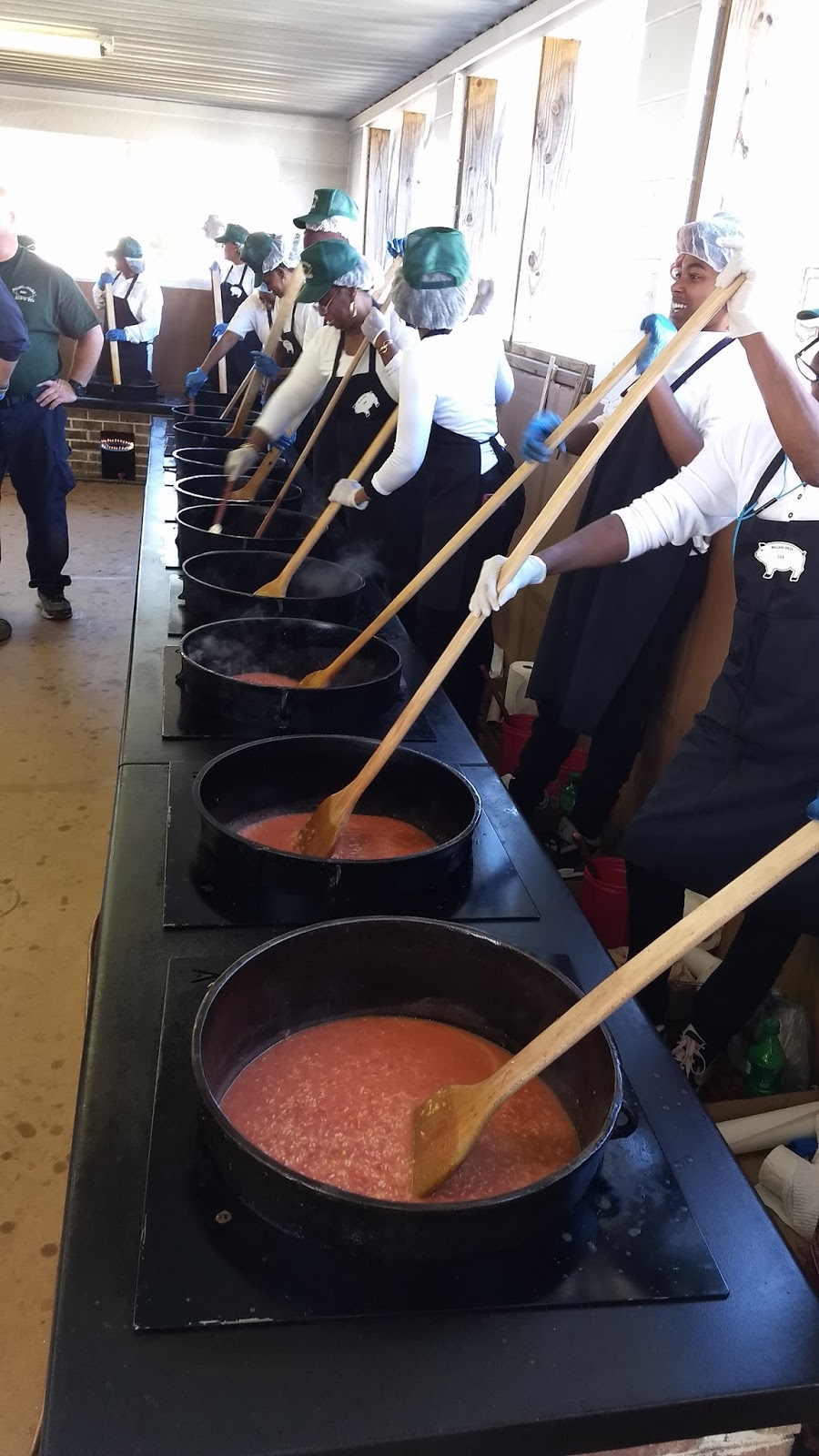
While applesauce on a barbecue plate may not be usual, the biggest surprise is the Brunswick stew, which is made with rice, not potatoes. In addition, instead of shredded chicken and other meat such as beef, it has ground-up chicken, pork, and beef; instead of lima beans, it has only tomatoes and corn.  Rebecca McLaughlin, who died in 2004 at age 93, is responsible for the stew recipe. According to her son Dale, she began overseeing its preparation in the 1940s and continued for about 40 years. Because she thought potatoes were too mushy, she swapped them out for rice. She stopped using lima beans because she thought they were too strong.

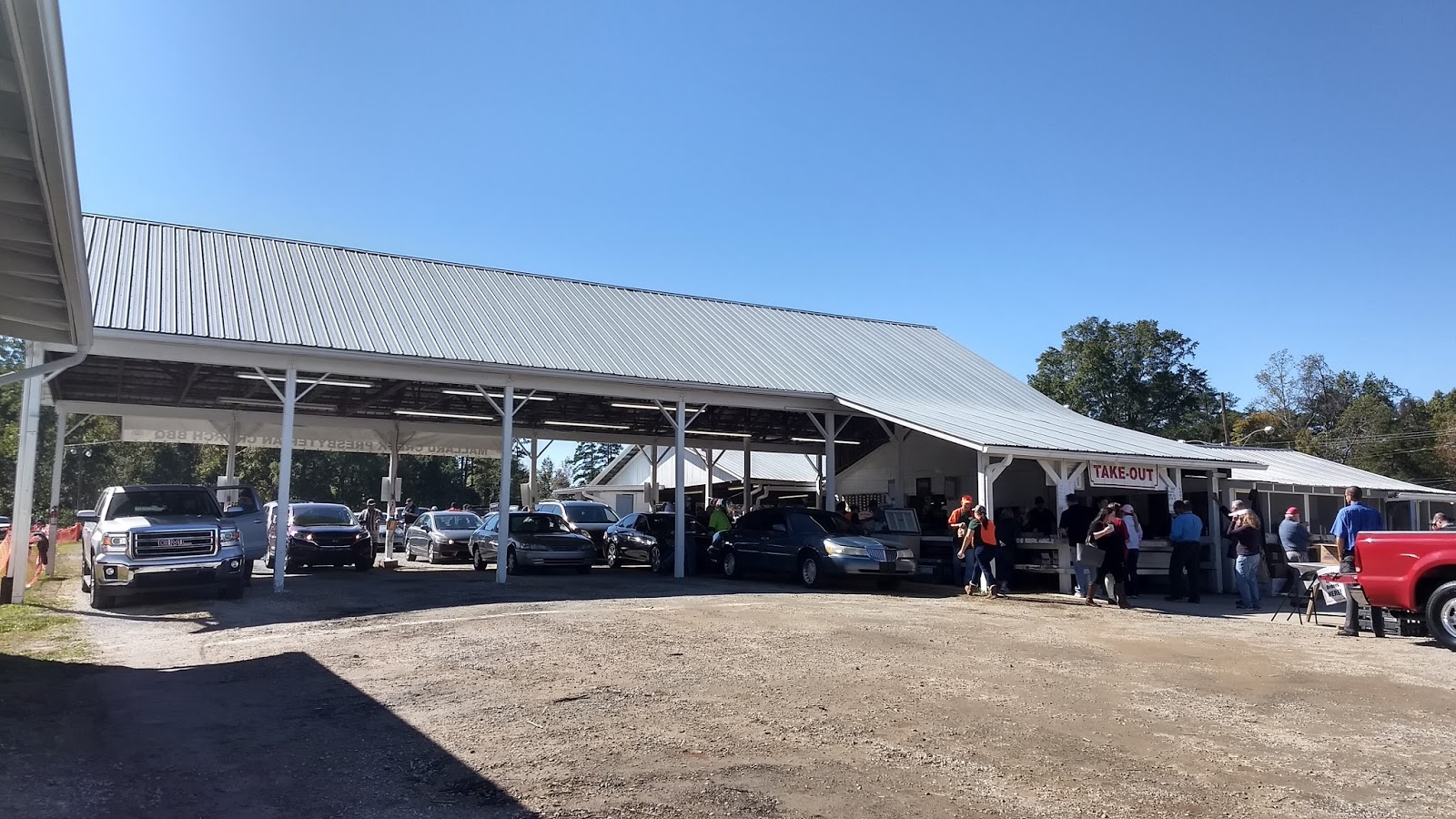
Four drive-through takeout lines serve customers until all the food is sold.

Always on the fourth Thursday of October, the sale requires much more effort than is obvious and begins in earnest early in the month when the Community House, where the event is held and that is located two miles from the church, is cleaned up and checked for general repairs. A week in advance, equipment for cooking the meat is set up and the seasoning room is prepared.

Politicians greet customers as they walk through the waiting line to the serving area.

On the Thursday before the event, the first meat comes off the cooker, and the chopping and seasoning process begins. Next the barbecue is weighed and bagged in one-pound packages. Then the equipment and area are cleaned and prepared for another day of cooking on Friday. On Saturday, the slaw – cabbage, onions, carrots, and celery – is made. More cleanup is needed on Saturday as well as Sunday afternoon.

Barbecue, Brunswick stew (made with rice), and coleslaw can also be bought in bulk quantities.

On Monday as early as 2 a.m., church members start cooking chickens to make the Brunswick stew. On Tuesday, the ingredients for the stew are mixed, and then the stew is dipped into containers. Additional site preparation continues on Wednesday so that the area is ready for the big day on Thursday.

The serving line never rests.

Customers begin arriving as early as 9:30 a.m. (although the publicized start time is 10 a.m.) and keep coming until the barbecue is sold out. On some years, it’s gone by late afternoon. Then the final cleanup begins as tables and chairs are taken down and paper goods are consolidated and stored.

Local neighbors, the only paid workers at the event, stir stew with long paddles. 

The event is a major undertaking. It seems each church member has an important task, and many work countless hours. Their joy and camaraderie are obvious as they work together and serve the crowd. So much good-tasting food is prepared for so many customers, and they keep coming back year after year.

Huge trailers keep prepared food refrigerated until the day of sale.


Saturday, August 27, 2016

Legacy of Lexington Style

Old-fashioned at Stamey's means Lexington style.
When people want traditional “Lexington style” barbecue of North Carolina, they often travel not to Lexington but to Greensboro. The Gate City is the home of Stamey’s, which traces its roots to 1930 and was founded by the legendary C. Warner Stamey, who taught the Lexington style to other early pitmasters.

Stamey himself learned in Lexington how to make pit cooked barbecue from early entrepreneurs Jess Swicegood and Sid Weaver when he was a high school student there in the 1920s. After moving back to his hometown of Shelby, he made and sold barbecue before returning to Lexington in 1938 when he bought Swicegood’s business. He renamed it Stamey’s where he continued to develop his reputation as a barbecue pitmaster and promoter.

A photo of the founder watches over the entrance that includes several vintage photos of the business and a waiting bench.


Greensboro has two Stamey’s locations, the second one opening in the 1970s. The original one, which I visited, was opened by Stamey in 1953 as a drive-in after he had moved from Lexington. Across the street from the Greensboro Coliseum, it was replaced with a new structure in 1979 and has been operated continuously by a member of the Stamey family, currently Chip Stamey (grandson of the founder).

Tables in the dining area turn over frequently because orders are taken and served promptly.

Adhering to the style promoted by the founder long ago, the pitmasters still cook only pork shoulders and only over hardwood coals. Although Stamey’s claims a “secret” sauce, the secret is not well kept because it has provided the recipe – equal amounts of ketchup and apple cider vinegar with sugar, salt, black and red pepper -- to the Cooking Channel. Ketchup in the sauce keeps Stamey’s true to the Lexington style and separates it from the style of eastern N.C. where the sauce has no tomato (and whole hogs rather than only shoulders are cooked).

Lexington style is barbecue (using only pork shoulders) with hushpuppies and red slaw.

The chopped barbecue that I ordered came from the kitchen already adequately sauced, so I added no more at the table. The plate included red slaw (coleslaw made with Stamey’s sauce, not mayonnaise) and crisp hushpuppies (reportedly popularized as a side on barbecue plates when Stamey began serving them decades ago after seeing them served at local fish restaurants). The Brunswick stew that I also ordered was a colorful complement to the red slaw.

Brunswick stew comes with the requisite amounts of vegetables.

Credited with spreading “Lexington style” in the western half of North Carolina, Stamey nurtured several protégés such as Alston Bridges, Red Bridges, John Stogner, Doug Gosnell, and Wayne Monk. Even though I’ve been to Lexington and also eaten “Lexington style” in other cities such as Winston-Salem and Shelby, I felt closer to the tradition by being in Stamey’s and at its first location in Greensboro. The way the servers greet customers and take orders shows they know that they are preserving a legacy.

The carry-out counter stays busy throughout the day.


Saturday, February 20, 2016

A Place Unchanged After 50 Years

As soon as I entered through the door, I knew that I had arrived at a place that many people would call their favorite restaurant. “Sit anywhere you want,” says the nearest server as someone comes in. I picked the closest table to the checkout counter, which is in front of the kitchen, and watched families and other groups amble to their regular places.

A moon, hanging in fog, watches over Stephenson's late in the evening before it closes.

Although most of its business today is with local residents, Stephenson’s does attract out-of-towners as the guest register at the front entrance indicates. Its inclusion on the North Carolina Barbecue Trail keeps new faces arriving. Travelers from Kentucky, New Jersey, and Virginia had signed recently.

A guest register is prominently displayed at the entrance.

Located on NC Highway 50 about 20 miles south of Raleigh in a community known as McGee’s Crossroads, Stephenson’s would have been a regular stop for families traveling to the North Carolina coast. Highway 50 begins in Granville County (adjacent to the Virginia border) and travels south to Topsail Beach in Pender County. Traversing only 164 miles, it once would have been the primary road for summer destinations for many residents in central North Carolina before the days of Interstate travel. Now that Highway 50 has been supplanted by I-40 for fast travel, Stephenson’s is almost forgotten by the beach traffic (except for those in the know), although it is less than three miles from the nearest interchange with I-40.

The parking lot lined with cars indicates Stephenson's popularity, although it's no longer on the primary road to the beach.

Stephenson’s was opened because William Paul Stephenson, Jr., a farmer, decided he could make more money by operating a barbecue business and selling sandwiches than by selling the hogs that he was raising. The building, in the shape of a barn, looks vintage 1958, the year that Stephenson opened his restaurant. A Pepsi sign near the entrance simply stating “Bar-b-que” also has a 1950s look. With only “Stephenson’s Bar-B-Q” in white letters above the entrance, a fast traveler might not even notice the building because it is set back from the road and no sign by the road marks the place.

The sign by the front door looks like it hasn't changed since the 1950s.

The classic red-and-white checkered tablecloths provide an easy, at-home feel. Soon after I had sat down and ordered, my server brought a tall pitcher of tea with a small pan of crushed ice -- more than adequate for a single customer and more ice that I would expect in February. I appreciate the service that patrons have plenty of tea -- with lots of ice.

Tea comes with all the ice that you need.

The barbecue is pit-cooked daily, hand-chopped, and seasoned lightly with a pepper-vinegar sauce in the finest traditions of eastern North Carolina, although Stephenson’s cooks only pork shoulders, not whole hog. For someone who needs more sauce, only two kinds – a pepper-vinegar sauce and the commercial Texas Pete – are on a table.

Although the menu lists chicken, barbecue brings in the customers.

The sandwiches are reasonably priced -- $3.65 for barbecue pork with slaw. For plates, the BBQ choices are simple: only two sizes -- small pig and large pig. On weekends, ribs are also available. The sides are typical for a barbecue restaurant in eastern North Carolina (except no baked beans): coleslaw, collards (in season), cabbage, applesauce, spiced apples, green beans, corn, and potatoes (boiled or french fries). Other sides include gizzards and livers! As a traditional barbecue house, Stephenson’s does offer dessert but only one: banana pudding.

The counter is always busy with customers placing takeout orders.

For large groups, Stephenson’s serves an all-you-can-eat, family style meal of pig, barbecue chicken, and Brunswick stew with boiled potatoes, coleslaw, and hushpuppies. (The menu warns, “Please don’t ask to take leftovers home.”)

Stephenson's pit is at the back of the building -- no wood pile here, Stephenson's cooks with hardwood coals.

Because I couldn’t miss on trying Brunswick stew, I ordered it as a plate with chopped barbecue that comes with two sides (for me, collards and coleslaw) and hushpuppies (that are excellent) or rolls. Everything more than met my expectations, and having a full glass of iced tea without having to ask for service was a nice touch for the family-operated business, now run by Stephenson’s son Andy.

On my plate of chopped barbecue and Brunswick, I ordered coleslaw and collards.

Stephenson’s deserves its place in the legends of pit-cooked barbecue, and it will continue to earn this respect for a long time as the second generation honors its traditions begun in 1958.

The founder, who died in 2008, opened the restaurant in 1958.

Tuesday, May 20, 2014

Stew on the Intracoastal Waterway

From the Intracoastal Waterway, Dockside is an alluring destination.

Imagine stopping for lunch on the Intracoastal Waterway and finding Brunswick stew on the menu. That possibility can happen in Wrightsville Beach, NC, if you stop at Dockside Restaurant and Bar


Customers can arrive by boat dockside ...
... or enter through the front door streetside.
Located on the westside of the waterway just south of US Highway 74/76, the restaurant attracts boating customers daily who may be as interested in boat fuel, power, ice, or other essential supplies as in lunch or dinner. A dining customer, on the other hand, usually arrives in search of great seafood and a cold beverage.

Tables on the deck by the waterway are popular.

When I began reviewing the menu, I was immediately attracted to blue crab and corn chowder listed in the soup category. Then “Uncle Satch’s Brunswick Stew” caught my attention. Even though its ingredients of pulled pork and chicken, corn, lima beans, potatoes, and tomatoes seemed ordinary, I was curious to know more about Uncle Satch. Although Dockside is better known for its seafood, any stew named for an uncle is worth a try.

“Uncle Satch’s Brunswick Stew” is a tasty choice.

The menu claims to support local growers at Xanadu Farms, but the vegetables in the stew seemed to be canned (typical today for most situations) rather than fresh from local suppliers. However, the stew was dense with its tasty ingredients, although more tomato content would have made the stew even richer.

Who Uncle Satch is still remains a mystery to me; however, I am now a fan of the stew that bears his name. If you are driving, boating, or even riding a bike near Dockside, stop in for more than seafood – try the stew, which definitely complements any sandwich or entree. On my next visit, I may even try the chowder – after I have another helping of Brunswick stew.

Across the street from Dockside, an elegant, tall, old tree laden with Spanish moss greets visitors arriving by car or bike.