Saturday, June 4, 2016

In Asheville for National Tour

More than 700 barbecue teams are competing again this year for $500,000 in cash and prizes in the Sam’s Club National Tour. The tour attracts some of the top cooking teams in the country, and being a judge is rewarding because the barbecue is so superior.

This year I was a judge in an initial qualifying event in Asheville, NC. At these events, thirty teams compete for the right to advance to a regional qualifying event where the top finishers are invited to the national event in October in Bentonville, Arkansas, where the grand champion takes home $50,000.

A table for demonstrations is set up beside The Sam's Club National BBQ Tour truck.

The tour started this year in February in Daphe, Alabama. Events continue almost every weekend until mid-September when the last regional event is held in Madison, Wisconsin. Michael McDearman, tour director, whom I met last year in North Charleston, SC, is one busy person as he travels to each site and organizes the events.

Michael McDearman, tour director, welcomes judges to the event in Asheville, NC.

At the judges’ meeting, McDearman emphasized how important the series is for promoting barbecue and encouraging teams to compete. The event in Asheville like the other local qualifying events had $10,000 in prize money. Smoking Butt Heads, the grand champion, won $2,000 and advanced to the regional qualifying event with the five other top teams. Although the prize money awarded in Asheville is important, the right to advance in the series is the best reward.

Cooking teams set up in the parking area of Sam's Club in Asheville.

Being a judge at a tour event was just as enjoyable as it was last year, and I hope to participate again next year. Evaluating teams that compete on the tour is a high point of participating as a judge.

Friday, June 3, 2016

Worthy of a Presidential Visit

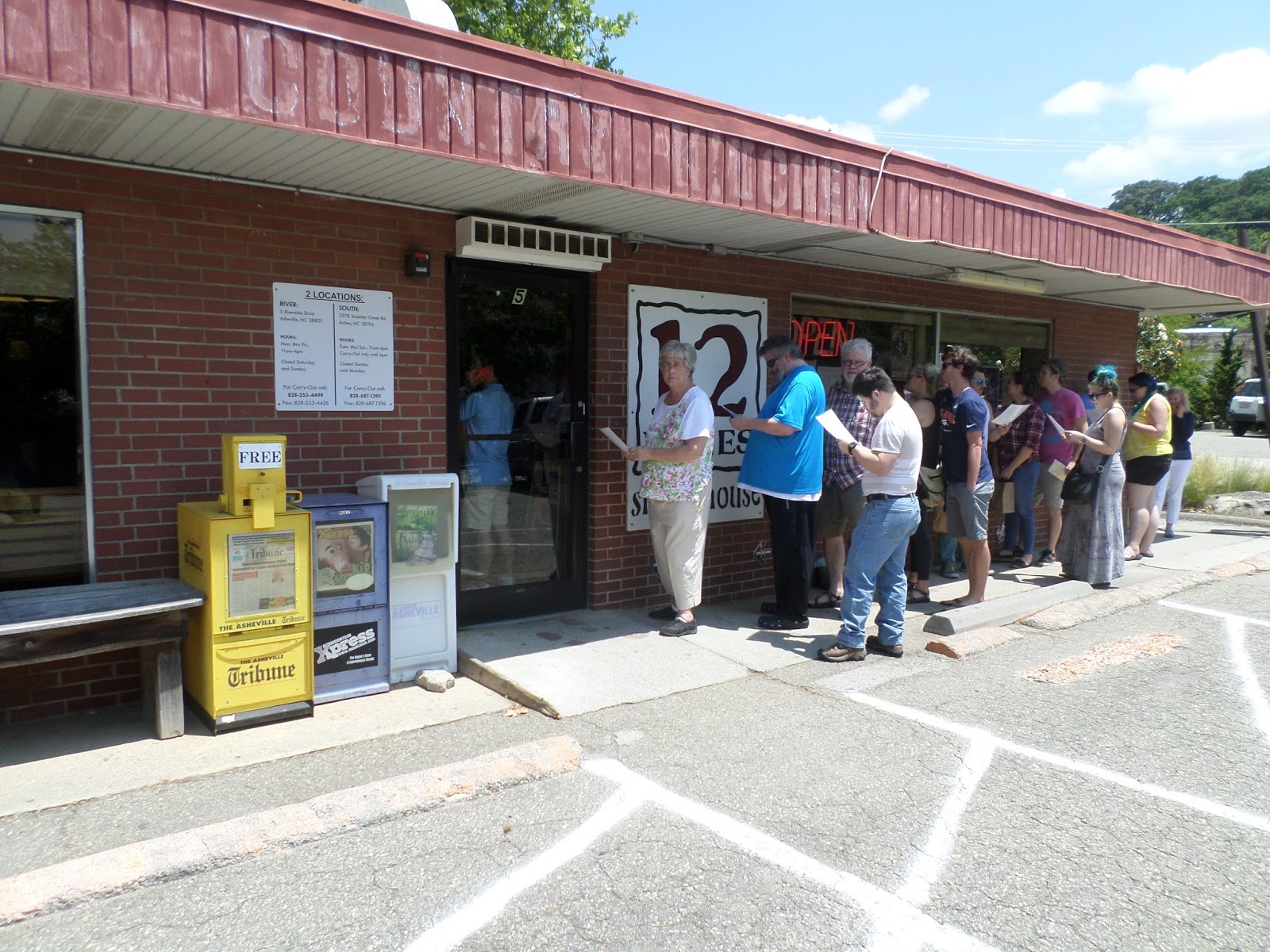
Few barbecue establishments can boast that a president of the United States while serving in office has visited them — with all the entourage required for security. In Asheville, NC, 12 Bones has gained media attention for repeat visits by President Obama as well as the long line of local carnivores that stretches out of its building into the parking lot.

The line at 12 Bones frequently stretches into the parking lot.
Before visiting 12 Bones, I had learned more about its popularity and food by watching a segment of the Bookwatch TV program broadcast by WUNC-TV. Head chef Shane Heavner and co-owner Brian King discussed the restaurant and their recipes in an interview about their recently published cookbook. As the 12 Bones owners and chef brag in the cookbook, Obama stopped there each time that he was in Asheville while in office, and he made an initial visit in 2008 when as a U.S. senator he was campaigning for president.

Ribs, the most frequent order, are heated before being served.

For the initial visit, take-out was ordered for Obama and his campaign staff, and it included ribs, brisket, and pulled pork with a double order of collards. For the next visit in 2010, Obama insisted going unannounced and standing in line to order. He and his wife ate in the restaurant to the fanfare of national and local media. Ribs with sides of baked beans, greens, and mac and cheese were ordered this time. A third visit in 2013 was similarly a media event that further enhanced the reputation of 12 Bones.

My order of ribs with corn pudding, mac and cheese, and cornbread was served very quickly.

Although a place of presidential proportions, 12 Bones is definitely a casual restaurant. Rolls of paper towels on the tables serve as napkins. Food is ordered at the central counter and then brought out by the staff after customers have picked their tables. A few orders are takeout, but most customers enjoy their lunch in the restaurant and in good weather pick a table in the outside, covered eating area.

The outside eating area is popular in good weather.

Because its popularity continues to increase, 12 Bones has opened a second location in the Asheville area, but many travelers, myself included, seek out the original location. It was opened in 2005 and brought to life a one-story brick building in the River Arts District that had been known as Kountry Kitchen. However, city planners are threatening to take the land that it occupies to relocate a road and build a roundabout. The current owners (Bryan and Angela King), who bought 12 Bones in 2013, are determined to keep the restaurant in the River Arts District if it has to be relocated.

Rib flavors are announced on a board at the order location.

Taking a cue from Obama and his preference for ribs, I knew before arriving that I had to try them (skipping brisket, pulled pork, chicken, and turkey – all smoked – that are on the menu and also deserving of consideration). The next choices were the sides: corn pudding, collard greens, mac and cheese, and mashed sweet potato. Everything at 12 Bones is made from scratch, and the recipes for each are in the restaurant’s cookbook.

Watching the crowd at 12 Bones is almost as enjoyable as eating the ribs. Although it’s hard to imagine that a president ate here, it’s easy to understand why he returned for encore visits.

Saturday, May 21, 2016

Inaugural Event in a Legendary Town

Ayden, NC, is the home of two legendary barbecue establishments: Skylight Inn and Bum’s Restaurant. When town leaders decided to hold a barbecue cookoff and festival, they were inspired to name the event in honor of their two kings -- Kings of Q was an easy choice for the contest’s name.

It’s surprising that a barbecue town such as Ayden never before had a barbecue festival. The town clearly enjoys a homegrown festival because it has hosted the Official Collard Festival of North Carolina since 1975. When Stephen Tripp, the town’s mayor, spoke to judges at their initial meeting, he said, ”We want to book summer with two festivals” as he explained why town leaders wanted a second festival as a companion to the collard festival.

Teams set up in BBQ Village.

Officials were very excited to be conducting their first barbecue cookoff and festival. “You’re making history with this inaugural event,” Tripp told the judges. He also said that he had given the same message to the cooking teams the night before.

The Smokin' BBQ team prepares its chicken entries.

Tripp told the judges that they would be “tasting the best barbecue ever judged because Ayden is known as the barbecue capital of the world.” In a nod to the two kings – Skylight Inn and Bum’s Restaurant – Tripp said, “We have the best barbecue in the world. When the cookers get permeated with that legacy, they’ll produce the best barbecue that the teams have ever made,” the mayor projected.

A contestant prepares a tray for the People's Choice category.

I have to agree with the mayor. For a first-ever event, the contest was well organized, and the cooking results were exceptional. Of the entries that I judged, the beef brisket in particular was superior, which is typically difficult for some teams to prepare. The other entries – chicken, ribs, and pork – were also better than expected. The teams must have been inspired by not only being in Ayden but also the opportunity to compete for a total prize amount of $10,000.

Amanda Reed of Coastal Smoke looks happy with her cooking results.

Because many judges were aware of the importance of Ayden in the history of N.C. barbecue, several traveled from out of state to be a part of the inaugural event. Cooking teams from Texas and Pennsylvania also joined in the competition that featured mostly N.C. teams. For the cookoff, 30 cooking teams registered, and 30 judges were required. Fortunately, I had submitted my application when the contest was first announced and assured my participation by being one of the early judges to apply.

Music plays during the festival on the main stage at the center of the street scene.

Even before the event was over, the organizers were so pleased with the event that they began planning for the “second annual” next year. The good news for me is that all the judges who participated will be invited to judge again before registration is made available to others. Because Ayden is one of my favorite small towns, I’m looking forward to being part of the festival again.

Near the main stage, the trailer of Skylight Inn stays busy selling barbecue sandwiches.

Saturday, April 2, 2016

Shadowing Judges at a Whole Hog Cookoff

For some time, I’ve wanted to judge barbecue cooked in the “whole hog” style and add those skills to my credentials as a judge. The opportunity developed quickly when a training judge invited me to shadow him at a contest sanctioned by the North Carolina Pork Council.

Cooking whole hog has been part of the barbecue history and heritage in North Carolina for more than 300 years. To determine the best whole hog cooks, the N.C. Pork Council conducts a series of events from March through September in its Whole Hog Barbecue Series, which celebrates the history and artistry of whole hog cooking. Top finishers in each event are invited to compete in the fall in a Whole Hog Championship, which the Pork Council has conducted since 1985.

Chief cooks listen as Jim Bristle, contest president, explains procedures at organizational meeing.

At each event, judges certified by the Pork Council evaluate all the cooked pigs. The evaluation criteria are very specific, and a standard scoring sheet provides consistency and uniformity. More than taste is important. One significant criterion of judging a cooked pig is color, which should be golden brown. In addition to appearance and brownness, the pig is scored for skin crispness, meat and sauce taste, moisture, and completeness.

When a pig is not perfectly golden brown, points are deducted for charred areas.

For an event to be sanctioned by the Pork Council, at least 10 cooks need to participate. At the Newport Pig Cookin’ Contest in 2016 where I shadowed a training judge, 77 cooks participated (and more than 100 have participated there in previous years). Judging began promptly at 8 a.m. and lasted well past noon because the judges had so many pigs to evaluate. As a result, Newport, the longest-running and largest whole hog cookoff in North Carolina, is an excellent preparation for judging future events.

Judges conduct a thorough evaluation of each cooked pig.
Each team cooks a “whole hog,” which is split down the middle without head and feet. It weighs about 100 pounds, although I did see a couple that were much larger (114 pounds). At Newport, most teams cook with propane gas, although some traditional cooks use wood or charcoal.

The crowd enjoys barbecue by center stage in the Newport Community Park.

Watching the four judges poke, prod, flip, taste, and evaluate 77 cooked pigs gives me more experience than I expected and is a great starting point for future events. In addition, seeing the dedication and enthusiasm of the cooks gives me a greater appreciation for their importance in a barbecue competition. Now that I’m certified, I’m now looking forward to my first judging opportunity at a “whole hog” cookoff.

A young cook, hopeful of winning the $100 prize for best cook under the age of 18, watches as the judges evaluate his cooked pig.

Note: A related article that I wrote about the Newport Pig Cookin' was later published on line by the North Carolina Folklife Institute.

Saturday, March 5, 2016

Sip and Swine


All roads in Georgia lead to Atlanta, except when a barbecue cookoff is happening someplace else. On a sunny weekend, Lawrenceville was the destination for cooking teams, certified judges, and a very large crowd as it was the venue for the inaugural Sip and Swine BBQ Festival.

The Black Tie BBQ team has an appropriately designed cooker.

A suburb of Atlanta, Lawrenceville is about 30 miles northeast of downtown. Although it is the second oldest city in the metropolitan Atlanta area, much of the area seems to have been recently constructed, such as Coolray Field where Sip and Swine was held. It opened in 2009 and is the home of a minor league affiliate of the Atlanta Braves. The location is perfect for a barbecue festival because the parking areas of Coolray provide ample space for cooking teams, vendors, entertainers, and the crowd.

Judges sign in for the festival.

The festival attracted almost 90 cooking teams, a phenomenal turnout for an inaugural event, that were lured by $9,500 in prize money and the rivalry offered by an event sanctioned by the Kansas City Barbeque Society. With the festival having so many cooking teams, 15 tables of judges were needed to evaluate and score the entries that they turned in. In the professional division, 60 teams competed in the usual categories of chicken, ribs, pork, and brisket. The remaining teams formed a backyard division and competed in all categories except brisket.

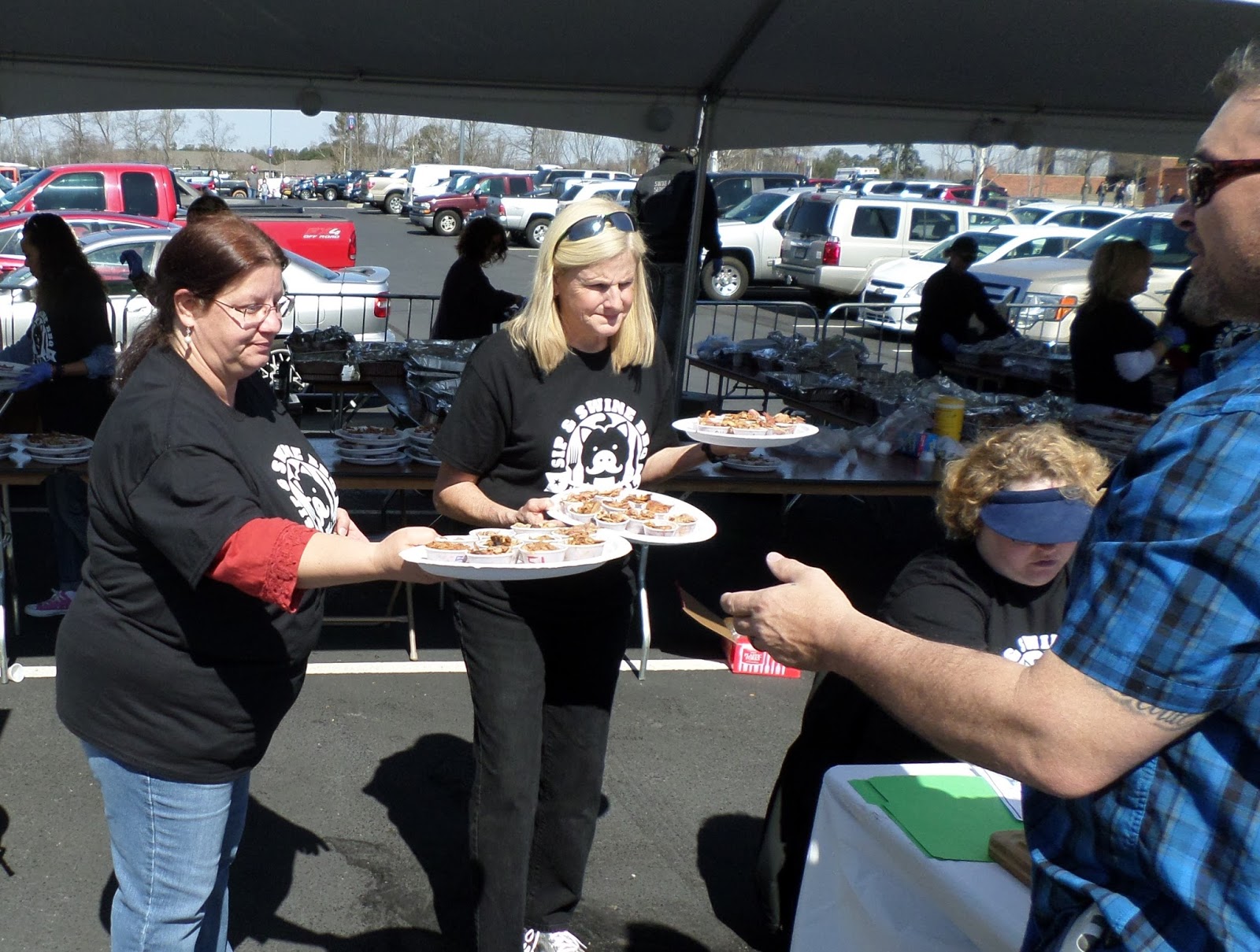
The lineup for samples in the People's Choice begins early.

Although the main attraction of the festival was the cookoff and the chance to see the teams in action, the People’s Choice competition was a major hit. A long line of eager BBQ fans, who paid $10 for an assortment of samples and the opportunity to vote in the People’s Choice, formed well before the competition began. All proceeds were donated to a local children’s shelter. Otherwise, Sip and Swine was free.

Samples of barbecue are plated for the People's Choice.
An amazing lineup of local benefactors sponsored the festival and helped to guarantee its success. The crowd enjoyed music played by prominent local entertainers as vendors dispensed food, beer, and sweets. Because the vendors were continually serving long lines, they will be sure to return next year for an encore.

Officials label and place boxes of brisket in trays to take to judges.

Sip and Swine is destined to be an annual event because all the components – location, sponsors, cooking teams, People’s Choice competition, entertainment -- were successful. For at least one weekend each year, the roads in Georgia will be bringing travelers to Lawrenceville instead of Atlanta.

The Checkered Pig team takes top honors.


Saturday, February 20, 2016

A Place Unchanged After 50 Years

As soon as I entered through the door, I knew that I had arrived at a place that many people would call their favorite restaurant. “Sit anywhere you want,” says the nearest server as someone comes in. I picked the closest table to the checkout counter, which is in front of the kitchen, and watched families and other groups amble to their regular places.

A moon, hanging in fog, watches over Stephenson's late in the evening before it closes.

Although most of its business today is with local residents, Stephenson’s does attract out-of-towners as the guest register at the front entrance indicates. Its inclusion on the North Carolina Barbecue Trail keeps new faces arriving. Travelers from Kentucky, New Jersey, and Virginia had signed recently.

A guest register is prominently displayed at the entrance.

Located on NC Highway 50 about 20 miles south of Raleigh in a community known as McGee’s Crossroads, Stephenson’s would have been a regular stop for families traveling to the North Carolina coast. Highway 50 begins in Granville County (adjacent to the Virginia border) and travels south to Topsail Beach in Pender County. Traversing only 164 miles, it once would have been the primary road for summer destinations for many residents in central North Carolina before the days of Interstate travel. Now that Highway 50 has been supplanted by I-40 for fast travel, Stephenson’s is almost forgotten by the beach traffic (except for those in the know), although it is less than three miles from the nearest interchange with I-40.

The parking lot lined with cars indicates Stephenson's popularity, although it's no longer on the primary road to the beach.

Stephenson’s was opened because William Paul Stephenson, Jr., a farmer, decided he could make more money by operating a barbecue business and selling sandwiches than by selling the hogs that he was raising. The building, in the shape of a barn, looks vintage 1958, the year that Stephenson opened his restaurant. A Pepsi sign near the entrance simply stating “Bar-b-que” also has a 1950s look. With only “Stephenson’s Bar-B-Q” in white letters above the entrance, a fast traveler might not even notice the building because it is set back from the road and no sign by the road marks the place.

The sign by the front door looks like it hasn't changed since the 1950s.

The classic red-and-white checkered tablecloths provide an easy, at-home feel. Soon after I had sat down and ordered, my server brought a tall pitcher of tea with a small pan of crushed ice -- more than adequate for a single customer and more ice that I would expect in February. I appreciate the service that patrons have plenty of tea -- with lots of ice.

Tea comes with all the ice that you need.

The barbecue is pit-cooked daily, hand-chopped, and seasoned lightly with a pepper-vinegar sauce in the finest traditions of eastern North Carolina, although Stephenson’s cooks only pork shoulders, not whole hog. For someone who needs more sauce, only two kinds – a pepper-vinegar sauce and the commercial Texas Pete – are on a table.

Although the menu lists chicken, barbecue brings in the customers.

The sandwiches are reasonably priced -- $3.65 for barbecue pork with slaw. For plates, the BBQ choices are simple: only two sizes -- small pig and large pig. On weekends, ribs are also available. The sides are typical for a barbecue restaurant in eastern North Carolina (except no baked beans): coleslaw, collards (in season), cabbage, applesauce, spiced apples, green beans, corn, and potatoes (boiled or french fries). Other sides include gizzards and livers! As a traditional barbecue house, Stephenson’s does offer dessert but only one: banana pudding.

The counter is always busy with customers placing takeout orders.

For large groups, Stephenson’s serves an all-you-can-eat, family style meal of pig, barbecue chicken, and Brunswick stew with boiled potatoes, coleslaw, and hushpuppies. (The menu warns, “Please don’t ask to take leftovers home.”)

Stephenson's pit is at the back of the building -- no wood pile here, Stephenson's cooks with hardwood coals.

Because I couldn’t miss on trying Brunswick stew, I ordered it as a plate with chopped barbecue that comes with two sides (for me, collards and coleslaw) and hushpuppies (that are excellent) or rolls. Everything more than met my expectations, and having a full glass of iced tea without having to ask for service was a nice touch for the family-operated business, now run by Stephenson’s son Andy.

On my plate of chopped barbecue and Brunswick, I ordered coleslaw and collards.

Stephenson’s deserves its place in the legends of pit-cooked barbecue, and it will continue to earn this respect for a long time as the second generation honors its traditions begun in 1958.

The founder, who died in 2008, opened the restaurant in 1958.

Saturday, January 30, 2016

Returning to Lakeland, Florida


The Lakeland Pigfest has been held for 20 years.

When the opportunity to return to Lakeland, Florida, for a barbecue contest became available, I jumped at the chance. Being in Florida in January to enjoy warm temperatures and combining the travel with judging barbecue is a great combination.

Pig In or Pig Out competed in the pro division of Pigfest.

Although Lakeland is a nine-hour drive from my home, the destination makes the journey more than worthwhile. I decided to stay a week more than last year in Florida after I was notified by contest organizers that I would be a judge. The extra time gave me and my family time to explore the panhandle of the state, visit Gulf Coast beaches, and spend several days at Walt Disney World – and miss a snow and ice storm in my home area.

Judges mingle before the competition begins.

Another change this year is that I was able to judge in the “pro” division, which is for the highly competitive teams (last year I judged in the “backyard” division of the Lakeland Pigfest). Participating as a judge in the “pro” division was phenomenal. The meats were exceptional, particularly the briskets.

Fired & Wired was one of the teams competing in the backyard division.

The Pigfest is one of only four events in January sanctioned by the Kansas City Barbecue Society. Two are in foreign countries (Italy and Australia). If a cooking team wants to compete in January in the United States, it has to choose the Pigfest or a BBQ throwdown in Denver. Quite a few choose the Pigfest, which has been the host to more than 200 teams from 17 states since it began in 1997.

The Smoke Shack team had the tallest signs but placed low (57 out of 58 teams) in the pro division.

The pro event attracted 58 cooking teams from all over the country, and the backyard competition attracted an equally large number of teams -- requiring the organizers to field a huge number of certified judges: six judges and a table captain are needed for each increment of six cooking teams. 

The perfect way -- homemade ice cream -- to end a day of judging barbecue.
The 2016 Pigfest was the 20th annual occurrence. All the past experiences have given the organizers an excellent foundation for planning and conducting the next event. It remains one of the top events that I’ve been able to attend as a judge. The nine-hour drive is a small concession to make to start a new year in Florida with a premier contest.