Saturday, April 8, 2017

Improving an Agricultural Celebration by Adding a Whole Hog Cookoff

Homegrown in the Park, an annual festival in Burlington, NC, was begun by the Farm Bureau of Alamance County as a way to “bring the farm to the city” by holding a farm day in a city park. Previously, the bureau had offered tours of neighboring farms to educate the public about local agriculture.

Several teams created an inviting atmosphere at their cook sites that added to the ambiance of the festival.

The county has become increasingly urban, led by the growth of Burlington, its largest city, and Graham, the county seat. In recent decades, the population of the county has grown by as much as 20 percent. Farms have been lost as new residential areas have been created. Because many residents live in the county but work elsewhere, it is often described as a “bedroom community,” and appreciating its agriculture is important because the number of its farms have declined by 70 percent over the last century.

Impressive trophies were taken home by the finalists.

In its first three years, the festival drew increasingly large crowds by offering educational exhibits and displays to celebrate local agriculture -- music and free food were additional enticements to attend. For its fourth year, the festival was expanded to include a whole hog cookoff, and sanctioning by the N.C. Pork Council was obtained so finalists could advance and compete in the state championship, the culmination of the Whole Hog Barbecue Series.

Barbecue chopped by a team after being judged was served on plates to the public.

The whole hog cookoff seems to be exactly what the festival needed to complete its celebration of the county’s agricultural traditions and heritage. Barbecue from the cookoff is served to the public, and nothing brings out a crowd like excellent barbecue cooked by competitive teams. For its first cookoff, the festival attracted 14 teams. Although several had not competed in the Whole Hog Barbecue Series before, they all produced superior barbecue. The three other judges and I were impressed with how most pigs were scored high in areas of skin crispness, brownness, moisture, and appearance.

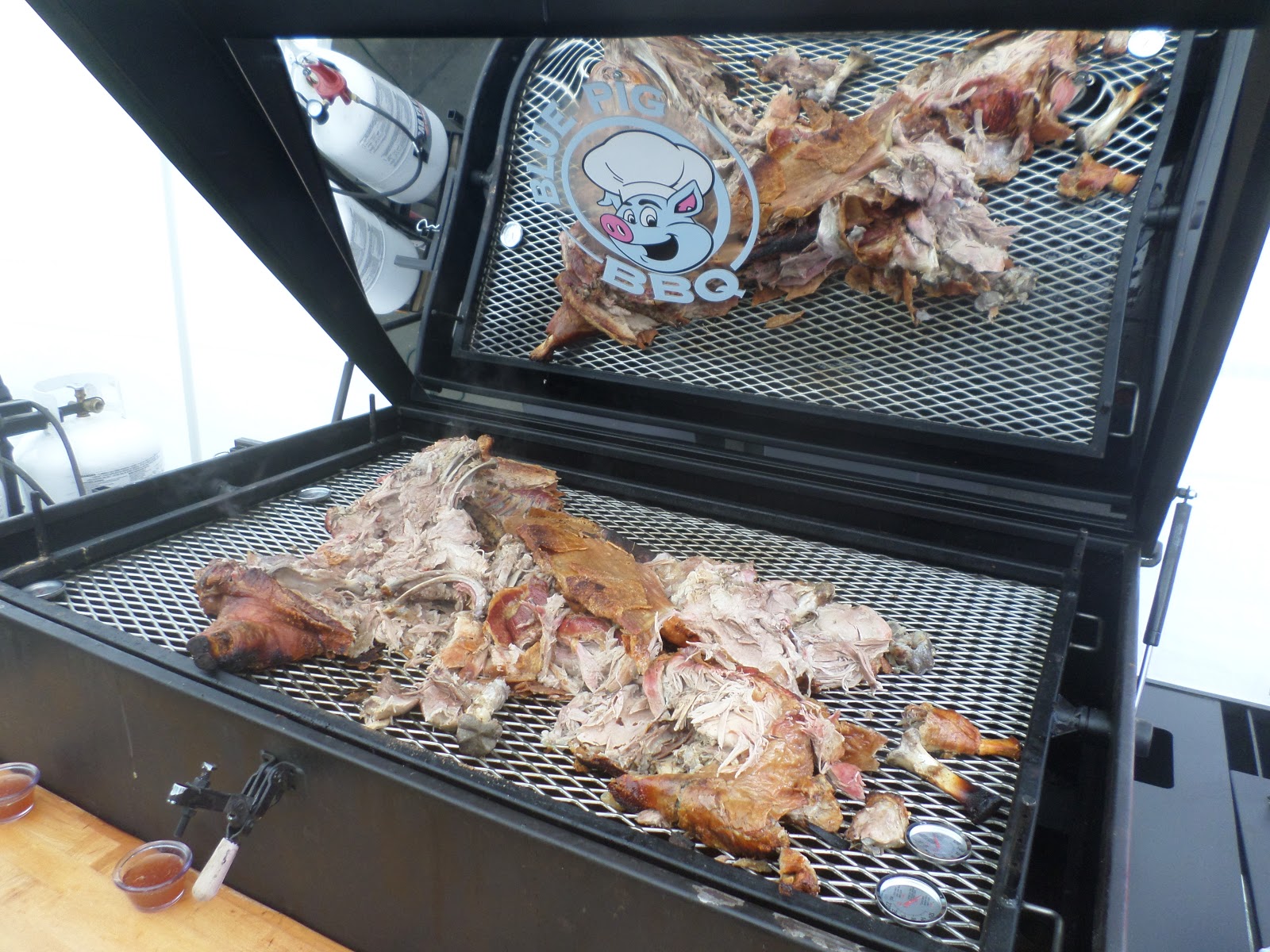
The pig cooked by Blue Pig BBQ, now in shambles after being judged, took home first-place honors.

With a whole hog cookoff now a major part of the festival, Homegrown in the Park is guaranteed to continue to grow and attract large crowds as its organizers and sponsors celebrate local agriculture.

Saturday, April 1, 2017

A New Cookoff to Start a Tradition

Duplin County in North Carolina is well known for its wines, history, museums, and festivals. After having its first whole hog cookoff that promises to be an annual tradition, the county -- big in square miles (ninth largest in the state) but small in population (58,000) -- will also be known for its competition-quality barbecue.

Showtime's Legit, the first team to be judged, awaits arrival of the judges.

The Duplin County Events Center, which hosts a variety of tourism and agricultural events, is the home to concerts, competitions, shows, tournaments, exhibitions, and other activities. The N.C. Muscadine Festival, which has been held annually each fall since 2005, was the first major event held at the center. To balance the schedule by holding a major event in the spring, a whole hog cookoff has been added. Although excellent barbecue is enticement enough to attract a sizable crowd, the organizers have also included bluegrass music and craft beer sampling. The event’s name says it all: Blue, Brew, and Cue Festival.

A pig looks perfectly prepared before the judges begin their inspection.

Because the organizers achieved sanctioning by the N.C. Pork Council for the festival, they were assured that the event would attract competitive cooks. Although the cooks want to earn bragging rights as finalists and win a festival trophy, they also want to qualify for the annual statewide championship held later in the year. When at least 10 cooks participate in a local contest sanctioned by the Pork Council, the finalists are eligible to advance and compete in the championship.

I check a temperature gauge as part of the evaluation.

For the inaugural cookoff, 20 competitors registered. Many cooks earned high scores – an indication of how competitive an inaugural contest can be. Although a few novices to the Whole Hog Barbecue Series were competing in a sanctioned event for the first time, several had been competitors in past years and achieved success in those contests. At least one competitor -- Roy Parker -- had won the annual Whole Hog Barbecue Championship (2006), and he clearly was confident. When I visited his site with the other judges for this festival, I thought the skin crispness -- one of the scoring criteria of a cookoff -- of his pig was excellent.

After judges walk away from a cooker, the pig is in shambles from the inspection.

The pigs were provided by Smithfield, a festival sponsor, to the cooks the evening before judging was conducted. Although they varied in weight from about 94 to 116 pounds, they were uniformly moist after having been cooked overnight, a phenomenal accomplishment for the cooks because contest rules prevent them from injecting the pigs or adding any sauce.

I enter the scores for one team before leaving its site.

For the contest, I teamed up with two long-term judges, Charlie Martin and Timmy Evans. Martin had been a judge at the Newport Pig Cookin’ Contest in 2016 and was one of the judges whom I shadowed as part of my certification by the Pork Council.

After the pigs are judged, meat from the cookers is brought in bins to festival volunteers who prepare for selling barbecue plates to the public.

For a first-time event, the Blue, Brew, and Cue Festival was well planned and organized. The combination of music, beer, and barbecue is a winner and should serve as a strong foundation for future cookoffs. Duplin County should soon be able to add excellent barbecue to its other tourism credentials – how appropriate for the county that has more hogs than any other in the United States. 

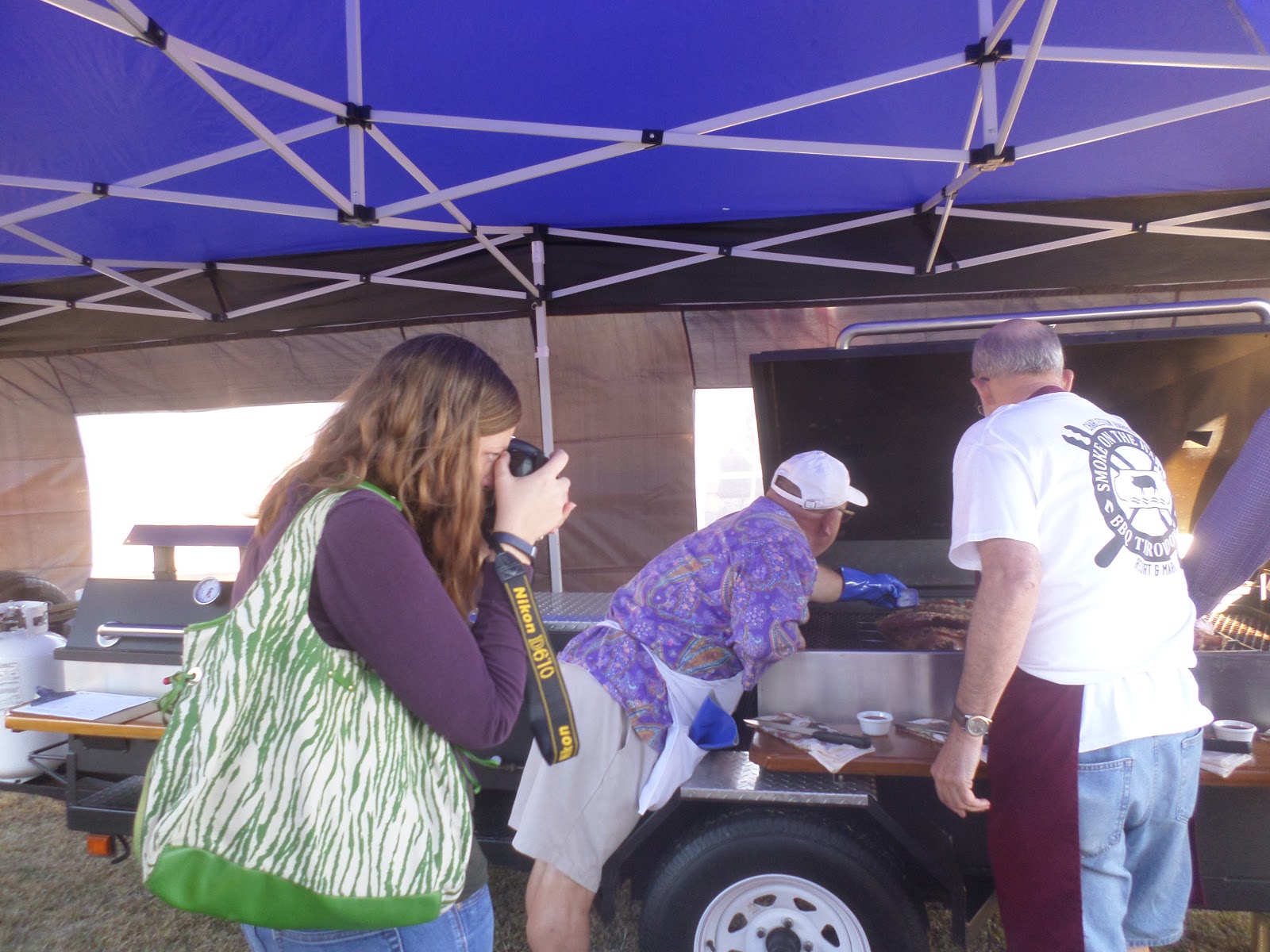
Photographer Katherine Clark takes pictures as I and the other judges evaluate a pig.

Note: During the judging process, I was followed by photographer Katherine Clark, who took pictures to accompany an article that I had written for OutreachNC magazine.

Monday, February 20, 2017

Curling Whiffs of White Smoke

As you approach the original Little Richard’s Lexington BBQ [now known as Real Q -- see note below] in Winston-Salem, NC, it’s easy to notice the curling whiffs of white smoke spiraling from the smokestacks. It’s a good sign. Barbecue is being cooked in the traditional manner – over hot wood coals.

Spiraling smoke tells you how Little Richard's cooks its pork shoulders.

Little Richard’s takes its name from founder Richard Berrier who got his start in the barbecue business when he was 13. It cooks pork shoulders – the Lexington style, hence the use of Lexington in its name – with hickory wood on an open pit for up to 10 hours. Then they’re hand-chopped as the restaurant’s dip (sauce) is added.

The parking lot fills quickly when Little Richard's opens.

When I arrived for lunch several minutes before noon on a Monday, the restaurant was busy. Only two tables were available. Glancing at the other tables, I saw that most customers had a BBQ tray (a cardboard boat loaded with chopped barbecue and slaw) or a BBQ sandwich. Even a small tray, which also comes with hushpuppies or a roll, was more than enough for lunch.

My tray was packed with adequate servings of slaw and barbecue.

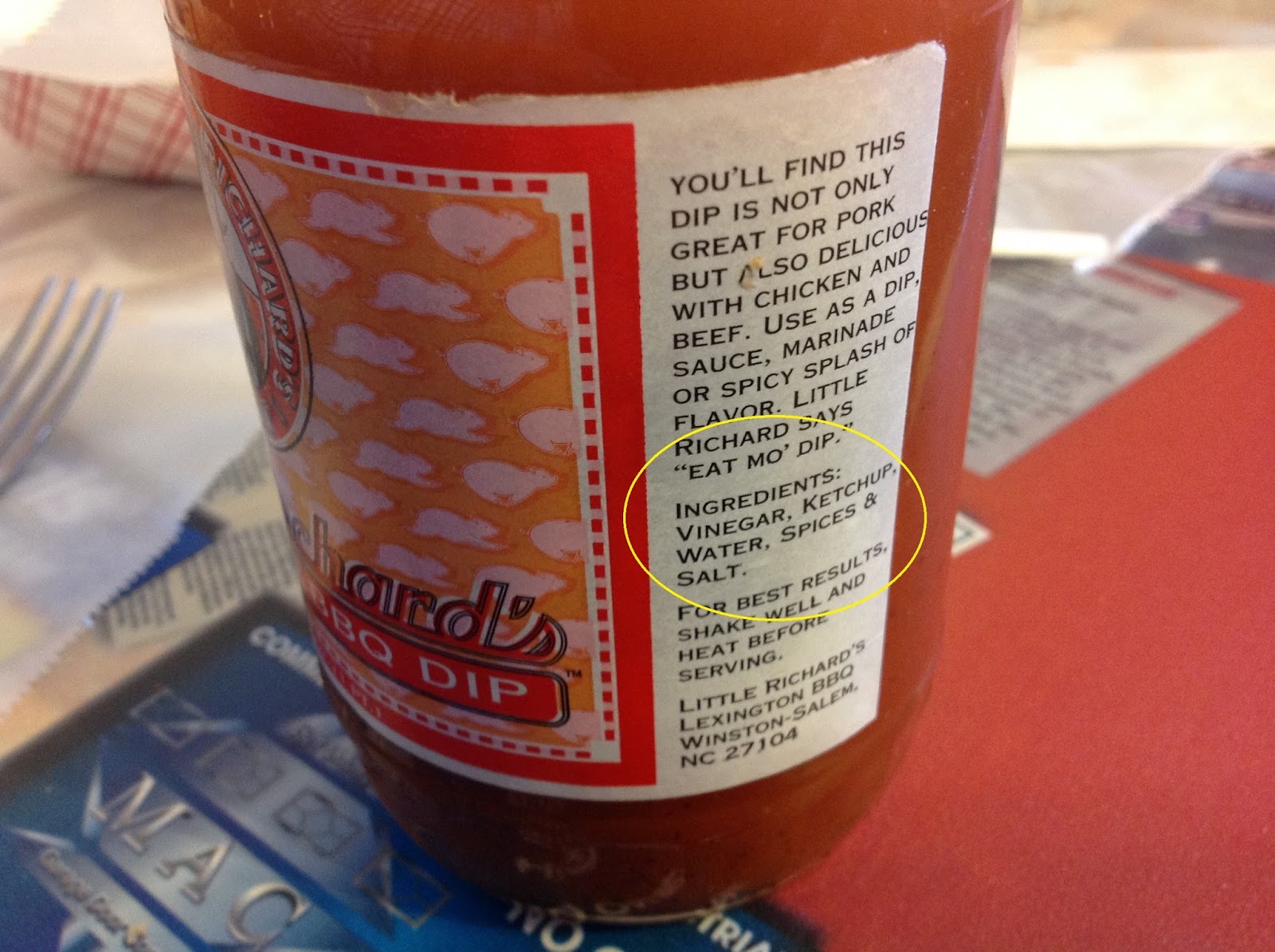
Although the chopped pork was moist and delicious without needing any extra sauce, I was captivated by the tangy flavor of Little Richard’s own house dip and kept adding more and more to my boat as I ate the barbecue. The dip, mixed every morning, is Little Richard’s select combination of vinegar, ketchup, water, spices, and salt. It is thin and vinegary with a consistency similar to sauces in eastern North Carolina.

The dip recipe is a secret, but the ingredients are listed on the bottles.

True to Lexington style, Little Richard’s offers a vinegary red slaw, which gets its characteristic color from ketchup, with its BBQ plates, trays, and sandwiches. The menu lists “slaw,” with no description -- the implicit understanding is that the mayonnaise-based coleslaw of eastern N.C. barbecue traditions isn’t available because it’s not Lexington style.

Soon after I arrived for lunch, every table was occupied.

The original location, a destination on the historic N.C. Barbecue Trail, opened more than 25 years ago (a second location is also available -- surprisingly and somewhat confusing, several other barbecue restaurants in the area are also named Little Richard’s but are not connected).

The wood pile in back is Little Richard's proof that it cooks its pork slowly over hot coals.

By serving delicious barbecue that is cooked slowly with hickory wood, Little Richard’s is easily achieving its goal of “Eat Mo’ Pig.”

"Eat Mo' Pig" is an appropriate motto.


Note: The name of the restaurant was changed to Real Q in early 2018 to distinguish it from other area restaurants with the name of Little Richard's that are operated by former partners of owner Richard Berrier.

Friday, February 17, 2017

Returning to a Classic in Lexington, NC


Soon after I moved back to North Carolina, a day trip to Lexington was high on my to-do list. The purpose, of course, was to enjoy barbecue at one of the city’s dozen classic establishments.

Plenty of wood is ready for slow cooking pork shoulders.

Of all cities in the state (and the South), Lexington is probably the one most closely identified with barbecue. Visit NC, managed by a state agency to promote tourism, recognizes the barbecue legacy of the city by featuring a “barbecue tour” of it < https://www.visitnc.com/trip-idea/lexington-barbecue-tour >, and its legendary barbecue festival attracts thousands of spectators each October.

A pig in the Pig in the City art initiative greets customers as they arrive.

Even the city’s official website pays homage to the city’s barbecue heritage < http://www.lexingtonnc.net/>, and many businesses participate in the Pigs in the City art initiative, which places life-size pigs painted and decorated artistically around the city.

A barbecue tray with slaw is served in a cardboat boat, typical for Lexington-style restaurants.

Because Lexington Barbecue Restaurant (sometimes called “Lexington #1” or “The Honey Monk” by the locals) was the first place where I ate barbecue in Lexington, it’s always a place to stop when I’m in the area as I was recently. Very little changes here. Although it has expanded from a small café to the large white building it now occupies, it has always served excellent pit-cooked barbecue since being opened in 1962 by Wayne Monk (hence, its alternate names of “The Monk” and “The Honey Monk”). Monk, who worked under the legendary Warner Stamey of Greensboro, was 26 when he built the first building and opened the business.

The white building is the current home, long ago replacing the small cafe built in 1962.

Located on appropriately named Smokehouse Lane, Lexington Barbecue cooks pork shoulders slowly and fresh daily over oak or hickory coals for about ten hours. The result is always superior barbecue – well worth the drive and the logical starting point for enjoying barbecue in the “barbecue capital.” USA Today has listed it in the top 10 best Southern barbecue spots, and Southern Living magazine has identified it as the favorite barbecue place of its readers in North Carolina.

The line of customers waiting for tables on a Friday night seems to never end.

Barbecue is served chopped, sliced, or coarse chopped. Plates, trays, and sandwiches come with “red” slaw, traditional for Lexington-style. Returning to Lexington Barbecue reminded me of my first visit – the simplicity of the restaurant; the friendliness of the wait staff; the authentic preservation of its style; and the excellent barbecue, slaw, and hushpuppies. No wonder that it continues to receive high praise and recognition even with all the other nearby barbecue restaurants.

A young fan declares Lexington Barbecue, also known as Honey Monk ("Hnemonk"), is the best. 

Saturday, January 28, 2017

A Third Contest in Lakeland, Florida

Going to Lakeland, Florida, for a third consecutive year to judge at a barbecue cookoff must mean that I think the location, contest, and competition are top-notch. They are. The Lakeland Pigfest is a superior event that attracts a huge number of cooking teams and an overflowing crowd at a scenic site.

The crowds show up in droves on both Friday and Saturday.

For the first time in its 21 years, the Pigfest was held away from its usual location, Joker Merchant Stadium, the winter home of the Detroit Tigers because it was being renovated. This year the event was held on the Sun ‘N’ Fun campus at Lakeland Linder Regional Airport. Although the scenic atmosphere of the stadium was missed, the temporary home has more space for cooking teams and vendors, and the huge crowd could move easily and enjoy the largest event in Florida sanctioned by the Kansas City Barbeque Society.

Musical groups play continuously on the main stage.

I again was assigned as a judge in the “pro” division, which means judging teams that are a cut above. The ribs were so superior that one judge commented, “These are as good as it gets. Each one is perfect.” The briskets that we judged were also excellent. With prize money of $20,000, the Pigfest always attracts outstanding teams.

Judges assemble in the hanger in advance of the first meat turn-in.

In the “pro” division, 60 teams competed. Another 57 participated in the less competitive division known as “backyard,” although this division does include many excellent teams. For such a huge field of teams, Pigfest organizers assembled 22 tables of certified judges (7 at each table). All judging was conducted in an enormous hangar, which seemed cavernous when we entered but soon seemed just right once the 150 judges and volunteers inside were engaged with their duties.

The turn-in table is ready to receive the first meat category, chicken.

Immediately before the “adult” contest, the Pigfest conducts a “Kids Q,” a competition to nurture an interest in preparing barbecue for kids in two age groups: 11 to 15, and 10 and under. The children are provided grills by the Pigfest and then are responsible for the preparation, cooking, and presentation of their entries, although a parent or guardian is present during their cooking process. Watching the young cooks parade in with their entries is one of the highlights of being a judge at the festival, and I enjoyed serving also as a judge for this contest.

Cooking teams are well prepared and stocked with wood.

Being at the Pigfest in 2017 was a rewarding experience and as much fun as the festivals in 2015 and 2016. Because the Pigfest has now generated more than $2 million in charitable donations for local charities, it’s a significant part of the spirit in the Lakeland community.

Cookers at the Pigfest literally come in all shapes and sizes.

Monday, January 16, 2017

Opening Day and a Dream Come True for a Pitmaster

Eating at a new restaurant on its opening day can be disappointing – what will go wrong, will the food be good? However, at the new barbecue restaurant of Jerry Stephenson Jr., being there on opening day was worth the drive – finding pulled pork and ribs that have garnered awards on a very competitive barbecue circuit.

The Redneck BBQ Lab is the dream come true for Jerry Stephenson Jr. after years of catering and competitive barbecue cooking.

Stephenson has achieved his fair share of fame as the pitmaster for Redneck Scientific, a competitive cooking team that has won repeatedly at cookoffs sponsored by Kansas City Barbeque Society. In five years, Stephenson’s team has won 16 grand championships, 6 reserve grand championships, and 6 perfect scores (of 180), a rare achievement. It has also placed in the top ten more than 250 times for the individual categories of chicken, pork, ribs, and briskets at these contests.

Trophies and awards won by Stephenson's cooking team on the competitive barbecue circuit are proudly displayed above the serving area.

Located in space previously occupied by a Dairy Queen in a building anchored by a gas station in McGee’s Crossroads, NC, just off I-40, Stephenson’s restaurant will soon be attracting barbecue fans traveling on the interstate as well as expanding his local followers developed during the past few years by his catering business. The new restaurant should also bring more barbecue fans into McGee’s Crossroads, where historic Stephenson’s BBQ has been in business for more than 50 years (and operated by a different Stephenson family – no relationship to Jerry).

Stephenson relaxes between conversations with customers on opening day.

When I arrived, a steady line of customers was waiting to place their orders – not bad for the first day. I recognized several customers -- barbecue judges and pitmasters -- from KCBS contests. “That’s the biggest compliment that I can receive,” Stephenson said when I asked him about how many KCBS members had come to opening day -- some as far away as the Charlotte area to the west and Jacksonville to the east (which made my 70-mile trip seem short).

Order a sandwich or take home a pound (or more).

For lunch, I ordered a pulled pork sandwich, which comes topped with slaw, but without sauce. On the tables is a vinegar sauce, traditional in eastern North Carolina, that seemed to be the choice of local customers. Also on the tables is a thicker, sweeter, tomato-based sauce that Stephenson uses at KCBS cookoffs and has been indispensable for his high contest scores and multiple awards. I alternated between the two as I ate the sandwich but clearly preferred Stephenson’s competition-style sauce.

A sandwich with perfectly cooked pulled pork piled high and topped with slaw makes the trip worthwhile.

For supper, I took home a half rack of ribs (with cornbread). As excellent as the pulled pork was, the ribs were even better. They were moist, tender, and perfectly prepared. When I ate them later that night, they reminded me of the best ribs found at KCBS cookoffs. In fact, I was glad that I was not judging at an event so that I could eat more than one rib. (At a contest, a judge receives only one rib from a cooking team and usually can take only two or three bites of the sample to have room to taste other entries – although ribs this good are saved and eaten, if not after the category has been judged, soon after the contest has ended.)

Ribs (with cornbread) taken home for supper were moist, tender, and perfectly prepared.

The restaurant doesn’t serve hushpuppies -- a minor disappointment, although I somewhat agree with the reason that Stephenson gave me: “We don’t need hushpuppies -- all you need is barbecue.” He also said, “Hushpuppies don’t go with collards -- cornbread does," and his cornbread is excellent. (Collards is one of the sides available daily on the menu.)

Although the draw to the restaurant is competition-winning barbecue, the restaurant offers several sides: collards baked beans, green beans, BBQ potatoes, jalapeno mac and cheese, and slaw.

For opening day, Stephenson told Raleigh food writer Andrea Weigl that he would be smoking 450 pounds of meat. In addition to pulled pork and ribs, the restaurant also serves chicken and brisket (although it had sold out of the brisket when I arrived). After I got my takeout order, ribs were also sold out, at least for a few hours until more could be prepared.

On the wall is Stephenson's definition of "redneck," which names his restaurant and cooking team.

Stephenson is living a pitmaster’s dream -- opening his own restaurant and having a dedicated group of followers show up on opening day. It’s a dream that will continue to make many customers very happy.

Fair warning: Don't show up too late or the "sold out" sign might be on.


Saturday, November 12, 2016

A New Experience in Mount Pleasant, NC

Town leaders of Mount Pleasant combine
a pig cookoff with a fall festival.
A barbecue cookoff has high expectations – for the cooks, judges, organizers, and public. Each year that an event is held, everyone expects it to be better than the last one. Because an inaugural event can’t build on past experiences, a first-time event is sometimes entered with apprehension – about what will go right and what will go wrong.

The Town of Mount Pleasant, NC, joined the barbecue circuit when it held its first Polar Pig Cookoff, appropriately named for an event near the end of the year. For the inaugural event, 25 teams completed in the pro competition and another eight in the backyard category. The town plans to make the event annual because, as the Mayor Del Eudy says, “there’s a lot of cookers here.”

At an inaugural event, popuptents of novice cooks set up next to plush trailers and campers of experienced teams.

An event that is the first one of a hoped-for continuation often produces surprisingly good results as happened in Mount Pleasant because organizers are so determined to be successful. The barbecue entries that I judged were just as competitive as those turned in at established cookoffs. Although many judges were from the region, others had traveled a long distance, such as from Ohio, to participate in this inaugural event.

Some teams set up on the infield of the ball field of town park at Mount Pleasant.

An important part of a fall event is weather, which was perfect for the inaugural Polar Pig Cookoff. Although “polar” is part of the cookoff’s name, the area was far removed from any polar conditions. The balmy fall weather benefited the cooking teams and also enticed local residents to check out the festival and enjoy live music, craft vendors, and children activities.

Very creative trophies await the winners.

Even though the cookoff was Mount Pleasant’s first, it attracted more than the usual number of cooking teams for an inaugural event, which guaranteed its success for this year and also projects even better success in the future. For a small town of only 1,700 residents, Mount Pleasant can be proud of its inaugural cookoff