Saturday, September 10, 2016

Finding the Best Barbecue in Jacksonville, NC

It’s easy to find the best barbecue cooked whole hog style in Jacksonville, NC. All you have to do is head for the Onslow County Shrine Club when it is having its annual pig cookin’.

The sign by the highway that draws attention to the cookoff is only yards away from the Shrine Club where the cooks set up.

The Shrine Club attracts some of the best cooks in North Carolina who are competing for the right to advance to the state championship sponsored by the N.C. Pork Council. The top three cooks at the Onslow County event are eligible to participate in the Whole Hog Barbecue Championship, which this year will be held in Raleigh during Wide Open Bluegrass, the largest urban bluegrass festival in the world.

Sometimes a fan is needed to control the cooking temperature.

I was pleased to be one of the three judges for the Onslow County event and worked with two seasoned pros, both from Newport, NC: Jim Bristle and Bobby Prescott, who not only judge but also complete as cooks. Each has been a finalist in a regional event and competed in the state championship cookoff, which Prescott himself won in 1989 and 1996.

Judges begin their evaluation of the first of 15 cooked pigs.

The pigs that the Shrine Club provided the cooks weighed an average of 125 pounds with the biggest one weighing 131. Of the 15 cooks who entered the Onslow County contest, 12 had participated in previous years and were seasoned competitors well prepared to win. The three cooks new to the contest were very successful, even without more competition experience.

The judges turn a pig over to evaluate both sides.

The NCPC criteria for judging each pig include appearance, brownness, skin crispness, moisture, and meat/sauce taste. In addition, the cook’s site is evaluated for completeness. The winning pig depends on the skills of the cook, who is prohibited by the rules from using any sauce or injecting the pig to improve moisture. Because judging begins at 8 a.m. on Saturday, the cooks set up the day before and begin their cooking so that their pigs are ready for evaluation when the judges arrive at their sites the next morning.

After the evaluation by the judges, the once perfectly intact pig is in pieces.

The top three cooks were David Grandy (1st), Kevin Peterson (2nd), and Roy Parker (3rd). Earlier this year Parker had placed first in the Johnston County Pig Cooking Contest in Smithfield and the Kickin’ It Country Whole Hog Cookoff in Raleigh, both in May, as well as first in the Gen. William C. Lee Celebration in Dunn in June.

Scoring sheets are filled out before moving to the next cooking site.
After the judges have completed the scoring, the cooks turn in chopped barbecue to the contest organizers who sell it to the public beginning at 11 a.m. Patrick McGirl of the Shrine Club estimates that about 350 plates are sold (at $7 a plate), and additional barbecue is sold in bulk quantities later in the day.


Judges evaluate the pig cooked by Roy Parker (left is Jim Bristle and right is Bobby Prescott).

The pig cookin’ in 2016 was the ninth annual contest conducted by the Onslow County Shrine Club. Because it limits the contest to 15 cooks, they are forewarned to register early next year for bragging rights and the opportunity to advance to the Whole Hog Barbecue Championship. Next year the Shrine Club’s tenth annual contest will again be the place to find the best barbecue in Jacksonville.

After the pigs are judged, the cooks
prepare chopped barbecue for the Shrine Club.
The winning cook
takes home an
impressive trophy.

Saturday, August 27, 2016

Legacy of Lexington Style

Old-fashioned at Stamey's means Lexington style.
When people want traditional “Lexington style” barbecue of North Carolina, they often travel not to Lexington but to Greensboro. The Gate City is the home of Stamey’s, which traces its roots to 1930 and was founded by the legendary C. Warner Stamey, who taught the Lexington style to other early pitmasters.

Stamey himself learned in Lexington how to make pit cooked barbecue from early entrepreneurs Jess Swicegood and Sid Weaver when he was a high school student there in the 1920s. After moving back to his hometown of Shelby, he made and sold barbecue before returning to Lexington in 1938 when he bought Swicegood’s business. He renamed it Stamey’s where he continued to develop his reputation as a barbecue pitmaster and promoter.

A photo of the founder watches over the entrance that includes several vintage photos of the business and a waiting bench.


Greensboro has two Stamey’s locations, the second one opening in the 1970s. The original one, which I visited, was opened by Stamey in 1953 as a drive-in after he had moved from Lexington. Across the street from the Greensboro Coliseum, it was replaced with a new structure in 1979 and has been operated continuously by a member of the Stamey family, currently Chip Stamey (grandson of the founder).

Tables in the dining area turn over frequently because orders are taken and served promptly.

Adhering to the style promoted by the founder long ago, the pitmasters still cook only pork shoulders and only over hardwood coals. Although Stamey’s claims a “secret” sauce, the secret is not well kept because it has provided the recipe – equal amounts of ketchup and apple cider vinegar with sugar, salt, black and red pepper -- to the Cooking Channel. Ketchup in the sauce keeps Stamey’s true to the Lexington style and separates it from the style of eastern N.C. where the sauce has no tomato (and whole hogs rather than only shoulders are cooked).

Lexington style is barbecue (using only pork shoulders) with hushpuppies and red slaw.

The chopped barbecue that I ordered came from the kitchen already adequately sauced, so I added no more at the table. The plate included red slaw (coleslaw made with Stamey’s sauce, not mayonnaise) and crisp hushpuppies (reportedly popularized as a side on barbecue plates when Stamey began serving them decades ago after seeing them served at local fish restaurants). The Brunswick stew that I also ordered was a colorful complement to the red slaw.

Brunswick stew comes with the requisite amounts of vegetables.

Credited with spreading “Lexington style” in the western half of North Carolina, Stamey nurtured several protégés such as Alston Bridges, Red Bridges, John Stogner, Doug Gosnell, and Wayne Monk. Even though I’ve been to Lexington and also eaten “Lexington style” in other cities such as Winston-Salem and Shelby, I felt closer to the tradition by being in Stamey’s and at its first location in Greensboro. The way the servers greet customers and take orders shows they know that they are preserving a legacy.

The carry-out counter stays busy throughout the day.


Tuesday, August 23, 2016

Morphing from a Dairy Center

The Barbecue Center was
once the Dairy Bar.
No trip near, through, or to Lexington, NC, is complete without a stop at one of its legendary barbecue establishments -- with more than 20 places to choose from. In the city that boasts the opening of its first one in 1919, the lineage of pitmasters is very royal.

The Lexington style of barbecue is so well known: pork shoulders cooked slowly over hardwood coals. It is always served with red slaw (coleslaw made with ketchup rather than the traditional mayonnaise base). The meat is usually served chopped, although sliced can be requested, and with a sauce seasoned with vinegar, ketchup, pepper, and other spices.

The wood outside tells you that slow cooking over hardwood coals is still the tradition.

For my most recent foray into Lexington, the destination was the Barbecue Center, which is the oldest barbecue restaurant in Lexington that still cooks on pits. It had its early beginnings as the Dairy Center and was known for its ice cream and banana splits, which seems an unlikely beginning for a legendary barbecue restaurant in Lexington. Barbecue now brings in the customers, but the signature dessert is still a humongous banana split.

The counter, originally in the Dairy Center, was moved to the Barbecue Center's new location when it opened in 1961.

Barbecue was added to the menu to improve business for the Dairy Center in the winter months. Doug Gosnell, who took over the restaurant in 1955, learned how to make pit-cooked barbecue, Lexington-style from the legendary C. Warner Stamey, who trained many other early pitmasters in the Piedmont area of North Carolina.

The dining area of the Barbecue Center is busy throughout the day.

The tray of barbecue that I ordered arrived just as expected: packed with chopped pork and red slaw. They and the hushpuppies were excellent. Rather than end the meal with the mountainous banana split, which reportedly weighs more than three pounds (a table of four usually shares one banana split), I settled for the much smaller and almost as famous banana pudding. 

A tray of barbecue (chopped, course chopped, or sliced) comes with red slaw.

Being able to trace its roots to Stamey places the Barbecue Center at the beginning of Lexington style. By continuing to make excellent barbecue and sides, it has a secure place in preserving Lexington traditions for a long time to come.

Banana splits are still
made at the counter.
Banana pudding is almost as famous as the banana split.


Saturday, August 6, 2016

Pigs and Pedals Revisted

Returning to Asheboro, NC, to judge has been a priority since 2014 when I participated in the inaugural Pigs and Pedals cookoff. Because family obligations prevented me from attending in 2015, I was interested this year in seeing how the event had changed since its inception.

In its first year, the cookoff was well planned, organized and executed. For 2016, Pigs and Pedals was again a superior experience. A few changes had been made since the initial cookoff. Judging is now conducted in The Exchange, an attractive event space in the middle of the downtown area and very convenient to the cooking teams. The number of cooking teams also increased to the maximum that the event space can accommodate: 47.

The Smokehouse Mafia, last year's Grand Champion, sets up early.

The surprise for me was an assignment as table captain, which meant that I would not be judging and evaluating barbecue entries. It was my first time as a table captain although I had been certified early last year and had volunteered at other events. The primary duties are to assist the contest representatives of Kansas City Barbeque Society by coordinating activities at a judging table (there were eight this year), serving the judges and collecting their evaluations.

Piggy cupcakes made by a local bakery greet judges as the arrive in The Exchange.

The six judges at the table where I was assigned had a wide range of experience. Three were master judges (more than 30 contests), one was participating for only his third event, and one was recently certified and judging for the first time. Contest organizers attempt to include new judges at events and place them at tables where they can learn from experienced judges.

The Exchange, an event location, is now the venue for all judging activities.

Although I prefer to judge, I willingly had volunteered to assist as a table captain when I registered. I will continue to volunteer in more than only the capacity of judge, although the rewards of being a judge and evaluating barbecue entries are clearly the motivation for judges to participate and spend the time required to drive and attend.

Pigs and Pedals remains one of my favorite barbecue contests and I hope to attend future cookoffs – as a judge or in another capacity.

Saturday, June 18, 2016

Cooking with a Team

The thrill for some barbecue fans is being a judge at a cookoff. For others, it’s taking on the challenging work of a cooking team. Sometimes the interests combine, and a cook wants to be certified as a judge, or a judge joins a cooking team to experience a cookoff from a different perspective.

Amanda Reed, her husband Jim, and best friend Kendra Battasta (left to right) show me the cookoff from a team's perspective.

In Apex, NC at the Peak City Pig Fest, I had the opportunity to join Coastal Smoke, a team from Wilmington, NC. It has competed at events sanctioned by the Kansas City Barbeque Society for about three years and successfully competed even earlier at community cookoffs.

Amanda and Kendra continue setup activities by placing a cooker in position.

Last year at the Smoke on the Harbor BBQ Throwdown in Mount Pleasant, SC, I met Amanda Reed, the head cook for Coastal Smoke. When I asked if I could join her team at an event in 2016, she was more than gracious and agreed that I could join her at the Pig Fest. Cooking with a team is a KCBS requirement for certification as a master judge, which I hope to gain when I have completed other requirements.

Amanda injects a pork butt with a solution of apple juice and vinegar.

For the Pig Fest, Amanda arrived about noon to set up and begin preparations. Because I wanted to see the cooking team in action from start to finish, I also arrived at noon. I was amazed at the constant motion of the team on the first day. So many steps – setup, meat inspection, cooks’ meeting, meat preparations -- have to be completed early to be ready for the quick pace of simultaneous actions on Saturday.

Pork butts are checked on a cooker.

After spending nine hours on site on Friday, I left for the evening (and a comfortable, uninterrupted sleep). Amanda with her husband Jimmy and best friend Kendra Baratta continued with other activities that shortened their sleep considerably. (Although I briefly thought about staying with them, I long ago gave up “all nighters” and don’t get up in the middle of the night for anything.) 

Kendra watches as Amanda puts chicken pieces on a cooker.

Amanda, on the other hand, slept very little. Around 3 a.m., she started the fire so that the charcoals would be ready to smoke and provide residual heat when she placed the meats on the cookers. The brisket and two of four pork butts went on the cookers at 5 a.m. At 7 a.m., the other two pork butts were placed on the cookers. These two would provide the “money muscle” (a small strip of loin meat opposite the blade bone side that is very tender) for the pork entry.

After slow cooking for several hours, the ribs are sliced for the turn-in box.

On Saturday I returned to the team site just before 8 a.m. (I could tell that Amanda and the others hadn’t enjoyed much sleep.) I watched most of the preparations for the two remaining meat categories: ribs and chicken. The ribs went on the cooker at 8 a.m. and finally the chicken at 10 a.m.

The chicken looks so good as it is arranged in the turn-in box.

So that the meats would be ready at the contest turn-in times (beginning at noon for chicken and continuing to 1:30 p.m. for brisket, the last one), each was prepared in advance – liquid injections, sauces, rubs. For example, the pork butts were injected with a solution of 3 parts apple juice and 1 part vinegar with a little sugar and salt. Even before arriving at the contest site, Amanda had prepped the chicken pieces by removing the bones, some skin and fat.

Kendra turns in chicken, the first entry, exactly at noon to Doug Reid, the KCBS rep.

When the turn-in times arrived, I was surprised how calm the team was. Everything was going just like clockwork. Kendra was the “runner” and took each entry for turn-in at the designated time after Amanda had completed the final stages. Before a turn-in was ready, she had picked the best pieces, cuts, or slices from everything that had been cooked, which was three or four times what was needed for turn-in. For example, to select at least 6 pieces of chicken for the entry, 19 had been cooked.

Rib are perfectly placed in the turn-in box for a high appearance score.

When the last entry was turned in, there was a brief sigh of relief before starting the final actions: cleaning and packing for the journey home – and waiting (more than 3 hours) for the awards ceremony. The results were bittersweet. The scores for chicken, ribs, and brisket were lower than hoped for, but Coastal Smoke placed among the top 10 teams in the pork category (even at turn-in, we thought that the pork was the best of the four entries submitted).

The pork entry, with money muscle lining the center, is ready for turn-in.

Looking back on the weekend activities, I have much more appreciation for a cooking team. The investment of time, money, and effort is substantial. Few people, particularly the public that arrives mid-day on Saturday, realize the amount of work involved. For me, the weekend was great. Because I had judged at the Peak City Pig Fest last year, seeing the event from the perspective of a cooking team was rewarding. If I ever spend time with a cooking team again, I can only hope that they are as congenial as Coastal Smoke


Note: To see an album with more pictures of my cooking experience with Coastal Smoke, click here.

Saturday, June 4, 2016

In Asheville for National Tour

More than 700 barbecue teams are competing again this year for $500,000 in cash and prizes in the Sam’s Club National Tour. The tour attracts some of the top cooking teams in the country, and being a judge is rewarding because the barbecue is so superior.

This year I was a judge in an initial qualifying event in Asheville, NC. At these events, thirty teams compete for the right to advance to a regional qualifying event where the top finishers are invited to the national event in October in Bentonville, Arkansas, where the grand champion takes home $50,000.

A table for demonstrations is set up beside The Sam's Club National BBQ Tour truck.

The tour started this year in February in Daphe, Alabama. Events continue almost every weekend until mid-September when the last regional event is held in Madison, Wisconsin. Michael McDearman, tour director, whom I met last year in North Charleston, SC, is one busy person as he travels to each site and organizes the events.

Michael McDearman, tour director, welcomes judges to the event in Asheville, NC.

At the judges’ meeting, McDearman emphasized how important the series is for promoting barbecue and encouraging teams to compete. The event in Asheville like the other local qualifying events had $10,000 in prize money. Smoking Butt Heads, the grand champion, won $2,000 and advanced to the regional qualifying event with the five other top teams. Although the prize money awarded in Asheville is important, the right to advance in the series is the best reward.

Cooking teams set up in the parking area of Sam's Club in Asheville.

Being a judge at a tour event was just as enjoyable as it was last year, and I hope to participate again next year. Evaluating teams that compete on the tour is a high point of participating as a judge.

Friday, June 3, 2016

Worthy of a Presidential Visit

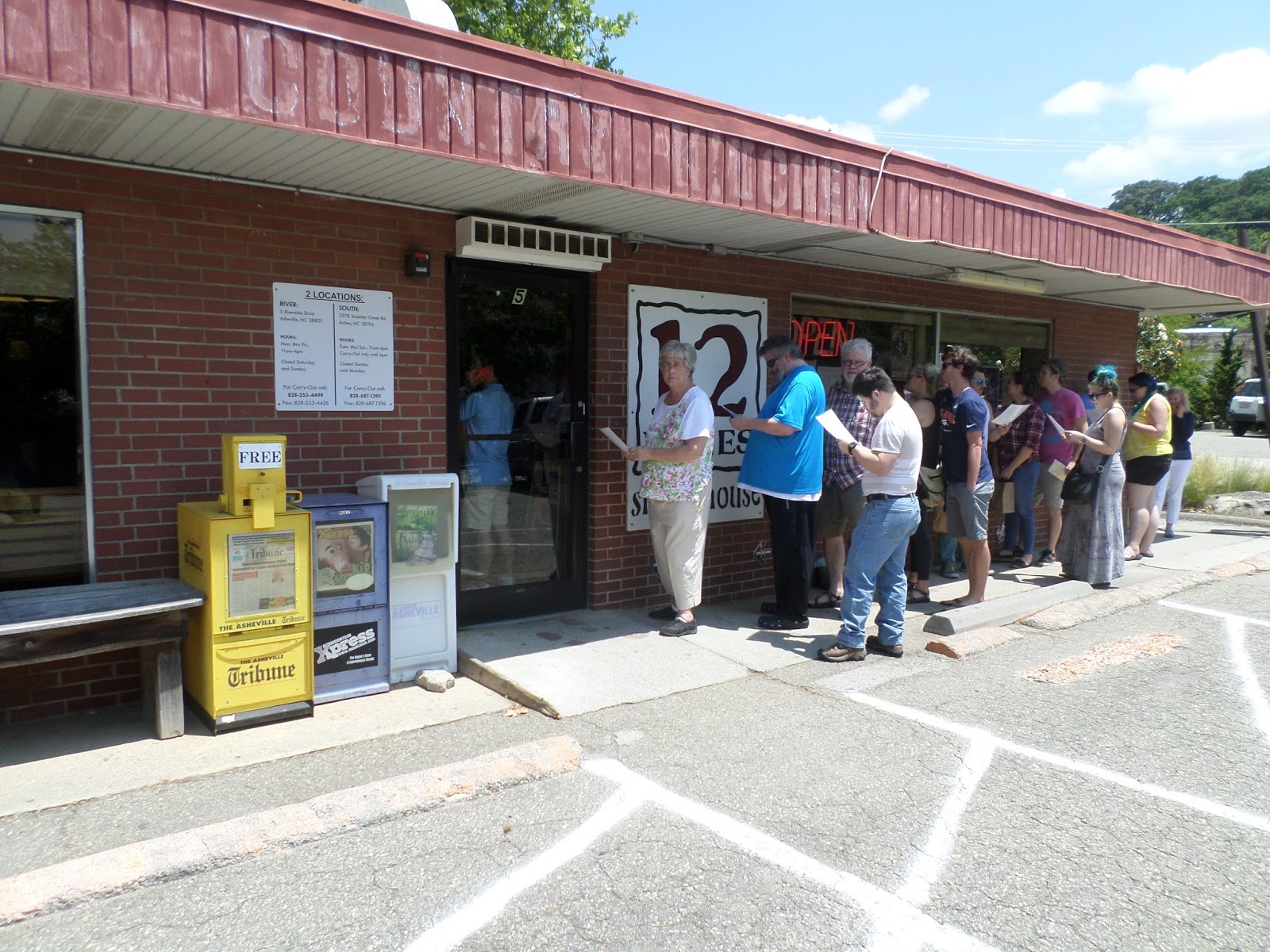
Few barbecue establishments can boast that a president of the United States while serving in office has visited them — with all the entourage required for security. In Asheville, NC, 12 Bones has gained media attention for repeat visits by President Obama as well as the long line of local carnivores that stretches out of its building into the parking lot.

The line at 12 Bones frequently stretches into the parking lot.
Before visiting 12 Bones, I had learned more about its popularity and food by watching a segment of the Bookwatch TV program broadcast by WUNC-TV. Head chef Shane Heavner and co-owner Brian King discussed the restaurant and their recipes in an interview about their recently published cookbook. As the 12 Bones owners and chef brag in the cookbook, Obama stopped there each time that he was in Asheville while in office, and he made an initial visit in 2008 when as a U.S. senator he was campaigning for president.

Ribs, the most frequent order, are heated before being served.

For the initial visit, take-out was ordered for Obama and his campaign staff, and it included ribs, brisket, and pulled pork with a double order of collards. For the next visit in 2010, Obama insisted going unannounced and standing in line to order. He and his wife ate in the restaurant to the fanfare of national and local media. Ribs with sides of baked beans, greens, and mac and cheese were ordered this time. A third visit in 2013 was similarly a media event that further enhanced the reputation of 12 Bones.

My order of ribs with corn pudding, mac and cheese, and cornbread was served very quickly.

Although a place of presidential proportions, 12 Bones is definitely a casual restaurant. Rolls of paper towels on the tables serve as napkins. Food is ordered at the central counter and then brought out by the staff after customers have picked their tables. A few orders are takeout, but most customers enjoy their lunch in the restaurant and in good weather pick a table in the outside, covered eating area.

The outside eating area is popular in good weather.

Because its popularity continues to increase, 12 Bones has opened a second location in the Asheville area, but many travelers, myself included, seek out the original location. It was opened in 2005 and brought to life a one-story brick building in the River Arts District that had been known as Kountry Kitchen. However, city planners are threatening to take the land that it occupies to relocate a road and build a roundabout. The current owners (Bryan and Angela King), who bought 12 Bones in 2013, are determined to keep the restaurant in the River Arts District if it has to be relocated.

Rib flavors are announced on a board at the order location.

Taking a cue from Obama and his preference for ribs, I knew before arriving that I had to try them (skipping brisket, pulled pork, chicken, and turkey – all smoked – that are on the menu and also deserving of consideration). The next choices were the sides: corn pudding, collard greens, mac and cheese, and mashed sweet potato. Everything at 12 Bones is made from scratch, and the recipes for each are in the restaurant’s cookbook.

Watching the crowd at 12 Bones is almost as enjoyable as eating the ribs. Although it’s hard to imagine that a president ate here, it’s easy to understand why he returned for encore visits.