Monday, January 25, 2016

Finding and Appreciating Jim ‘N Nick’s

The sign by the road says it all.

Have you been traveling down a highway when you saw a sign for a restaurant and thought, “That’s a place I’ve been wanting to visit”? As I was driving through the panhandle of Florida on U.S 98 heading west into Destin, the neon sign for Jim ‘N Nick’s Bar-B-Q caught my attention.

On arrival you are greeted with a basket of mni cheese biscuits, a specialty of Jim 'N Nick's, which also sell the mix in bags.

Jim ‘N Nick’s serves barbecue I’ve wanted to taste since I first learned about it from Southern Foodways Alliance, an organization that documents, studies, and celebrates the food cultures of the American South. As I have attended SFA events, I’ve noticed that Jim ‘N Nick’s is one of the dedicated SFA corporate donors and actively promotes SFA’s events, programs, and workshops.

Riblets, a small plate or appetizer to share, are bite-sized pieces of smoked ribs.

Jim ‘N Nick’s, a casual chain that features slow-cooked barbecue, began in Birmingham, Alabama, where the late Jim Pihakis with his son Nick opened the first restaurant in 1985. Nick learned how to smoke meat slowly over wood coals by apprenticing under Phillip Audrey, pitmaster of Ollie’s Bar-B-Q in Birmingham. Jim ‘N Nick’s has grown to 34 locations in seven states. Almost half are in the state of Alabama, and four are as far away from my home as Denver.

A pulled-pork sandwich comes with two sides -- collards and beans were my choices.

The food definitely doesn’t taste like it was prepared by a chain, perhaps because its network of local producers provides pastured-raised heritage breed pork and each restaurant is locally owned and operated. Jim ‘N Nick’s says, “All BBQ has the same three basic ingredients: smoke, meat, and time,” and it combines all three superbly. It refers to its classic pulled pork sandwich as “pig on a bun,” which John T. Edge, SFA director, calls “the ideal pulled-pork sandwich, the workaday sustenance of all BBQ aficionados.”

John T. Edge's observation is highlighted in the menu.

With such a lofty portrayal, I couldn’t order anything else. With a pulled pork sandwich, I ordered slow-cooked collards and baked beans. To accompany a sandwich or plate, Jim ‘N Nick’s offers several favorite sides, or “scratch-made trimmings.” Also on the menu are mac & cheese, coleslaw, potato (mashed, chips, fried, or baked), fresh fruit, and house or potato salad. Even with several cheese biscuits, I saved room -- a challenge -- to finish with banana pudding.

Banana pudding is always on the menu as a dessert.

Everything brought to the table was superior. It’s hard to pick a favorite, although the cheese biscuits are a great way to begin a meal and the riblets that my wife ordered were perfectly prepared. Although I generally don’t consider a chain to be topic for this blog, Jim ‘N Nick’s is definitely an exception that deserves praise and a place that I would visit when I’m in one of its locations again.


Saturday, November 14, 2015

Smoke on the Harbor Again

Being a judge at the Smoke on the Harbor BBQ Throwdown in Mount Pleasant, SC, for the third year in a row was just as enjoyable as being at my first two events there. The contest is superbly organized, and its location attracts a great crowd in the Charleston area.

Smoke on the Harbor has become a premier event for the Charleston, SC, area.

Hosted by the Charleston Harbor Resort & Marina, the throwdown takes place at the scenic Lookout Pavilion on Patriots Point across Cooper River from historic downtown Charleston. At the pavilion, a virtual village is created with the cooking teams, vendors, and displays. The village comes complete with even a kid drop-off zone that lets parents enjoy food, music and drink while someone else watches their children.

The kid zone was popular with parents.

Unusual for a barbecue cookoff is the cocktail competition that is part of the throwdown – the barbecue scene continues to change with a younger generation that wants to enjoy more than simply smoked meat. George Dickel Tennessee Whiskey is a sponsor of the throwdown, and its presence is very prominent.

A member of the Coastal Smoke team prepares garnish for its entries.

The throwdown also raises awareness of hunger in the area and includes a food drive that benefits the East Cooper Meals on Wheels. A donation of five canned goods cuts the admission price of $10 in half.

The cooking team Fire and Smoke Shak sets up early.

After conducting the inaugural event in 2012, the organizers have sought KCBS sanctioning, which significantly raises the competitive level of the cooking teams. Because I’ve been a judge at each of the subsequent events that have been sanctioned, I’ve observed how important sanctioning is to the throwdown’s success. At the opening meeting of the judges with the KCBS contest representative before the competition begins, the organizers specifically mention the value of sanctioning.

Judges (including Joyce Gardner, judge coordinator of the Hog Happnin' event
in Shelby, NC) take their seats to be ready for the first entries.

Cooking teams are looking for the slightest advantage to leave as winners. For the 2015 event, 28 teams competed for the total prize purse of $6,150. In addition, an official proclamation by the South Carolina governor declares that the cooking teams are vying for the winning designation as a S.C. State Barbecue Champion.

A remote-control hog entertained several spectators during the afternoon.

Returning to the throwdown in Mount Pleasant again was like visiting a favorite place. It’s a great venue, and I hope to return for a fourth time next year.

Saturday, November 7, 2015

Shelby, a Legendary Place for Barbecue

Shelby, NC, is where many people go for great barbecue. As the home of Red Bridges’ Barbecue Lodge as well as the annual Hog Happnin’ cookoff, Shelby has been on the “barbecue map” for a long time.

One of the prominent destinations on the North Carolina Barbecue Trail, Red Bridges’ has contributed to N.C. barbecue lore and brought many visitors to Shelby, a small city in western North Carolina between Charlotte and Asheville. They come to taste barbecue prepared by third-generation family members who learned their craft from the original Bridges, who himself learned the art of cooking pork shoulders slowly over wood coals from legendary Warner Stamey of Greensboro. Similarly, the Hog Happnin’ entices visitors to Shelby with its fine reputation as a competitive barbecue event since it began 24 years ago.

Hog Happnin' is held at the Cleveland County (NC) Fairgrounds.

After visiting Red Bridges’ earlier this year, I wanted to be a judge for the Hog Happnin’ to experience how it contributed to the barbecue culture of Shelby, the county seat of Cleveland County. A large crowd at Hog Happnin’ is typical because the weather during the first weekend in November is almost always perfect. Only once before (in 2014) had it rained during the event – and the second time was this year. Although the rain dampened the crowd turnout, it didn’t diminish the spirits of the cooking teams.

Rain chilled but didn't diminish the enthusiasm of the cooking teams.

This year Hog Happnin’ attracted 61 teams – some from as far away as California, Rhode Island, Massachusetts and Florida that sought to advance in the overall points tournament held nationwide by KCBS, and they came to Shelby to hold their places in the points race. Teams were also attracted by cash prizes that total $15,000, in addition to the prospects of advancing in the Old North State Barbecue Series. Hog Happnin’ is one of five KCBS-sanctioned events in the series held throughout North Carolina to determine the Old North State Champion (other events are held in Kings Mountain, Lexington, Kannapolis and Salisbury).

Several out-of-state teams, such as this one from Rhode Island, traveled a long distance to compete.

The contest has been superbly organized since it began. Jerry Gardner, whose KCBS membership number of 461 indicates that he is an early member of the Society, served as the event director for its first 17 years. Now as the BBQ competition director, he focuses more specifically on cooking teams, judges, and other competition details.

Although the typical gate fee of $5 was waived, rainy weather reduced the size of the crowd.

I had met Gardner in April at Bib’s Camel City Cookoff (we were seated at the same judges table) and learned about his long involvement and leadership of Hog Happnin’. Gardner also mentioned that registration for judges was timed to open online on June 1. Early that day I completed the application but didn’t receive notification until mid-September that I had been selected as a judge (from his wife Joyce, also a certified judge, who is the judge coordinator). With such a large number of cooking teams, the organizers fielded 12 tables of judges.

Judges relax in the fairgrounds exhibition hall before the turn-in of entries begins.

Since its beginnings, proceeds from the Hog Happnin’ have benefited the local charities. Among its recipients is the Children’s Homes of Cleveland County. According to Gardner, the event has raised more than $300,000 over the last 13 years for the Homes. Before the judging began, Margie Christopher of Children’s Homes spoke to the judges about how important Hog Happnin’ is for providing necessary funds for its annual operations.

Winner of the Grand Championship was Smokin' Mo's, a team from California.

Although being a judge is a reward in itself, an added benefit at Hog Happnin’ is that judges are treated to homemade ice cream after all entries have been judged. Made by David Lail of Frostbite Ridge Farm, it was the perfect end to the competition.

Homemade ice cream is a great way to finish an afternoon of BBQ judging.

Shelby is a logical location to conduct a barbecue cooking competition. Hog Happnin’ has deservedly earned its place in the statewide culture for promoting and enjoying barbecue and in the community for contributing to worthwhile causes.

Saturday, October 10, 2015

The Real Squeal in Georgia

The Real Squeal is a BBQ and music festival with activities for all ages.
Where can you find a mechanical pig to ride? Only at a barbecue festival. The pig at The Real Squeal in Lyons, Georgia, challenges all to demonstrate their rodeo skills. This barbecue competition is as much about identifying and rewarding the best cooking teams as it is providing entertainment, music and community activities for all ages.

Even as grimacing as the mechanical pig looks, most kids ended their rides very happy.
On the drive to Lyons, as I began to pass pecan orchards and cotton fields on an almost empty state highway, I knew I had arrived in rural Georgia. Even though Lyons is a county seat, the population doesn’t surpass 5,000 and the city is overshadowed by neighboring Vidalia, only 10 miles away that bestows its name to the sweet onion grown here. Many people attend its annual Onion Festival each spring, but the Real Squeal in Lyons is the place to be on the second weekend in October.

Rows of pecan trees line the highways on the way to Lyons.
The early role of Lyons as a depot on the railroad is clearly evident as it still bisects the city’s small business district. The city wasn’t founded until 25 years after the American Civil War had ended. Although located near the route of the famous “March to the Sea” by General Sherman’s troops, Lyons had yet to develop as a commercial center and avoided much of the destruction when the railroad in many locations was torn up and twisted into “Sherman’s neckties.”

Friday events include a backyard BBQ contest and many activities in the business district.
An open house of merchants and a backyard BBQ contest (that attracted 18 teams) start The Real Squeal downtown on a Friday morning. Later street dances begin before the sun sets and continue well into the evening. When I arrived at dinner time, both sides of Broad Street (the street that sandwiches the railroad track) was overflowing with a crowd enjoying food, music, and other entertainment, including the famous mechanical pig.

A display shows the expanding popularity of barbecue contests in Georgia.
In only their sixth year, the festival organizers have done an amazing job of soliciting almost 100 local businesses as sponsors, which underwrite a remarkable assortment of activities, such as a BBQ scholarship pageant. My favorite event is “Pig Tales,” a competition for students to write a poem, essay, or short story about growing up in rural Georgia. Students receive awards at the ceremony on Saturday that closes the festival with other festival winners such as the cooking teams.

Music continues throughout Saturday in Partin Park as the crowd awaits the awards ceremony.
The professional BBQ contest moves into the limelight on Saturday at Partin Park where music plays throughout the day on the main stage (The Real Squeal is equally a music and barbecue festival). In keeping with the barbecue theme, the mechanical pig is moved overnight from downtown to the park and is typically surrounded by kids wanting to test their riding skills. The crowd wanders among food vendors, arts and crafts, cultural displays, and other kid activities.

The Real Squeal attracts about 8,000 spectators.
Meanwhile the barbecue judges quietly assemble in the park at the Callaway Center and await the arrival of entries by the 27 teams completing for the $20,000 in prize money. The typical four categories – beef brisket, chicken, pork ribs, and pork – of an event sanctioned by the Kansas City Barbeque Society are carefully prepared and submitted for evaluation.

Judges await the arrival of the first entries.
Begun in 2010 as an effort to revitalize the downtown area of Lyons, The Real Squeal has done more than that. It has brought a greater appreciation for living in rural Georgia as well as attracted dedicated cooking teams that want to prove their prowess at preparing great barbecue.

It's a long weekend for cooking teams who set up early and leave late.

Saturday, September 12, 2015

It's Still a Favorite

The Shindig began in 2006.
Fiddle-N-Pig Shindig in Fort Mill, SC, is becoming an annual destination, and I returned for the third consecutive year. From a judge’s perspective, this year’s event seemed like the ones in the past – efficiently run with great barbecue. However, the space for the cooking teams and the music performers was significantly improved at Anne Springs Close Greenway where the event is held. 

Bluegrass musicians performed on
the stage of thee new amphitheater.
Rather than being tightly compacted in a lawn next to the historic Dairy Barn, the cooking teams had more roomy space that seemed almost twice as large as before and took advantage of an additional area made available by relocating the amphitheater and the stage for musicians. The amphitheater was redesigned to take advantage of a nearby natural slope shaded by huge trees. A newly constructed wooden stage was much more attractive than the flatbed trailer that had been used.

People's choice contest was held indoors.
Although stormy weather was threatening for most of the day, it didn’t dissuade a crowd of bluegrass music and barbecue lovers from attending. The people’s choice competition among the cooking teams was again a main event, although this year it was moved inside the Daily Barn to avoid any potential rain (which never came).


Hands of guests are stamped with a pig design as proof of paid admission.

Walking a Swine Line won the
people's choice award.
The judges again assembled on the top floor of the historic Dairy Barn, which provides a scenic setting and ample spacing. With a total purse of $10,200 in prize money, Fiddle-N-Pig attracted 29 cooking teams. A group of 36 judges plus a complement of 6 table captains were needed to score the entries. At the table where I was a judge, the beef brisket and chicken were uniformly excellent; the pork and ribs had much more variability that was also reflected in their scores.

The Backwoods BBQ team won
the grand champion prize.
Smoke billows out of the Backwoods BBQ cooker.

MacDonald welcomes judges as
the Reids watch.
The event was efficiently run because the organizer again was Mina McLean MacDonald. She has planned the Fiddle-N-Pig competitions sanctioned by the Kansas City Barbeque Society. KCBS reps again this year were Doug and Susan Reid, who are not only experienced but superior in their skills for managing competitions.

Returning to Fiddle-N-Pig gave me the opportunity to explore more small towns nearby, this time over the border in North Carolina –- Kings Mountain, Pineville, and Waxhaw. In addition, because Shelby is also close, I stopped at the famous Red Bridges Barbecue Lodge for lunch and thoroughly enjoyed the food prepared by such a historic barbecue restaurant. Being there calibrated my taste buds to be ready to judge at the Shindig.

The Hog Wild team prepares its entries.

Fiddle-N-Pig is a great event in a scenic park-like setting. If I’m lucky, I’ll return again.

The historic Dairy Barn, built in 1947, is where the judges meet.


Friday, September 11, 2015

Red Bridges Barbecue Lodge: A Tradition Dating to 1946

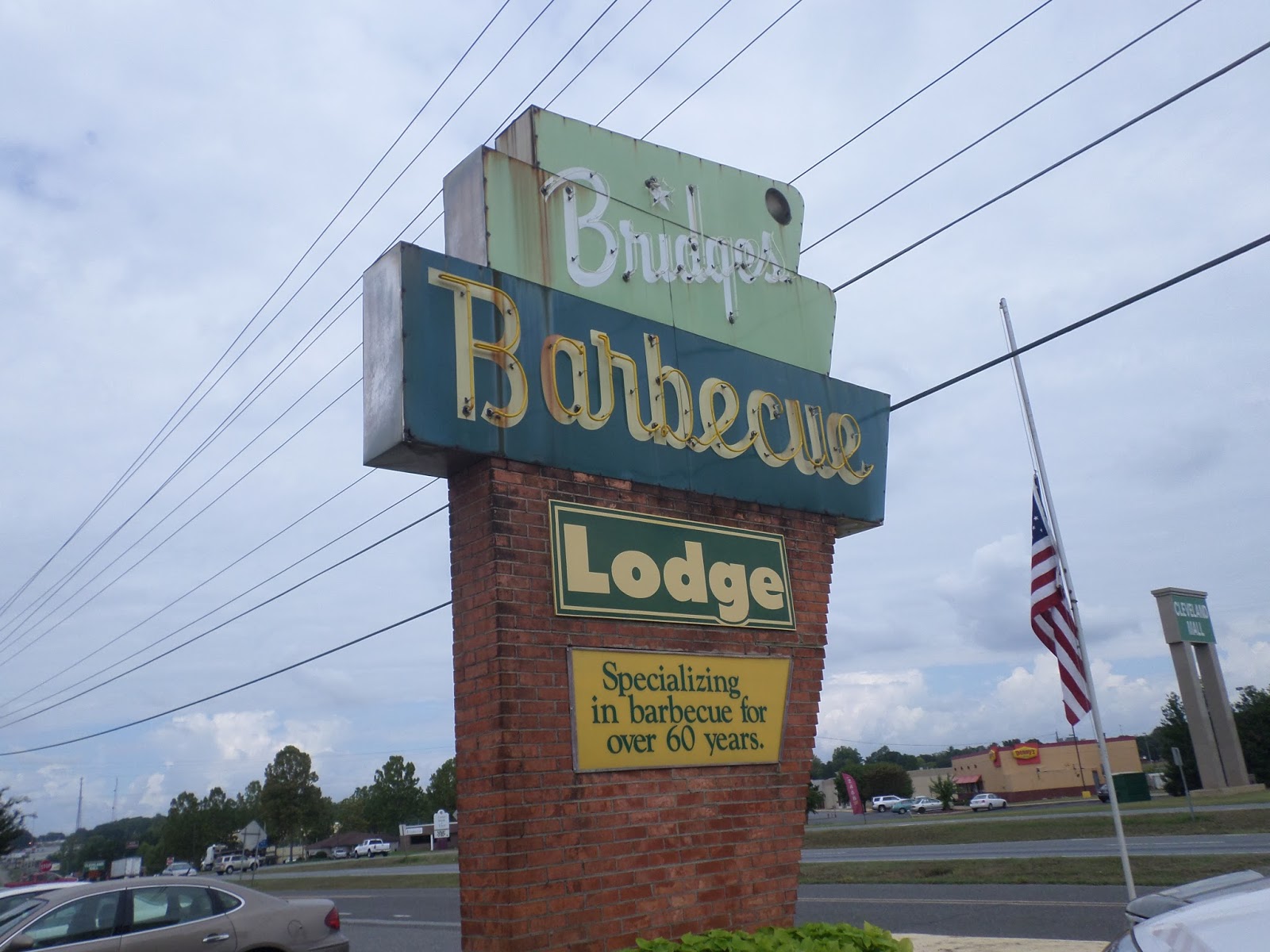
The sign in front has been a beacon
for BBQ fans for decades.
Red Bridges Barbecue Lodge in Shelby, NC, has been a place I’ve wanted to visit for a long time. It is one of the top BBQ places in the South and continues to be recognized for its tradition and legacy of serving moist and tender barbecue.

A main stop on the historic barbecue trail of the N.C. Barbecue Society, it ranks high on just about everybody’s list – Southern Living, Southern Foodways Alliance, and barbecue writers such as Randy Moss. In 2015, it won the “Ultimate Barbecue Bracket” competition of Garden & Gun. Magazine articles and photos line its walls among family pictures and scenes of yesteryear. 

Bracket results tell the story.
Because it is set back from U.S. Highway 74 Bypass, I missed it when I drove by the first time. After making a U-turn, I found what everyone has been talking about – the restaurant looks like it’s been frozen since the 1950s in a time warp (you can almost imagine it being on a two-lane road that the bypass was at the time) and the barbecue is still prepared in the same time-honored tradition as it has been for decades.

On the wall is a picture of the restaurant in the "old days" (observed the vintage cars).

After I had ordered lunch, I started taking pictures. My server Diann (who is certified as a barbecue judge by the Kansas City Barbeque Society and has been a member of a competitive cooking team) asked if I wanted to take pictures of the pit. Of course! There’s where I found Dennis at work, guarding the fire and watching over the smoking shoulders. He has a lifetime of experience and learned his skills from his father, who was cooked pork for most of his life.

Pitmaster Dennis, 55, learned the skills
 of of operating a pit from his father.
Red Bridges himself learned the art of cooking pork shoulders slowly over wood coals from Warner Stamey of Greensboro fame. True to “Lexington-style,” he used only shoulders for pork barbecue that he served with the cole slaw variety that is “red.” I obviously had to order pork barbecue for lunch. The easy choice was a jumbo BBQ plate (combination of chopped pork and chicken with a thin stream of sweet sauce on top) that included baked beans and red slaw and was accompanied by a basket of perfectly fried, crunchy hushpuppies. For dessert, I selected banana pudding (always available) over pineapple-coconut cake, the dessert of the day – both made by Diann who makes all the desserts.

"Lexington-style" barbecue always comes with "red" slaw.

Granddaughter Natalie (left) and daughter
Debbie keep Bridges' spirit alive.
The restaurant continues the legacy of Red Bridges, its namesake, who started selling barbecue in 1946. It is now run by second and third generation family members. Granddaughter Natalie said that she began working there when she was 14 or 15. Diann mentioned that grandson Chase makes all the red slaw and never deviates from the family’s recipe.

The restaurant has a steady stream of customers -- new and repeat.

The woodpile is huge -- and neat.
I couldn’t believe how much chopped wood was in back of the restaurant waiting to be turned into hot coals on another day of cooking. The wood was stacked as neatly as a Boy Scout project and all in a single row as long as the restaurant. Next to the woodpile was the remains of an old free-standing pit building that with a little coaxing looks like it could be returned to service with some tender care. I could almost picture coals blazing in the pits.

Banana pudding is always available.
The constant stream of customers coming and going made the restaurant seem like a train station. A line of customers at the cash register waiting to pay their bills seemed to never disappear. The dining area displays a community spirit as several customers greeted each other and the restaurant’s staff, and most tables were noisy with friendly conversation until food was served. It was obvious that a few customers were also first-time visitors as they (like me) were taking pictures.

Watching descendants of Red Bridges work in the restaurant that he and his wife Lyttle started many decades ago was a special experience. Enjoying pork barbecue and red slaw at Red Bridges Barbecue gave me a greater appreciation for the role of “Lexington” style in creating N.C. barbecue traditions and for this particular restaurant’s connection to others that serve barbecue in the Piedmont.
 
About 50 shoulders cooked the day before are ready to be chopped or sliced in the kitchen.


Saturday, July 25, 2015

Bum's in Ayden

The huge pile of cut wood captured my attention as I drove north on West Avenue in Ayden, NC, towards the center of the business district. In a mostly nondescript paved parking lot, the pile guarantees that a barbecue pitmaster is onsite.

Although smoke usually is seen first, the wood pile outside Bum's tells you that good barbecue is inside.

Bum’s Restaurant lies in the heart of the Ayden Historic District, which was listed in 1994 on the National Register of Historic Places. Bum’s obviously contributes to the historic credentials of Ayden, but it contributes even more to the legacy of whole hog cooking in eastern North Carolina.

Bum's Restaurant is in the heart of the historic district of Ayden, NC.

Bum’s opened in 1966 in a town as famous for collards as it is for wood-cooked barbecue. When Latham “Bum” Dennis began his restaurant, he drew upon family cooking styles that date to the 1930s. Now operated by his second and third generation family members, the restaurant still serves fresh vegetable sides that are family grown: cabbage, black-eyed peas, rutabagas and collards. Although the sides are remarkable, customers arrive wanting barbecue, which is chopped bigger than that prepared at the equally famous Skylight Inn, operated by a cousin, also in Ayden.

Garden fresh vegetables, as promoted in the sign, distinguish Bum's from other BBQ establishments.

The Dennis family claim to be descendants of the first U.S. barbecue operators. Skilten Dennis, an early ancestor (born in 1842), started selling smoked hog meat and cornbread out of a wagon in the mid-1800s. The legacy continues today in Bum’s that N.C. writer Daniel Wallace describes as “unpretentious as a middle school cafeteria.”

The unpretentious counter of Bum's is where many customers enjoy their favorite barbecue and vegetables.

After the smokehouse in the back of the restaurant was engulfed in flames in early January, Larry Dennis (the second-generation operator) returned Bum’s to full working order in the first renovations to the complex. Given the honor of lighting the new wood stove in May was Billy Parker of Parker’s Barbecue in Greenville, NC, another family-run whole hog restaurant in eastern North Carolina. With the renovations complete, Bum’s continues to build to its legacy and history.

Bum's brags about its new "coalmaker" on its Facebook page.

At Bum’s, history comes alive one plate at a time. Usually it’s surrounded by smoke too.