Saturday, July 25, 2015

Bum's in Ayden

The huge pile of cut wood captured my attention as I drove north on West Avenue in Ayden, NC, towards the center of the business district. In a mostly nondescript paved parking lot, the pile guarantees that a barbecue pitmaster is onsite.

Although smoke usually is seen first, the wood pile outside Bum's tells you that good barbecue is inside.

Bum’s Restaurant lies in the heart of the Ayden Historic District, which was listed in 1994 on the National Register of Historic Places. Bum’s obviously contributes to the historic credentials of Ayden, but it contributes even more to the legacy of whole hog cooking in eastern North Carolina.

Bum's Restaurant is in the heart of the historic district of Ayden, NC.

Bum’s opened in 1966 in a town as famous for collards as it is for wood-cooked barbecue. When Latham “Bum” Dennis began his restaurant, he drew upon family cooking styles that date to the 1930s. Now operated by his second and third generation family members, the restaurant still serves fresh vegetable sides that are family grown: cabbage, black-eyed peas, rutabagas and collards. Although the sides are remarkable, customers arrive wanting barbecue, which is chopped bigger than that prepared at the equally famous Skylight Inn, operated by a cousin, also in Ayden.

Garden fresh vegetables, as promoted in the sign, distinguish Bum's from other BBQ establishments.

The Dennis family claim to be descendants of the first U.S. barbecue operators. Skilten Dennis, an early ancestor (born in 1842), started selling smoked hog meat and cornbread out of a wagon in the mid-1800s. The legacy continues today in Bum’s that N.C. writer Daniel Wallace describes as “unpretentious as a middle school cafeteria.”

The unpretentious counter of Bum's is where many customers enjoy their favorite barbecue and vegetables.

After the smokehouse in the back of the restaurant was engulfed in flames in early January, Larry Dennis (the second-generation operator) returned Bum’s to full working order in the first renovations to the complex. Given the honor of lighting the new wood stove in May was Billy Parker of Parker’s Barbecue in Greenville, NC, another family-run whole hog restaurant in eastern North Carolina. With the renovations complete, Bum’s continues to build to its legacy and history.

Bum's brags about its new "coalmaker" on its Facebook page.

At Bum’s, history comes alive one plate at a time. Usually it’s surrounded by smoke too.

The Capital of ‘Cue

The drive to Ayden, NC, had been a journey I wanted to take for some time. I initially became aware of the small town in rural Pitt County because it’s the home of the official N.C. Collard Festival, a four-day extravaganza in August. The town of fewer than 5,000 expands with several more thousands who line the streets to watch the annual parade and participate in other festival events.

The silver dome marks "the Capital of Barbecue."

Throughout the rest of the year, the historic Skylight Inn attracts almost the same large crowds. It boasts that it’s “The Capital of Barbecue” and even proudly tops its building with a dome replica of the U.S. Capitol in Washington, DC. Some of Skylight’s bragging rights date to the 1980s when founder Pete Jones went to the Washington, DC, and defeated a team from South Carolina in a barbecue cooking contest. In addition, National Geographic has proclaimed that Skylight Inn is the “capital of ‘cue,” and the N.C. BBQ Society starts its barbecue trail at Skylight.

Chop, chop, chop are the sounds you hear when you enter the Skylight Inn.

The signature chopped whole hog (with the crisp skin mixed in) is seasoned with a little salt, pepper, vinegar and hot sauce and nothing else. When you walk in, you hear the constant rhythmic sounds of chop, chop, chop. As you stand in front of the counter, you watch as a huge pile of pork barbecue is chopped by a member of the kitchen staff. The chopping board is part of the spectacle of Skylight Inn, but it also conveys a message, just like the “Hot Now” light at Krispy Kreme. Whole hogs cooked had been cooked all night (for about 16 hours) in open brick pits heated by scoops of hot coals.

A historic family recipe is used to make the skillet cornbread.

The skillet cornbread tastes just like the mid-1800s because Skylight Inn uses a family recipe that dates to 1830 and the initial creation of Skilten Dennis, an early ancestor who began cooking whole hogs in the area. Made with drippings from barbecued hogs, the dense bread is somewhat greasy, soft on the inside but has a crust on the outside.

A tray of barbecue includes cornbread and cole slaw -- everything made according to family traditions.

Often referred to as “Jones’ Barbecue” in deference to Pete Jones, who began the restaurant (as well as the other Joneses who have followed him), Skylight Inn is unpretentious -- except for the big dome on top. The menu still reflects his character and offers a choice of a BBQ sandwich or tray. Money is also handled in an old-fashioned way – piled on the back counter rather than being placed in a cash register. Having not changed since 1947, Skylight Inn, named by Pete Jones after his experience of flying small airplanes from the airstrip behind the restaurant, remains authentic to its traditions.

Bruce Jones (left) introduced himself to me as the "father of Samuel ... and son of Pete."

When Pete (born Walter B. Jones but always known by his nickname) died in 2006, his son Bruce embraced the challenge of continuing the family’s barbecue traditions. Now the notoriety has been passed to his son Samuel, who in an interview with A Chef's Life said, "If the sign says BBQ and you don't see any smoke, you probably ought to keep on driving. In fact, when I met Bruce Jones, he introduced himself as the “father of Samuel, the young one featured on the cooking shows, and son of Pete.”

Skylight Inn is one of the few American restaurants that displays a James Beard award.

Even with the expanded recognition, the display wall of mementos near the counter doesn’t seem to have been updated since the early 1980s. On a far wall is displayed with little fanfare a medal from the James Beard Foundation, which celebrates and honors the nation’s diverse culinary heritage. The foundation selects the most beloved regional restaurant each year by bestowing the America’s Classic designation, which Skylight received in 2003. The award recognizes timeless appeal and quality food served at a locally owned and modestly priced restaurant that reflects the character of its community.

The letter from N.C. Gov. Hunt proclaims Skylight Inn as the "king" after winning the contest in Washington, D.C.

The visit to Skylight Inn is like a journey back in time. It is an American classic that earns its high praise for good reason.

The woodpile in the back is
proof of traditional cooking.
Coals are made in the fireplaces.


The line of customers frequently
extends out the door.
The pit is where good cooking happens.

Sunday, July 19, 2015

Cooking Whole Hog in a Competition

The skills for cooking a whole hog have always impressed me. I admire someone who can prepare all cuts to reach perfection simultaneously and appreciate the tradition of regions, particularly eastern North Carolina, where barbecue is nothing less than a whole hog cooked slowly over low temperatures using only wood or charcoal.

A whole hog cooked by the Boonetown BBQ team awaits inspection by the judges.

I have visited establishments where whole hogs are cooked and am honored when I meet someone who continues family cooking traditions passed down through extended generations such as Rodney Scott of Scott’s Bar-B-Que in Hemingway, SC. However, watching cooking teams use a mobile grill brought to a contest site to cook whole hogs is even more impressive. At Smoke on the Mountain, the annual barbecue cooking competition in Galax, Va., whole hog is one of the categories in the competition sanctioned by the Memphis Barbecue Network.

The Shed team pulls out its whole hog for a judge's evaluation.

I was at the event as a judge in the competitions sanctioned by the Kansas City Barbeque Society. Although I like how KCBS sanctions competitions worldwide and promotes barbecue, I have to admit that I am thoroughly impressed with the whole hog competitions conducted by MBN and how its judges interview cooking teams as well as conduct blind evaluations of cooked meat. (In addition to the whole hog category, the pork-only MBN also has categories of ribs and shoulder. In contrast, KCBS events include categories of chicken, pork, ribs, and brisket.)

The Shed from Ocean Springs, Miss., brought the most unusual grill (a converted vehicle on a trailer).

For its competitions, MBN requires that a whole hog weigh at least 85 pounds (some weigh 200 pounds or more) and be cooked as a complete unit on one grill surface. Because judges sample portions of ham, shoulder, and loin in their evaluations, the cuts have to reach perfection at the same time – a delicate feat considering that hogs may cook for as long as 24 hours.

A Shed team member displays tray of hot coals under the grill for a judge.

Cooking whole hogs to perfection is difficult for the novice; however, the results improve with time, patience, and experience. Observing the whole hog competition at Smoke on the Mountain increased my respect and admiration for cooks who have honed their skills and compete at such a high level.

The Boonetown BBQ team prepares its display for a judge's visit.

Saturday, July 18, 2015

Barbecue with Altitude

With a small population of only 7,000, Galax, Va., achieves what many large cities only attempt: a successful and popular barbecue competition that draws many well-known and successful cooking teams and attracts the local community to spend a day or two in its central business district. Smoke on the Mountain has been conducted for ten years, and each year it adds to its reputation as the official Virginia state barbecue championship.

Dancers add to the merriment created by the old-time mountain music performers.

With a motto of “Barbecue with Altitude,” the contest accentuates Galax’s claim as the gateway to the Blue Ridge Mountains and the city’s elevation of 2,500 feet. Galax is also a favorite destination because it is the World Capital of Old-Time Mountain Music, a traditional American music that gave rise to bluegrass, country, rock and other styles, and home of the Old Fiddlers’ Convention, the world’s largest and oldest fiddlers’ convention.

Percussion by a washboard (lower left) creates a special old-time mountain sound.

With such a cultural legacy, it’s somewhat surprising that Galax was named in 1906 for a low-growing evergreen shrub native to the southern Appalachian Mountains. Its leaves are valued in the florist trade because they are attractive, sturdy, and have a long shelf life. Today, a more fitting name would be Smoke City because spiraling columns of smoke fill the downtown area during its barbecue competitions.

A potted Galax plant makes a great souvenir.

At the meeting of Kansas City Barbeque Society judges, organizer Ron Passmore explained how important the event is to the local economy. For Galax and its surrounding area, the contest is more than entertainment – it’s economic development for stores, restaurants, motels, and other businesses. When I went into several antique stores in downtown Galax, I was surprised how busy each one was with customers who had wandered inside on their stroll through the city.

Judges relax before the competition begins.
Vendors along the city’s main streets and near the competing cooking teams enjoy the crowds that meander among their booths and venture into the local shops. In addition to music performed on the Farmers’ Market stage, the street scene also includes bluegrass and old-time music by local ensembles who watch as spectators dance while they play.

Ribs are prepared by the Bare Bones BBQ team.

When Smoke on the Mountain began, it was sanctioned by the Memphis Barbecue Network, an organization that promotes the “Memphis style” of barbecue. As the event continued to grow, it added the sanctioning of the Kansas City Barbeque Society, the reason that I attended as a judge for the competition among the 29 teams contesting for KCBS prizes. A dual contest is unusual and enhances the influence that the event has to attract superior cooking teams.

Serial Griller team placed in the top 5 overall as well as in the pork and brisket categories for the KCBS contest.

For the 2015 event, 43 teams entered, and eight competed in both KCBS and MBN categories. The contest offered a total of $12,000 in prizes, including a total of $5,500 for the KCBS competition. In recognition of Galax’s long heritage of traditional music, handmade musical instruments are also awarded as trophies to the grand champions of the KCBS (a guitar) and MBN (a banjo) competitions. MBN runners-up receive fiddle trophies, and KCBS runners-up receive Galax leaf plaques. (The MBN grand champion is also invited to compete in the World BBQ Championship because Smoke on the Mountain is a qualifying event.)

Trophies await the awards ceremony after all judging scores have been tabulated.

Smoke on the Mountain has definitely earned its place at the mountain top of barbecue competitions. It awards amazing handmade prizes (plus money), the street scene is unmatched, and the cooking teams are phenomenal.

The Shed team from Ocean Springs, Miss., brought the most unusual grill (vehicle on the trailer).

Friday, July 17, 2015

The Galax Smokehouse

In southwest Virginia only a few miles from the busy crossroads of I-77 and I-74, The Galax Smokehouse has become a destination for the traveling public as well as the local community. Owner Ron Passmore, founder of the Smoke on the Mountain barbecue contest, deservedly has gained many accolades since the restaurant opened in 2003.

Not a table is vacant even late in the afternoon.

Named as “Best of the Best” barbecue restaurants in America by National Barbecue News, the Smokehouse caters to a variety of barbecue traditions. Texas-style beef brisket and St. Louis-style ribs are popular on the menu that also features pulled pork and chicken. The brisket is smoked with mesquite wood. Pulled pork barbecue and ribs are smoked with hickory wood, and barbecued chicken is smoked with apple wood.

The Smokehouse has been designated "Best of the Best" every year since it opened.

Visitors can also find their favorite sauces. For travelers from North Carolina, both an “eastern NC” sauce, which is vinegar-based and spicy, and a “western NC” sauce, which matches the Lexington tradition of a vinegar base with tomato and spices, are available. Customers who favor the sweet Tennessee tradition can enjoy another tomato-based sauce sweetened with honey and brown sugar. Fans of a South Carolina mustard-style sauce will appreciate the Smokehouse’s version that includes black pepper to give it a spicy flavor. The house sauce is a Texas-style tomato-based black pepper sauce that is hot and spicy.

Statues of piglets and a mama hog greet everyone at the entrance.

If all those options are not enough, the Smokehouse has three more sauces: the vinegar-based Mountain sauce is sweet and tangy, the Sweet ‘n’ Sassy sauce has a molasses base and is “sweet with a slow burn,” and a white Alabama sauce with a mayonnaise base boosted by horseradish has a spicy taste. Bottles of each sauce are available for $5. For customers lucky enough to live nearby, empty bottles bought back to the restaurant are refilled for $4.

At the Smokehouse, you can pick your favorite sauce.

Located in the downtown center at the intersection of Main and Grayson streets, the Smokehouse is housed in the former Bolen’s Drug Store, one of the oldest buildings in Galax, which boasts of having four structures listed in the National Register of Historic Places. (Although the Smokehouse is not one of them, it should be!) In addition, the Galax Commercial Historic District, consisting of 67 buildings in the central business area, is also listed in the National Register.

The counter is a popular place to eat.
The desert menu is limited – for good reason. The banana pudding was named as the best in the Southeast by Southern Living in 2008. Who would want anything else?

Pig Pub serves more than banana pudding.

The Galax Smokehouse is worth a visit any time (it’s closed only two days, Christmas and New Year’s Day) but beware that Smoke on the Mountain is held on the third weekend in July. Galax then mutates from a small mountain town into a busy and overflowing street scene with cooking teams, judges, barbecue fans, vendors, and other visitors who want to be part of the action.

Outside display sells homemade sauces during Smoke on the Mountain weekend.


Saturday, June 20, 2015

The Peak of Good Judging

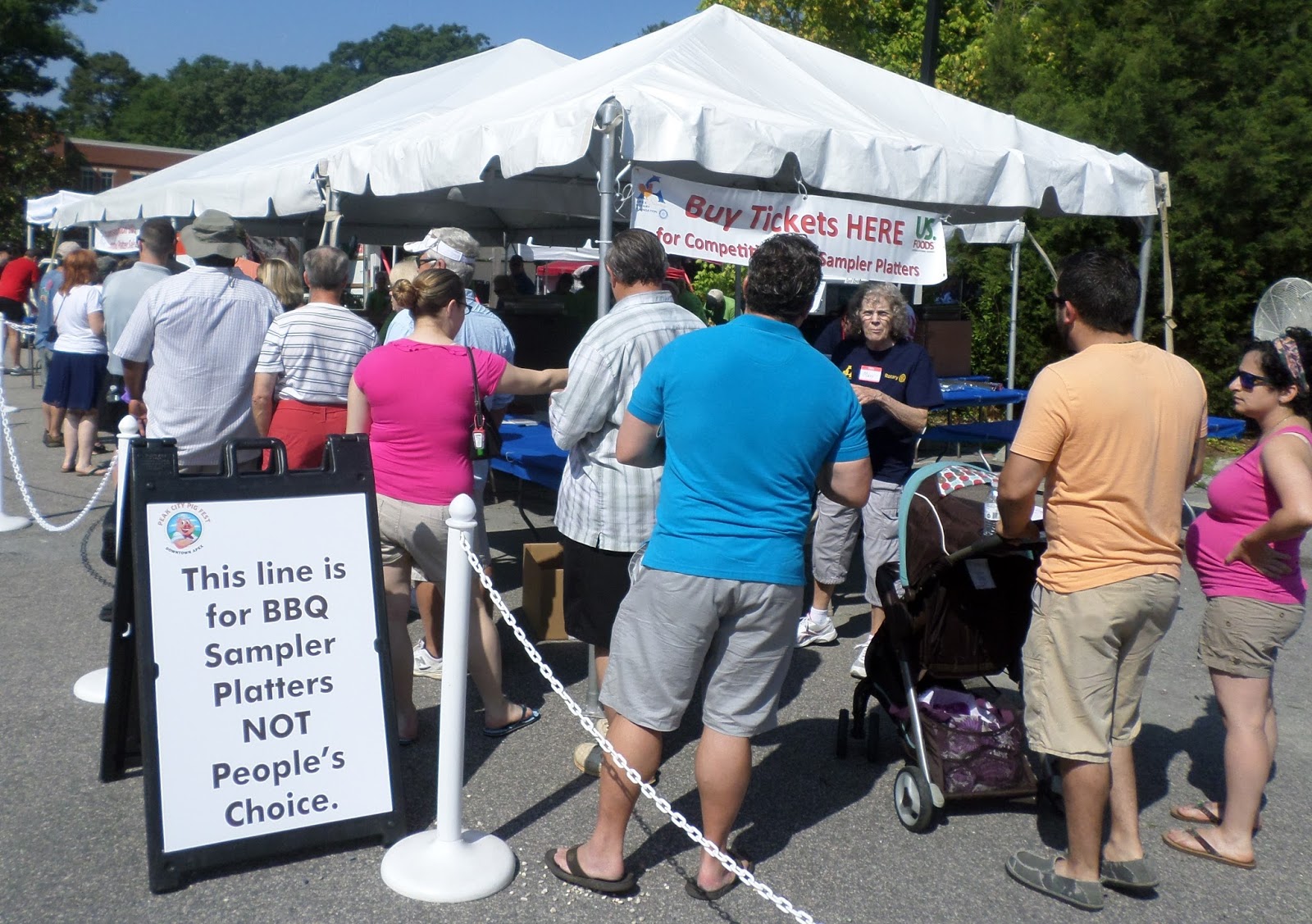
Judging at the Peak City Pig Fest in Apex, NC, has been a goal since I was first certified as a judge. The classes that I attended for being both a judge and table captain were conducted by the Apex Sunrise Rotary Club, the organization that organizes the Pig Fest, and I wanted to participate in the club’s signature event.

Even though the Pig Fest was established as recently as 2012, it has quickly become one of the popular barbecue competitions on the East Coast. The Rotary Club, which has only 28 members, takes barbecue seriously — half the members are certified judges — and considers the Pig Fest as its signature event for good reason. It raises about $20,000 annually for local charities, which is usually donated to two worthy causes such as Western Wake Crisis Ministry (which provides emergency financial aid and food to families in a crisis) and Operation Coming Home (which builds homes for disabled veterans).

The grand champion wins $2,000.

The cooking teams were vying for a first place prize of $2,000 and competing for $9,000 in total prize money. The Pig Fest also has been proclaimed a N.C. state championship by the governor (although more than one state championship may be held). Because the Pig Fest doesn’t charge for parking or admission and is held in the historic downtown section of Apex, it’s very popular. More than 20,000 visitors attend. Most adults are interested in the pork barbecue prepared by the cooking teams that is sold by the plate with slaw and bread, but the kids are also interested in pig races that are held every two hours on Saturday.

More than 1,200 platters (200 more than last year) of pork barbecue are sold.

The Pig Fest is named for Apex, which has a nickname of Peak City and is known as the “peak of good living.” When the railroad station at Apex was chartered in 1854, it was the highest point on the route between Richmond, Va., and Jacksonville, Fla. Proof of its high point (although only 499 feet above sea level) occurs when it rains. Water on one side of Salem Street (the main street) flows to the Neuse River, and water on the other side to a different river basin, the Cape Fear River.

Salem Street (the main street of Apex), known historically for its elevation, is now legendary for its Pig Fest.

At the Pig Fest, I met Bill Jones of Richmond, Va., who may set the record for judging contests in one year. Jones is a master judge — meaning that he has judged at 30 contests, cooked with a competition team, and passed a qualifying exam. He told me that he had applied to 38 events in 2015 and has been accepted so far at 28. Jones enjoys picking locations outside of his home state — Wisconsin, Vermont, Mississippi — and making an adventure of visiting new areas. He is inspiring for how much he enjoys being a judge.

Judges relax before the cooking teams begin to turn in their best barbecue.

The number of cooking teams was capped at 48 because the space available could not accommodate more. Typically, a contest needs a similar number of judges. However, more than 150 applied to the Pig Fest that needed 48 judges and 8 table captains. Terry Winebrenner, Chairman of Judging, culled through the applications to select a range of experience and background.

Cooking teams set up in 'Hog Heaven" in a parking lot on the west side of Salem Street.

For each table, which consists of a table captain and six judges, Winebrenner selected a master judge, a judge from out-of-state, and a newly certified judge. Letting new judges participate is important to the Kansas City Barbeque Society so that they can gain experience. As planned by Winebrenner, new judges have a chance to ask questions and work with experienced judges, such as Bill Jones.

Trophies await the judges' scores for best chicken, ribs, pork, and brisket.

In the two previous years, I had applied to judge but wasn’t selected (too many applications). In fact, the first event that I applied to judge after I had completed the judges’ class (with almost 100 others) was the Peak Fest, which was overwhelmed with more applications than it could accept. Fortunately this year my application was accepted, and I enjoyed sitting at the table where Winebrenner was the captain.


The Pig Fest was a great experience — the barbecue was excellent, the event is expertly run, and the setting in an old historic downtown is picturesque. Because the event was organized by the club that conducted my initial training, being a judge was even more special. Being in the Peak City is the peak of good judging.

Saturday, June 13, 2015

Judging on the National Tour

What barbecue contest awards the most prize money? Many cooking teams, judges, and barbecue society members are interested in the Sam’s Club BBQ National Tour because it has the largest prize purse of a barbecue competition anywhere. A total of $500,000 is awarded to the lucky competitors.

The Sam's Club National BBQ Tour attracts 750 cooking teams
and gives away $500,000 in prize money.

The Sam’s Club Tour attracts about 750 teams nationally who compete in 25 local events. The top six teams of local cookoffs continue to five regional competitions. The best of the regionals advance to the national finals in October when 50 teams, 10 from each region, compete at Sam’s Club Headquarters in Arkansas to determine the national champion.

Cooking teams set up a day in advance in the parking lot of Sam's Club in North Charleston, SC.

Registering to be a judge isn’t easy. The opportunities to judge quickly disappear in less than 24 hours when the web-based registration system is activated, and in the first 24 hours, judges may register for only one event (local or regional). When I connected to the system on the first day of registration, I signed up for the local event in North Charleston, SC, which is near my home. On the next day, when I tried to sign up for another event, a few locations still had judging spaces available, but they were too far away to consider.

The cooking teams set up side-by-side in several parallel rows..

The local events are limited to 30 cooking teams. After 40 judges have registered, a waitlist for 10 more judges is available before the registration is closed. I felt fortunate to be registered for at least one event, although I had been hoping to sign up for more than one.

The cooking teams quietly prepare the barbecue for the competition.

Like other local events, the North Charleston cookoff had $10,000 in prize money, including $2,000 awarded to Big Dick's BBQ as the grand champion. The other five overall high-scoring teams, who advance to the regionals, also won prize money. In addition, the top five teams of each category – chicken, ribs, pork, and brisket – won cash prizes as well. At each regional contest, the prize money awarded doubles to $20,000. Finally, the national championship has a total prize purse of $150,000, and the grand champion receives $50,000. The high amounts of cash prizes definitely motivates teams to register, succeed, and advance.

A member of a cooking team tends to his fire.

Smoke plumes were rising skyward in still air when I arrived at the event site in North Charleston about 10 minutes before the mandatory judges’ meeting. Michael McDearman, series director of the Sam’s Club National Tour, welcomed the judges and emphasized how significant the tour events are in determining a national champion. He also said that $2.5 million have been awarded in total prize money since the tour began in 2011. He indicated that he is “on the road” about nine months of the year to coordinate the tour events as they are held. From February through September, McDearman is changing locations to be at each local and regional event.

Employees of Sam's Club offer samples of beef brisket to spectators.

Although McDearman is the series director, each event is run by a representative of the Kansas City Barbeque Society. For the North Charleston event, Randy and Carol Bigler, whom I had met last year at a contest in Asheboro, NC, were the KCBS representatives. After the contest, he told me that they try to manage about 20 contests each year for KCBS.

Members of Yes, Dear BBQ (which placed third overall and advances to the regional event)
relax after all meat entries have been turned in for judging.

For me, judging at the North Charleston event was rewarding. I sampled some of the best barbecue chicken and pork that I have ever tasted. I also got to observe an event where cooking teams are focused only on submitting their best entries and are not distracted by selling food to the public. However, the day in June brought temperatures that reached 99 degrees. To combat the heat I drank the most water ever at a barbecue contest: four bottles. Water, routinely available to judges to refresh their mouths after they have evaluated an entry before they taste the next one, was very important on this day just to keep cool.

Judging at a Sam’s Club BBQ National Tour event gives me more appreciation for the effort by cooking teams as they prepare for a contest. If I participate as a judge again, I hope that it will be a regional event, so that I can judge the cooking skills of the top local teams who are competing for the chance to advance to the national championship.