Saturday, June 6, 2015

Traveling to the Bull City


Durham, NC, is not that far from my home. When I learned about the Bull City Barbecue Classic Cookoff, I was interested in participating for several reasons. Being at the event would give me the opportunity to experience an event that is still developing, work with several highly regarded barbecue experts, evaluate the value that a sanctioning organization provides, and develop more completely my judging skills.

Cooking teams set up on the grounds of the Durham County Stadium.

First, the event is still in its infancy. It started in 2012 with five cooking teams and three judges. Led by Renee Brown, the contest organizer, the cookoff has attracted more cooking teams in each subsequent year. This year 20 teams signed up to compete (and 19 did). For judges, Renee had put out a call in her network and recruited 19, a few who had been judges for her last year. Even as the cookoff has grown, it still limits teams to cooking two meats (pork ribs and barbecue), unlike other competitions that typically also include chicken and beef brisket.

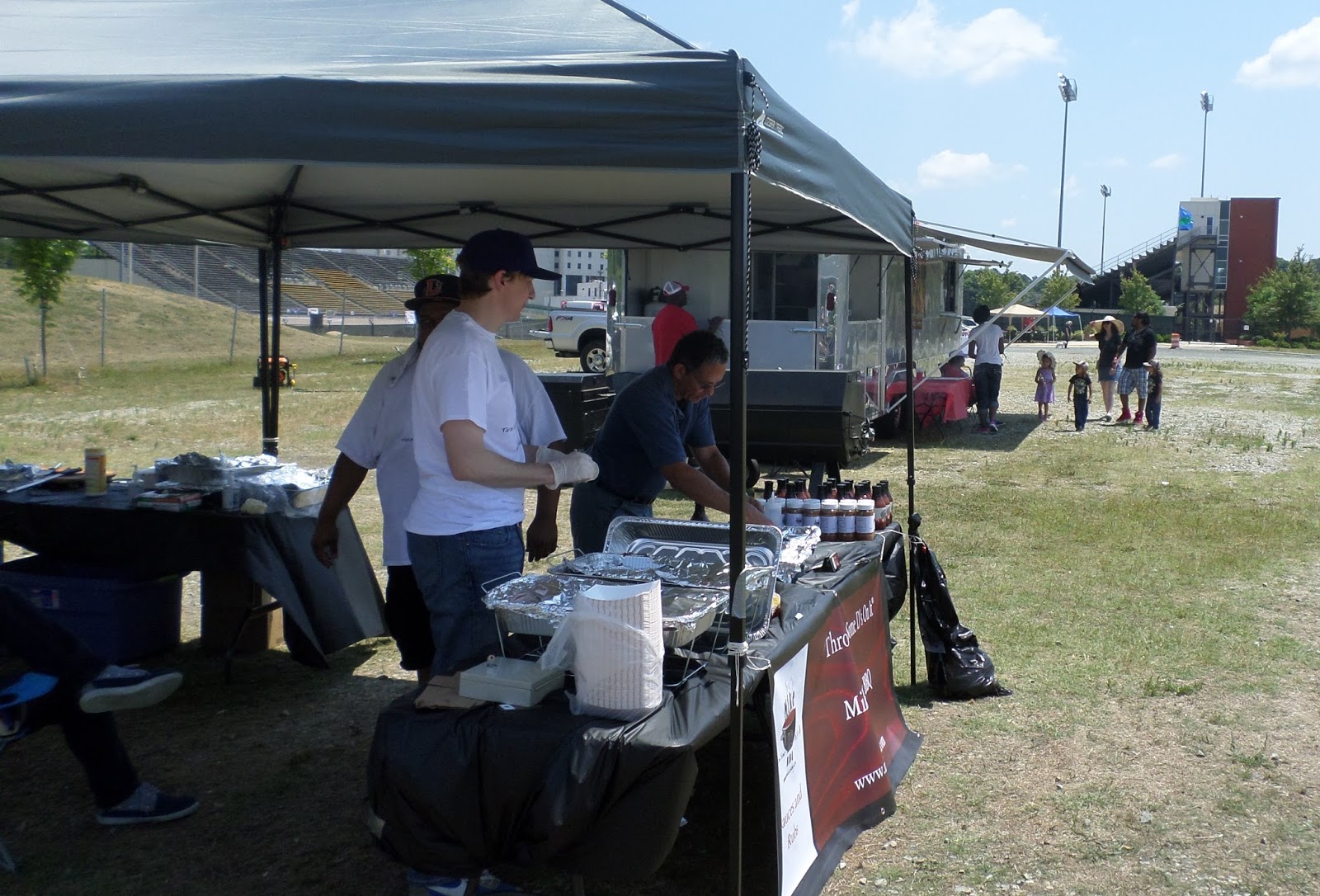
Smokin' Joe's BBQ was one of the 19 teams competing for contest awards.

Bob Garner, BBQ expert,
judges one of the ribs.
Next, I recognized several names in the “barbecue world” or media who had committed to judge and whom I would enjoy getting to know. One was Bob Garner, author of several books about North Carolina barbecue and traditional cooking, who is also a well-known pitmaster and connoisseur of N.C. barbecue. Another was Graham Wilson, who organizes the Peak City Pig Fest annually in Apex, NC, and in four short years has taken that event from being a dream to becoming one of the top N.C. contests sanctioned by Kansas City Barbeque Society. In addition, Anthony Wilson, news anchor and reporter for WTVD, the ABC TV affiliate in central N.C., was returning as a judge in Durham.

Anthony Wilson (right) returned to the cookoff again this year as a judge.

Another intriguing aspect of the Bull City Cookoff is that it is not sanctioned by any professional barbecue society such as KCBS, although Brown eventually hopes to make the transition to a sanctioned contest. Because all events that I have attended have been KCBS-sanctioned, being in Durham gave me the opportunity to see how judges perform who haven’t completed a uniform training program or don’t share a set of formally published rules. Although the judges did well, I easily recognized the value that a sanctioning organization provides.

Coookoff judges take their responsibilities very seriously.

Because the cookoff is not sanctioned, it attracted a wide variety of cooking teams. Some were had never competed before, and their equipment was quite basic. Others had very expensive setups, vans, and trailers; they also displayed trophies to show off their past successes. As the public entered, some teams were well-prepared to sell their barbecue and sauces, while other teams looked on and observed how they could improve their operation the next time that they competed.

Smoking Dave's shows off racecar,
trophies, and new trailer.
People Choice's trophy went again
to Smoking Dave's, also the winner
in 2012, 2013, and 2014.

The cookoff also helped develop my table captain skills. Several days before the event, Brown had asked if I would explain the procedures to the judges at the start of the competition and serve as table captain as the samples were distributed to judges for evaluation. Although a table captain at a KCBS-sanctioned event serves only six judges, two volunteers helped me stay on schedule.

A cooking team keeps the grill hot with barbecue to sell to the public.

The Bull City event achieved the purpose of a cookoff: encourage teams to compete and promote barbecue as a culinary technique and sport. I look forward to watching as the cookoff continues to grow and eventually transitions to a formally sanctioned contest.

The line formed early for people interested in attending the cookoff;
admission was $5 per person.

Saturday, April 11, 2015

Judging in My Hometown

After I was certified as a barbecue judge, I knew that I had to participate in an event in my hometown of Winston-Salem, NC. When I learned about Bib’s Camel City Cookoff, I hoped that I would be accepted as a judge. Fortunately, the grand prize of $10,000 attracted many cooking teams and required more judges than anticipated.

Teams were set up early for the competition.

The number of cooking teams had “exploded,” said Doug Reid, one of the Kansas City Barbeque Society reps at the event, as he commented on the jump from 40 teams last year to 51 this year. More cooking teams require more judges – this year judges filled 11 tables, and I felt lucky to be one.

Cookoff was held at the Winston-Salem Fairgrounds.

The competition built on the success of its first year when its inaugural name was Jammin’ Pig Music Festival. Even with the name change, music was still a major part of cookoff. Blues music was on schedule the night before, and the day of the cookoff featured four local groups in a battle of the bands. Held at the Winston-Salem Fairgrounds, the event had plenty of space for the cooking teams and other activities. Parking and admission were free, which helped to attract several thousand visitors to the cookoff.

Yesterday Village at the fairgrounds was a brief walk from the cookoff location.

The contest organizer was Mark Little, who goes by the nickname “Bib” and is the pitmaster and co-owner of Bib’s Downtown, a barbecue and catering establishment. When I asked him how he got the nickname, he said, “That’s all I wear.” Little wanted an opportunity to expand BBQ culture in Winston-Salem and bring more BBQ exposure to the city. Little is a third-generation resident of Winston-Salem, and I learned that I had attended the high school that his aunt Ruth had attended.


Mark Little (right), pitmaster at Bib's Downtown, was the contest organizer.

One of the special experiences I had was judging at a table with Jerry Gardner, a long-term judge. The number of 461 on his member tag indicates that he’s one of the early members of the Kansas City Barbeque Society. He said that he attended the first judging class east of the Mississippi River.

Checkered Pig, which placed second in the pork category, finished in fifth place overall.

When the final scores were in, the judges at the table where I was sitting were relieved. “My next meal will be salad,” one said. Another added, “The only thing I want now is ice cream.” However, we were all satisfied that we had judged some of the best barbecue ever.

Thursday, March 5, 2015

Barbecue Served with Recipes That Grandma Hill Created

Pork shoulders cook slowly over hardwood coals in the kitchen of Hill's Lexington Barbecue.

A trip to Hill’s Lexington Barbecue in Winston-Salem, NC, is a trip back to the 1950s. The food, hospitality, and atmosphere harken back to an earlier time and a slower pace. Drive-ins were family-owned. Another decade would be needed before McDonalds, Hardees, and similar places would open.

A traditional wood burner, this stack at Hill's was brought in from Asheboro, NC.

Imagine Winston-Salem, NC, in 1951, when Hill’s opened as a drive-in on Patterson Avenue, then U.S. 52 heading north to Mt. Airy and south to the Twin City. At that time the restaurant was outside city limits – a time and place I remember as a child because my dad was its mail carrier on his motor route and let me join him delivering the mail on summer days in the mid-1950s (without U.S. Postal Service approval or knowledge, of course). Today, although within city limits, Hill’s is now bypassed by the limited-access U.S. 52 that rises high above on an elevated road soon to be Interstate 74. 

Hardwood is burned until coals are ready for the smoker.

In 1951, the city population was around 90,000, and the dedicated customer enjoyed a scenic drive to Hill’s on a curvy, two-lane U.S. 52 at slow speeds. Today, U.S. 52 is the fast road north in a city of almost 250,000. Many wonderful places with cultural and historic connections are now missed by some travelers who are totally unaware they exist simply because highways have been redesigned and “improved” to move us at faster speeds. Although a new customer has to look for the overhead billboard to know which exit to take, long-term customers know exactly where on Patterson Avenue Hill’s is located.

Long-term customers arrive early for favorite seating in the dining areas,

The dining areas are typically filled with repeat customers who also know that the menu still reflects good value and a cooking method known as Lexington style.  The pork is prepared from only hog shoulders and cooked slowly over hardwood coals. Although it’s served in one of four ways -- chopped, pulled, sliced, and blocked -- it comes with only one kind of slaw – red – the only kind served with Lexington-style barbecue.

Lexington-style barbecue is always served with "red" slaw.

When I ordered a pulled pork tray for lunch, the server was careful to explain that it came with red slaw just in case I was not familiar with it. Unlike traditional coleslaw, no mayonnaise is in the vinegary red slaw, which gets its characteristic color from ketchup. The pulled pork with a thin but peppery sauce I enjoyed was tender and full of smoky flavor. With the red slaw, it’s a perfect lunch – with hushpuppies, of course.

The server brings more than enough hushpuppies to a table while the orders are being prepared.

The original small drive-in has been gone a long time. Although a larger building replaced it more than 40 years ago, the best recipes – banana pudding, slaw, hushpuppies, and sauce – are still the original family ones. The Hill family, with the third generation now operating the restaurant, has been wise in not modernizing or updating them.

A portrait of Edna Hill, wife of the founder, guards the entrance -- a good reason not to change a recipe, particularly the one for banana pudding.

The sign in front proclaims Hill’s to be “The Original Lexington Barbecue” for two good reasons. Founder Joe Allen Hill came to Winston-Salem from Lexington with the dream of cooking pork “Lexington-style” here and opened the first restaurant in the city to have “Lexington barbecue” in its name. More importantly, although other establishments in Lexington, NC, were in business when Hill opened this restaurant, he’s the first to name his “Lexington barbecue.”

Hill's is the original Lexington Barbecue for two good reasons.

Take a journey back to the 1950s – only the prices have changed (and modestly at that). The hospitality, atmosphere, recipes, and food at Hill’s remain the same. Even the mail boxes on the side of the road look like they are just as original.

The best finish for a meal at Hill's is its famous banana pudding, always served warm.

Notes: 

  1. An earlier post, prepared for the N.C. Folklife Institute that focuses on memory and changing cultural experiences and also discusses the traditions of Hill’s, is online at the Institute’s NCFood blog.
  2. The restaurant was permanent closed in January 2020 after being in business 68 years.

Sunday, February 1, 2015

Mapping a Barbecue Trail

Imagine a state preparing a map of all its barbecue restaurants and making it available at welcome centers and through visitor programs. When I stopped at South Carolina’s welcome center on Interstate 95 after entering from Georgia, I was interested in getting only a few simple brochures and a state highway map.

Which South Carolina map connects to culture and history?

A mouth-watering
sandwich graces 
cover of trail map.
When I arrived at a stack of highway maps, my eyes were immediately attracted to a picture of a mouth-watering barbecue sandwich on the front panel of different map. About the same size as the highway map and folded into similar sections, this one is labeled “South Carolina BBQ Trail Map.” It also proclaims that it is “official” (which is missing from the front of the highway map that indicates “free distribution only”). 

Although the state highway map is a great resource to navigate through South Carolina and includes useful travel information such as road classifications, symbols, distances, and hurricane evaluation routes, it lacks a cultural connection. On the other hand, the BBQ Trail Map highlights the culture of the state as it brags that South Carolina invented barbecue and is the only state to offer the fourofficial sauces – vinegar-pepper, mustard, light tomato, and heavy tomato.

South Carolina offers four different barbecue sauces.

As the trail map describes the state’s sauces, it connects them to cultural history. For example, German immigrants with a taste for mustard who settled in the 1700s are credited with popularizing mustard-style barbecue in the middle of the state. (In fact, South Carolina is the only state where this sauce is found.)

Mustard sauce is popular in the midlands of South Carolina.

The trail map also explains how the roots of barbecue run “five centuries deep” in the state and date to the time when Spanish explorers observed “open pit cooking” by Native Americans on the coast of South Carolina. According to the map, the first pit-cooked barbecue in America was created when the Spanish, who brought hogs on their long voyages for food and even left some on coastal islands of the Southeast, cooked in the style of the American Indians. 

Which sauce would be your favorite?
Although BBQ trail maps of other states are available, in both online and printed versions, South Carolina is the first and only state to prepare a trail map and make it available at its welcome centers. Consider how much its trail map advances its reputation and credibility as a tourist destination, particularly for culinary travelers. Maps of other states, such as North Carolina, have been prepared by associations (trail by NC Barbecue Society) or by entrepreneurs (Great NC BBQ Map by Amanda Fisher and Paul Bright). However, the map of South Carolina includes all establishments and their sauces. It divides the state into three regions – mountains, midlands, and coastal – and lists all barbecue establishments, marks their locations on the map, and identifies which sauces they serve. The S.C. Department of Tourism deserves a round of applause for its initiative.

Finding barbecue in South Carolina is easy with the trail map.

When you travel, don’t travel with only a highway map – also take a map that includes cultural and culinary connections. If you are searching for barbecue, include South Carolina in your journey because it knows how to map a trail.

Pick up a trail map at a S.C. welcome center.

Wednesday, January 28, 2015

A Place Called Swine

If a restaurant has the name of Swine, would you visit? Imagine standing at the entrance of an upscale eatery and seeing firewood ready for a smoker stacked against the front window. 

Stacks of firewood greet customers at the entrance.

That’s the scene on Ponce de Leon Boulevard, the main thoroughfare that bisects the fashionable business district of Coral Gables, Florida, where Swine entices crowds daily for food and drink. Although the restaurant is decorated creatively with photos and other art (as well as stacks of firewood) and softly lit with amber lighting, the huge lightbulb sign “Run Pig Run” is what captures the attention of new patrons. (Appropriately the website address for Swine is runpigrun.com.)

Run Pig Run says it all for Swine.

The place called Swine has the feel that it was just moved from a farm. Its exposed brick walls and wood structures deconstructed from barns create a comfortable feel that fits well with its comfortable food. The vintage-style bulbs with exposed filaments add to the restaurant’s relaxing atmosphere.

Customers enjoy Swine's relaxing atmosphere.

Officially known as Swine Southern Table & Bar, the restaurant has risen fast to the top of places to dine in South Florida. The Swine burger tops the list of best burgers in Miami by Miami New Times (which has also anointed Swine as the best restaurant in stylish Coral Gables), perhaps because it includes short rib, brisket and smoked pork with double hamburger patties.

The pork shoulder is ready for serving after twelve hours in the smoker.

However, the twelve-hour slow-smoked pork shoulder on the menu under the category “From the Smoker” is the entrée that caught my attention. Adorned with tomato-peanut relish and spiced honey glaze, the pork had been prepared superbly by Chef Cristian Cuevas, whom I sought out in the kitchen so that I could see Swine’s smoker. The smoker is impressive with layers of shelves for smoking beef brisket, pork ribs, and chicken, the other smoked entrees with pork shoulder: All four categories of an event sanctioned by the Kansas City Barbeque Society are on the menu.

Every chef, like Chef Cristian at Swine, needs a good smoker.

The sides -- or fixins as Swine describes them -- can delight any follower of Southern food. The roasted chilled beets that I ordered came with pickled red onion, cumin seed olive oil, and blue cheese; thy were a creative complement for the pork shoulder. Because I hadn’t ordered charred okra at Yardbird (a sister restaurant in Miami Beach that I had visited earlier in the week), I had to try the skillet charred okra. Coated in anchovy bread crumbs and charred with brown butter and lemon, the okra was another tasty dish. Because I saw it on several nearby tables, it must be more than an initial fascination but a delight enjoyed by customers more familiar with the menu.

Charred orka may be the most popular fixin at Swine.

Because I had visited Sunburst Trout Farm in North Carolina last year, I appreciated seeing it listed on the menu as the source of mountain trout for Swine, which also serves Florida shrimp, Atlantic swordfish, and Atlantic salmon as fish plates. The sides that accompany these plates (which I’ll have to try on my next visit) are also intriguing. Creamy Carolina gold rice is served with the mountain trout. Sea Island red peas come with the swordfish. Zucchini and red bell pepper succotash complement the salmon plate.

Florida berry cobbler ended my visit to Swine and was as noteworthy as the smoked pork.

Would a name other than Swine fit this restaurant? Because it is distinctly Southern, Swine is definitely the place to enjoy smoked pork and ribs. The customers come initially to taste something from the smoker and keep returning to enjoy the creative fixins -- if only every Southern restaurant that serves pork and ribs could be as imaginative and innovative.

No name other than Swine would be appropriate for this restaurant.

Friday, January 23, 2015

Heading to Florida for Barbecue

Trophies await the successful cooking teams.

Where in a new year should the first barbecue contest be? Why not Florida? When I was considering the early contests of the year, the idea of being in Florida seemed like a winner. Regardless of the temperatures elsewhere, the climate in January in Florida usually is better. Although great-tasting barbecue is the best reason to be a judge in a contest, I confess that temperatures in January are a major consideration.

The best vehicle belongs to Swinos Competition BBQ Team, which also shows off its trophies.

For Christmas, I wrapped my wife a map of Florida. “What does this mean?” she asked as she opened it. “Barbecue, of course,” was my answer. The location was Lakeland, home of a barbecue competition since 1997. The Lakeland Pigfest is unusual in many respects – long-standing tradition of the event, the high number of cooking teams that compete (which also requires a lot of judges), and the organizers’ ability to raise money for charity.

Tigertown in Lakeland is the home of the Pigfest.

What began as a small festival has grown into a major regional event attended by more than 30,000. The crowd keeps growing each year in part because the pigfest has no admission charge (only a parking fee) and cooking teams are encouraged to sell their barbecue at the event. However, cash sales are not permitted. Instead Pig Bucks are the tender for the day. When the festival ends, the organizers keep 20 percent for charities and return the other 80 percent to the cooking teams.

Pig Bucks are the currency to buy anything at the festival,

So many cooking teams apply, the festival now has two divisions: “pro” for very competitive teams and early registrants, and “backyard” for all others. Because the number of teams in the pro division is limited, the backyard contest includes many excellent teams as well as local teams who are improving their competitive skills. Because both divisions follow the rules of the Kansas City Barbecue Society, each one is a sanctioned event.

More than 30,000 attend the Lakeland Pigfest.

At the 19th annual pigfest that I attended, more than 170 cooking teams turned in their best barbecue in the four KCBS-sanctioned categories: chicken, pork ribs, pork, and beef brisket. I was one of the judges for the backyard contest. At the table where I was assigned, other judges have been organizers of events in other states, long-term master judges who have been at more than 100 events, and novices who were judging for the first time.

Judges relax in Hanger #2 of Tigertown before cooking teams turn in their first entries.

Being at the Lakeland Pigfest showed me how a community can successfully use a barbecue contest to benefit its area. The festival has given more than $1 million to local charities, and its “pro” winner is the Florida state champion. In addition to the contests for adult cooking teams, a special competition for only children has been held since 2004 to nurture their interests in preparing barbecue.

The kids competition, a popular part of the Pigfest, guarantees young winners.

Being in Lakeland was a great way to enjoy barbecue festivities, participate as a judge, and appreciate the warm temperatures of Florida in January. It’s a plan that needs to be repeated.

The Swine Dynasty cooking team displays trophies won at past events.

Saturday, November 15, 2014

Another Throwdown on the Charleston Harbor

Charleston is such a favorite place that I returned for another Smoke on the Harbor BBQ Throwdown. My experience in 2013 created many fond memories, and last year’s event continued to be unsurpassed throughout 2014 as I participated as a judge at other events.

Perfect weather drew a large crowd again to the Throwdown.

The competition this year was again a great event: superior location, large crowd, perfect weather, excellent organization, superior cooking teams and tasty meat. The only surprise: No team could surpass Killer B’s again this year. The winner of the 2013 contest repeated as grand champion, and its score this year was even higher than in 2013.

Cooking teams certainly know how to travel in style.

The public again showed up in droves and lingered for hours. A huge crowd enjoyed the music, food, and sampling. In addition to admission fee (which was cut in half with a donation to the local food bank), sampling tickets sold for $1. Sampling of pork butts cooked by teams was available after 1 p.m. However, for hours well before the public began arriving at 11 a.m., spirals of smoke rose from the cooking area.

No Throwdown can be planned without signs pointing to BBQ.

Although each team had received eight butts to prepare barbecue for the public, several teams ran out of samples by mid-afternoon – an indication of everyone’s interest in evaluating the skills of the cooking teams and voting for a favorite in the People’s Choice Award.

Samples of cooked pork are served to the public who vote for the People's Choice Award.

After all the votes were counted, the favorite barbecue team and the winner of the People’s Choice Award was Swig & Swine, a team from Charleston. Because it’s a full-service catering company as well as a restaurant, name recognition may have helped it in garnering the most votes.

Winner of the People's Choice was the appropriately named Swig & Swine team.

Dates for the fourth annual throwdown, which again will be sanctioned by the Kansas City Barbeque Society, have already been set for 2015 (the weekend of Nov. 12-14), and several cooking teams were discussing plans to return. With a total cash prize purse of $6,150, this event will continue to be popular in the Southeast. I hope to be with them again as a judge.

I hope to see this sign again next year.