Friday, November 14, 2014

In the Tradition Appreciated by a Community and Beyond

A trip to Hemingway, SC, has been a goal of mine for some time. The destination is Scott’s Variety Store and Bar-B-Que. This business has been a local community favorite for more than four decades because the barbecue that the Scott family serves has no equal. More recently, it has won national acclaim for the “cut, chop, cook” style — cut the wood, chop it up, and slow-smoke whole hogs all night — embraced by Rodney Scott, pitmaster for the family’s business.

The Scott family opened its business in 1972; the weathered church pew out front is used frequently by customers.

The tin-roofed store, which opened in 1972, once focused on dry goods and included a pool hall before the business swung decidedly to barbecue. Initially, whole hogs were smoked on only Thursdays. My, how times have changed. Selling the area’s best barbecue is now the goal, although the variety store still has a few items on its shelves. Some shelves are empty, but customers rarely notice because they are here for barbecue.

The menu board lists barbecue from a sandwich to a whole hog.

Scott is admired for his skills in the pits. However, before cooking the hogs, he also cuts all the wood himself with a chainsaw. With smoldering oak and hickory coals burning brightly in each pit, Scott monitors hogs weighing up to 150 pounds as they are smoked and mops them with peppery vinegar. The master of the pits has been cooking whole hogs since he was 11.

The cut hardwood behind the store is ready to be chopped; the telltale sign of smoke lets you know that the burn barrels are active.

Lots of customers take orders to go by the half pound and more. The to-go business is easy to understand. There’s no place inside to sit and eat. A weathered church pew on the front porch is about the only place someone can sit and eat on the premises. That’s where I sat and enjoyed pulled pork served with two slices of bread in a Styrofoam clamshell. The simplicity of the container matches the simplicity of the pulled pork barbecue prepared so deliciously.

Hardwood breaks down into coals as it's burned in five-foot barrels.

While I was there, I was able to visit the pits, which consist of two long concrete bunkers. Each one is fed hot coals from the burn barrels to cook hogs suspended above the heat by chicken wire. No other customers seemed interested in checking out the pits, a sign that they were locals and considered the pit area so functional with nothing to admire. However, the salvaged industrial piping and junked truck axles in the burn barrels seemed to me as artistic as any treasured folk art.

The pit area constantly stays busy.

The customers also seemed unimpressed to be ordering barbecue prepared by someone who has received so much attention. In July 2011, Time magazine heralded Scott for personifying “everything people admire about barbecue.”

Grocery items are still on the shelves for sale but more space is being taken over to document the recognition of Rodney Scott's pitmaster skills.

Two year earlier, on June 9, 2009, The New York Times exposed Scott, then 37, to the world in an article by John T. Edge, a food writer and director of the Southern Foodways Alliance. In the following year, SFA produced the documentary “Chop/Cut/Smoke” about Scott’s approach to whole hog cooking. Edge also extended the recognition of Scott in an article for Saveur on how barbecue is being preserved as an art form.

A plaque commemorates the initial showing of the "Cut/Chop/Cook" documentary by the Southern Foodways Alliance.

Rumors that Scott is planning a “city” restaurant in Charleston with his barbecue have started to circulate. I can’t imagine it would ever compete with the charm of the family’s variety store in Hemingway. Let’s hope that the barbecue and the approach for preparing it don’t change either.

Hot coals are added to the pits regularly as hogs are smoked.

Saturday, September 20, 2014

Returning to Fiddle-N-Pig Shindig

When I had judged at several events after my first one in Fort Mill, SC, I realized that Fiddle-N-Pig Shindig was a festival that I wanted to return to as a judge. The venue was fantastic, the contest was well run, a large crowd was entertained with music and food, and the judges were treated especially nice.

Contest organizers set up one of their festival tents.

When publicity for the Fiddle-N-Pig Shindig in 2014 began, I immediately sent a request to be a judge and hoped that sending in an application early as well as being a returning judge would bring positive news. I soon received notice that I could be a judge again and began looking forward to making a return visit to Fort Mill and seeing if my initial favorable impressions were still valid after having been a judge at five other events in the interim. They were.

Teams come with their favorite woods for cooking and smoking their meats.
The number of cooking teams that entered the Shindig for 2014 almost doubled. In 2013, only 21 teams had entered. This year the number was 35, which means that more judges would also be needed than last year. In addition, the prize money was increased from $5,370 to $11,500 – a great enticement for cooking teams to sign up.

Cookers of every variety can be seen in use by the cooking teams.

Otherwise, the event had a lot of similarities to the 2013 contest. Because the KCBS representative and the organizer were the same, much of the event was conducted as it had been last year. The judges again convened in the quaint Dairy Barn, and perfect weather was in store for another year that guaranteed a good crowd for the barbecue and music.

Judges again meet in the Dairy Barn to evaluate entries.

Being at Fiddle-N-Pig again showed me how much I had learned about judging barbecue since last year. In 2013, I was somewhat apprehensive in scoring entries, and this year I was much more confident. The experiences of the past contests also gave me a useful baseline to evaluate entries and to appreciate well-prepared barbecue.

One team begins to prepare the garnish early to earn high scores for appearance.

Should I apply to be a judge at Fiddle-N-Pig Shindig in 2015? Why not? It has been a great experience so far.

Teams display past trophies, such as the Blowin' Smoke team that won the people's choice contest in 2013.

Saturday, September 13, 2014

Eastern Tennessee: Great Place for a Barbecue Contest

Part of what makes judging at barbecue contests enjoyable is the opportunity to take side trips in a new area. When I learned about a contest in eastern Tennessee, I wanted to participate because this area has several places to explore early American history and culture while sampling great barbecue. 

Big Green Egg, a corporate sponsor of
the Grills Gone Wild BBQ series, was
on scene to give advice about grills.
The contest was held in Greeneville, named for Revolutionary War hero Nathaniel Greene. Several towns in the United States are named for him, but only the one in Tennessee still retains the historic spelling (with the silent e in Greene). The event was held on the campus of Tusculum College, the oldest college in the state. Its traditional campus with old historic brick buildings along tree-lined streets blend graciously with new additions such as the modern athletic complex. In the concourse of the minor league baseball park, the judges evaluated the entries out of sight of the cooking teams who had set up in the parking lot.

The contest was part of the BBQ series organized by Grills Gone Wild and was the first time it had been held in Greeneville. Most cooking teams were from eastern Tennessee (Kingsport, Johnson City, and Knoxville were represented). However, the judges were from a wider area – neighboring states of Virginia and Alabama as well as Tennessee.

Most teams were from Eastern Tennessee.
Organizers gave a cooler bag to
each judge.
The teams were competing for $6,000 in prize money, and all were eager to turn in their entries. Several teams were new to competing in an event sanctioned by the Kansas City Barbecue Society. Some chicken entries showed either creativity by the teams or lack of experience in competing at these events. One chicken entry even had an orange or citrus taste that surprised other judges. The ribs entries seemed to be all uniformly excellent. In fact, one judge commented that one entry was the best that he had ever tasted.

The State of Franklin, never admitted to
the Union by Congress, did have a
governor and other officials.
By being in Greeneville, I learned more about the failed State of Franklin. Several counties in the late 1700s seceded from North Carolina and tried to create an independent state, but Congress refused to admit it into the Union. Greeneville had been a capital of Franklin while it existed.

Less than 25 miles away is Jonesborough, the first town formed in the area that is now Tennessee. Jonesborough had also been a capital of Franklin and was a center of abolitionist movement in the South before the American Civil War. The self-proclaimed “Storytelling Capital of the World,” it is now home to the International Storytelling Center that holds a major festival each October.

Barbecue and history are a good combination. Eastern Tennessee has long been recognized for its history; now that it’s also a venue for barbecue competitions, more people will appreciate this combination.

The event offered several activities for children, including monster truck rides.

Saturday, August 2, 2014

Pigs and Pedals

How does a small city attract visitors to its downtown area during an otherwise quiet weekend? In many small towns, successful shops and restaurants depend not only on weekday regulars but also on customers after daytime hours end on Friday. To help maintain a lively downtown, community leaders in Asheboro, NC, plan several weekend events that draw locals and visitors to the heart of its business community.

Cooking teams set in next to Bicentennial Park in downtown Asheboro.

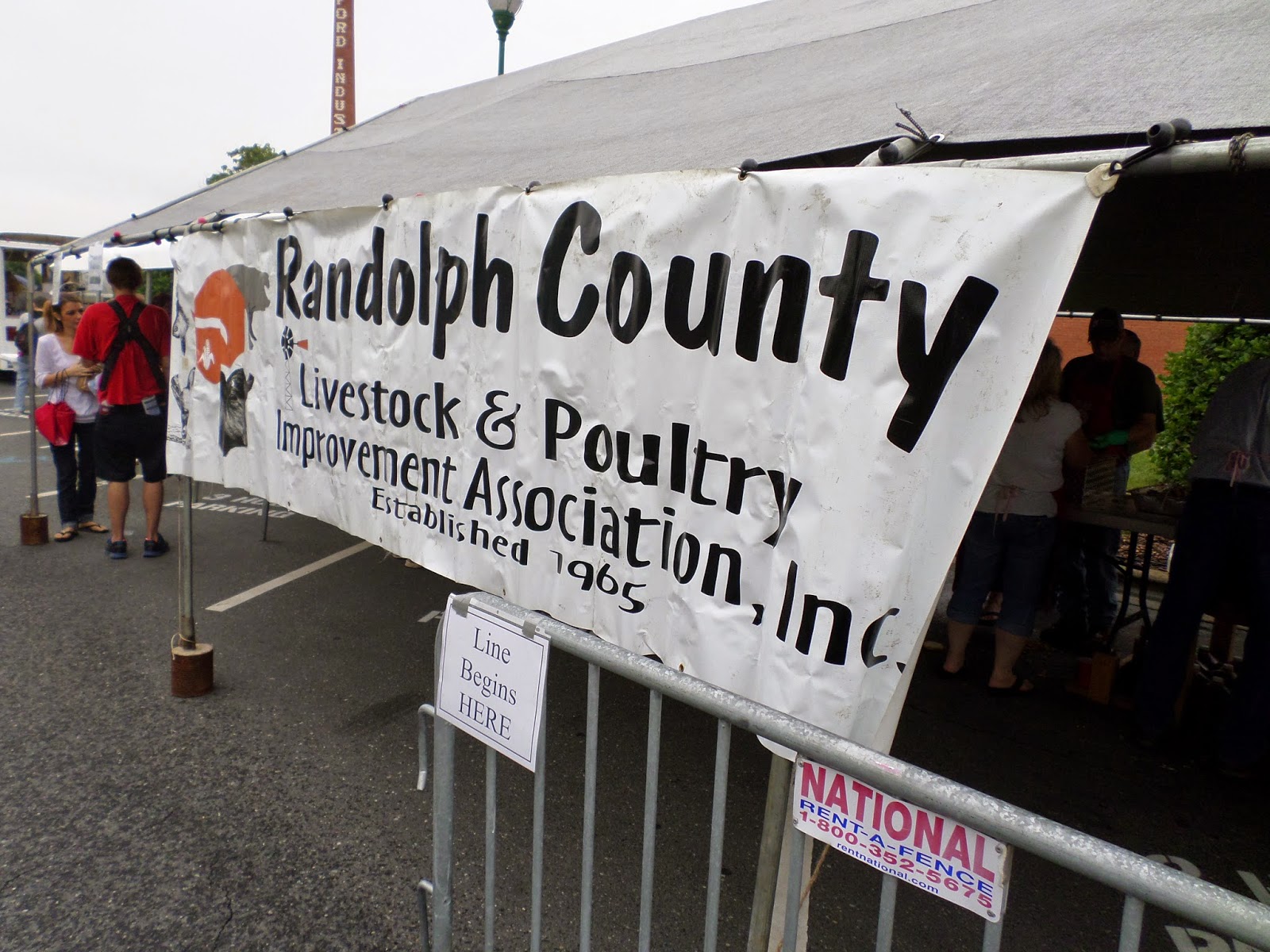
A creative activity in August is Pigs and Pedals, which combines two popular activities: eating barbecue and racing bicycles. Add music by local bands and craft beer served in a beer garden (the first time for Asheboro) at Bicentennial Park in the downtown center, and thousands of spectators come to enjoy the festivities as well as to observe the cooking teams set up in parking areas adjacent to the park. In addition, the Randolph (County) Livestock and Poultry Improvement Association cooks all night before selling hundreds of barbecue sandwiches beginning at noon on Saturday to raise money for local charities.


Meat for sandwiches being prepared by a civic organization smokes quietly
on Saturday morning before the crowd arrives and the street activities begin.

On Saturday morning, the downtown streets were relatively quiet except for the scuttle of cooking teams, contest officials, and a few pedestrians. However, by early afternoon, a crowd had arrived to enjoy the street scene and barbecue sandwiches.


A local civic organization sells barbecue sandwiches as a fundraiser.
Cooking teams brought their entries to turn-in tables at historic Sunset Theater, which opened in 1930 and was recently renovated by the city with $1 million in improvements. Upstairs in a quiet room that seemed far removed from the sounds of the park, the judges evaluated the chicken, pork ribs, pork and beef brisket to determine which teams would take home the prize money.

Judges evaluate competitive entries upstairs in the historic Sunset Theater.

The “Pedals” part of the event was a Criterium bike race along the streets of downtown Asheboro. Cyclists from across the state and region competed on a closed circuit course in races that began at 9 a.m. and continued until 4 p.m. on Saturday. The cyclists raced in front of an appreciative but small audience. By mid-day, the crowd was lured to Bicentennial Park by the smoke and aroma of barbecue in huge cookers now ready for the sandwiches.

Racers complete another lap under the banner that marks the finish line.

With 32 barbecue teams competing for $12,000 in prize money, Pigs and Pedals was quite successful. Although Criterium bike races had been held in downtime Asheboro in the three previous years, this year was the first time that the barbecue competition had been sanctioned by the Kansas City Barbecue Society.

Early arrivals buy barbecue sandwiches when they go on sale.

Like other small cities in the South, Asheboro has endured plant closings and manufacturing layoffs. In 2012 when a plant that made wires for car and truck tires was closed, another 310 jobs were lost. Pulling together to host Pigs and Pedals in this city with a population of about 25,000 does more than satisfy the desire for good barbecue. It also raises money for local charities, attracts first-time visitors, increases community spirit, and boosts the revenue of local merchants and restaurants. 


Saturday, July 26, 2014

Smokin’ in the Valley

Maggie Valley, NC, is the perfect location for a barbecue festival in the summer. In July, a good event in the South depends on sunny and warm weather, and Maggie Valley in the mountains offers days that are warm but not too hot with lots of sunshine.

Cooking teams set up the night before in the festival grounds of Maggie Valley
In July the maximum temperature is 82 degrees. At night the thermometer reading usually drops below 60, so cool temperatures in the evenings also offset the daily highs. In addition, the risk of rain is low. July is the driest month in the summer with only 3.7 inches of rain. With these conditions, the organizers of Smokin’ in the Valley, which proclaims itself as the Western North Carolina BBQ championship, couldn’t ask for more favorable conditions.

Smokin' in the Valley proclaims the Western N.C. BBQ Champion.
Smokin’ in the Valley is an event that local residents look forward to attending each year, even though Maggie Valley has a full summer schedule of exceptional events that annually draws repeat visitors. The motels, lodges, and inns fill up quickly, and I had to call several places before I found one with a room available (fortunately a reservation had just been cancelled).

Food vendors do a brisk business along the path to the music stage.
The most attractive part of Smokin’ in the Valley is not the weather but the crowd enthusiasm. The line to get a tray of samples by the cooking teams is long, but everyone waits patiently. Can you imagine standing in line for up to an hour to vote in the People’s Choice category?

The reward for standing in line to vote in the People's Choice category is
a tray of tasty samples prepared by cooking teams.
The event is held on the festival grounds (where parking is easy) of Maggie Valley next to charming Jonathan Creek, a regular destination for trout fishing because it is part of the Mountain Heritage Trout Waters Program. When Smokin’ in the Valley occurs, the grounds become a singular destination to browse through mountain arts and crafts and enjoy food from vendors (my favorites were cornbread salad and root beer float) that complement the barbecue sold in the People’s Choice contest. People arrive early and linger for hours to enjoy the music.

Mountain music performs throughout the day on the festival grounds.
Many entries that I judged were excellent, an indication that many cooking teams had been competing for years. Several earned high scores for appearance. For taste and tenderness, most beef brisket entries were excellent. Even judges who are die-hard pork aficionados considered the beef briskets as good as any other barbecue in the contest.

The judges tent is quiet before noon when the first meats arrive.
Maggie Valley is popular for more than barbecue. Several judges that I talked to were also dedicated motorcyclists, who had applied for this event to combine their interests in judging barbecue with riding mountain roads. The highways in this part of North Carolina are known not only for their scenery but also for their twisting turns and changing elevations. This area has several scenic journeys, including one with 318 twists and turns in 18 miles (known as “The Dragon”). In addition, some judges took time to visit the popular collection of vintage motorcycles on display at the Wheels Through Time Museum in Maggie Valley.

Backyard grillers can buy bags of wood -- pecan, hickory, cherry, and apple -- in the arts and crafts area.
A valley in the mountains is an excellent place to hold a barbecue festival in the summer. The trophies and prize money that Smokin’ in the Valley offers contestants is only part of the attraction for competing in this event.

Trophies for the reserve (left) and grand champions await the winners.

Sunday, July 13, 2014

Sampling and Learning at a Grilling Class

Would you take a barbecue grilling class at a restaurant owned by a highly regarded chef and graduate of the prestigious Culinary Institute of America? When I had the opportunity to participate, the decision to sign up was easy (although it was also sweetened by a discounted registration fee). The class indicated the growing interest in personal grilling.

Lots of food on the grills were ready for tasting when the class began

The class was held at Backyard Bistro, a family-owned restaurant in Raleigh, NC, well known for several signature dishes, including beef brisket slow roasted for 12 hours over hickory wood and St. Louis-style pork ribs dry-rubbed and also slow roasted. Three stations had been set up outdoors just outside the restaurant’s patio area: one was a custom-built open grill heated with charcoal briquettes, and another was a clamshell cooker fired by gas. The most intriguing grill had been made out of a trashcan for demonstrating smoking techniques.

The simplest grill is made out of a
trashcan.

The class was more a sampling class than a cooking class, although a chef at each station explained the advantages and disadvantages of the setup and heat source. The class favorite was clearly the homemade trashcan grill, and the distinctive smoke flavor imparted to food cooked in it attracted the most attention.

Smoking box with hickory wood inside
the trashcan grill.

The chef indicated that the trashcan grill had been built for less than $50 in supplies, including L-brackets, temperature gauge, circular steamer grates, and a smoking box for holding wood. At the bottom of the trashcan, holes had been drilled to let in air that kept charcoal embers slowly burning to heat and smoke hickory wood pieces in the smoking box set on the coals.

Ribs prepared in the trashcan grill
were extremely flavorful.

Food smoked in the trashcan is
ready for sampling.
Lots and lots of food items were grilled during the two-hour class: scallops, swordfish, shrimp, steak, beef brisket, chicken, pork ribs, and Portobello mushrooms. Veggies included corn, blanched potatoes, summer squash, and zucchini. In addition, pineapple basted in a mixture of brown sugar, butter, and cinnamon was on the grill to show how fruit can be part of a barbecue event.

The class was brief, and its instruction was basically only an introduction for someone interested in starting to grill. Anyone with grilling experience wouldn’t gain much except for enjoying the food that had been cooked.  In fact, some seemed interested in only eating. However, the chefs did offer suggestions practical for the backyard griller:
  • Don’t pre-soak wood being used to impart a smoky flavor to avoid smoldering it and changing the smoke flavor that would be otherwise produced. 
  • Use a smoking box for the wood (rather than placing the wood directly on the coals) so that the smoke is gradual. 
  • Sear meat on a hot cooking area initially to lock in flavor and juices. 
  • Move the meat after searing to a low heat area so that cooking continues slowly. 
One of the vehicles in
 Backyard Bistro's fleet
The class attracted more than 40 participants because Backyard Bistro is also acclaimed as a regional caterer. It has a fleet of “flame-wrapped vehicles and grills” for cooking on site. Its 40-foot “Big Rig” has four 3-by-5 feet grills (large enough to cook a whole 125-pound pig each) and has fed as many as 8,000 people with 16 buffet lines going at once. Joe Lumbrazo, head chef and owner, has been selected to cook for the governor at political events. What better crew of professional chefs to observe?

Joe Lubrazo discusses meat and vegetables cooked on gas-fired grill.

The buffet enjoyed
at the end of the class.
The class was entertaining and provided information about grilling techniques and fuel sources. Watching the chefs demonstrate their pride and skill in preparing exceptional food on a grill obviously motivated the participants to improve their grilling techniques.


Grilled Pineapple 


Although no recipes were provided as part of the class, this recipe is a good one for grilling pineapple.

1 fresh pineapple, peeled, cored, and sliced into one-inch rings
¾ cup dark brown sugar
1 tablespoon honey
¼ teaspoon ground cinnamon
3 tablespoons melted unsalted butter

Directions
1. Mix honey, butter, brown sugar, and cinnamon in bowl.
2. Add pineapple to bowl and spoon mixture over pineapple rings.
3. Place pineapple rings and mixture in plastic bag that can be resealed.
4. Seal bag and press to continue coating each ring.
5. Marinate overnight (but not less than 30 minutes)
6. Preheat an outdoor grill for medium-high heat and lightly oil the grate.
7. Grill pineapple for approximately 3 minutes per side. Remove when grill marks appear (and be careful to avoid burning sugar on pineapple).

Note: Makes about 12 servings.

Grilled pineapple that I prepared several days after the class using this recipe.

Saturday, June 28, 2014

Moved by Mother Nature but Not Stopped by Flooding

Competitive barbecue cookouts never occur as planned. A critical change in plans can pop up at the last minute, such as a mandatory relocation. When I was a judge at the Bend in the River Cookout in Minnesota, I saw the best of impromptu event planning.

Torrential summer rains that hit the Midwest in June caused extensive flooding in towns and cities along key rivers. Several days before the cookout was to begin in Mankato, the Minnesota River overflowed its banks. Flood waters churned down city streets after daily massive downpours; during one, 5 inches of rain fell overnight. The event had been planned at the scenic Land of Memories Park that is in a large bend of the river, but after days of rain – and extensive flooding – not a dry spot was available. The park was completely under water, and the river was cresting at levels higher than predicted.

Nate Herme always picks dry places
for his barbecue cookouts!
Nate Herme, the event organizer, moved the festival to Saint Peter, a nearby city that is home of the county fairgrounds. The cookout was held in amazingly calm conditions, although the forecast of thunderstorms again proved true when they eventually arrived in the late afternoon. At the judges’ meeting before the start of the competition, Nate joked that the original location was now the Lake (rather than Land) of Memories because it had so much water. Coordinating the relocation was a huge task because this event had so many cooking teams (the first cookout in Minnesota with 50 competitive teams – plus the amateur contest had another 50 teams as well).

However, the last-minute change in location didn’t seem to affect any of the cooking teams. Saturday morning was quiet as they focused on preparing their entries. While the competitive teams were busy, the amateur teams were also cooking. The festival is well known for pulled pork and ribs available for sampling, and a $10 ticket entitles a person to five samples. Proceeds of the ticket sales are used to purchase playground equipment for children with disabilities and to make local parks more accessible to them.

Barbecue samples for only $10 draw a crowd.

The competitive teams prepared the usual meats – chicken, pork ribs, pork, and beef brisket – for an event sanctioned by the Kansas City Barbecue Society. The beef brisket samples were some of the best that I have judged, and I assigned the highest score of 9 to more than one. The other meats were also exceptionally well prepared.

Several teams are busy at work on a Saturday morning.

An unexpected surprise of being at the cookout was a chance to talk to Dean Compart, who told me about his Duroc hogs, the second most recorded breed of swine in the United States. His family farm, which initially imported the Duroc breed from Sweden and Denmark in the early 1990s to produce leaner pork, is now managed by a third generation with the fourth generation being groomed for future operations.

Dean Compart (right) is extremely proud of his Duroc swine.

Even with the change in location, the cookout drew a large crowd of spectators interested in observing the teams and sampling the best barbecue in the Midwest. Seeing the skilled cooks in action was a big draw, but knowing that buying tickets to sample barbecue would help to upgrade local parks and make them more accessible to children with disabilities made the event meaningful.


Does carefully selecting your own wood guarantee better results?

Some teams spare no expense to travel in style.


Barrels are another choice for cooking equipment.
Have cooker on trailer, will travel.

Who is doing all the work for this team?