Showing posts with label clamshell. Show all posts

Friday, April 5, 2024

90 Years and Counting: Continuing the Barbecue Tradition at Holland’s Church

The quiet, rural community around Holland's Church knows where to find excellent barbecue. 

When a community has been fixin’ barbecue for 90 years, it has to be good. Located nine miles south of downtown Raleigh, NC, near the intersection of two historic roads, Old Stage and Ten-Ten, Holland’s Church has been doing just that for nine decades. 

The popular barbecue is served in clamshell boxes with potatoes, coleslaw, and hushpuppies.

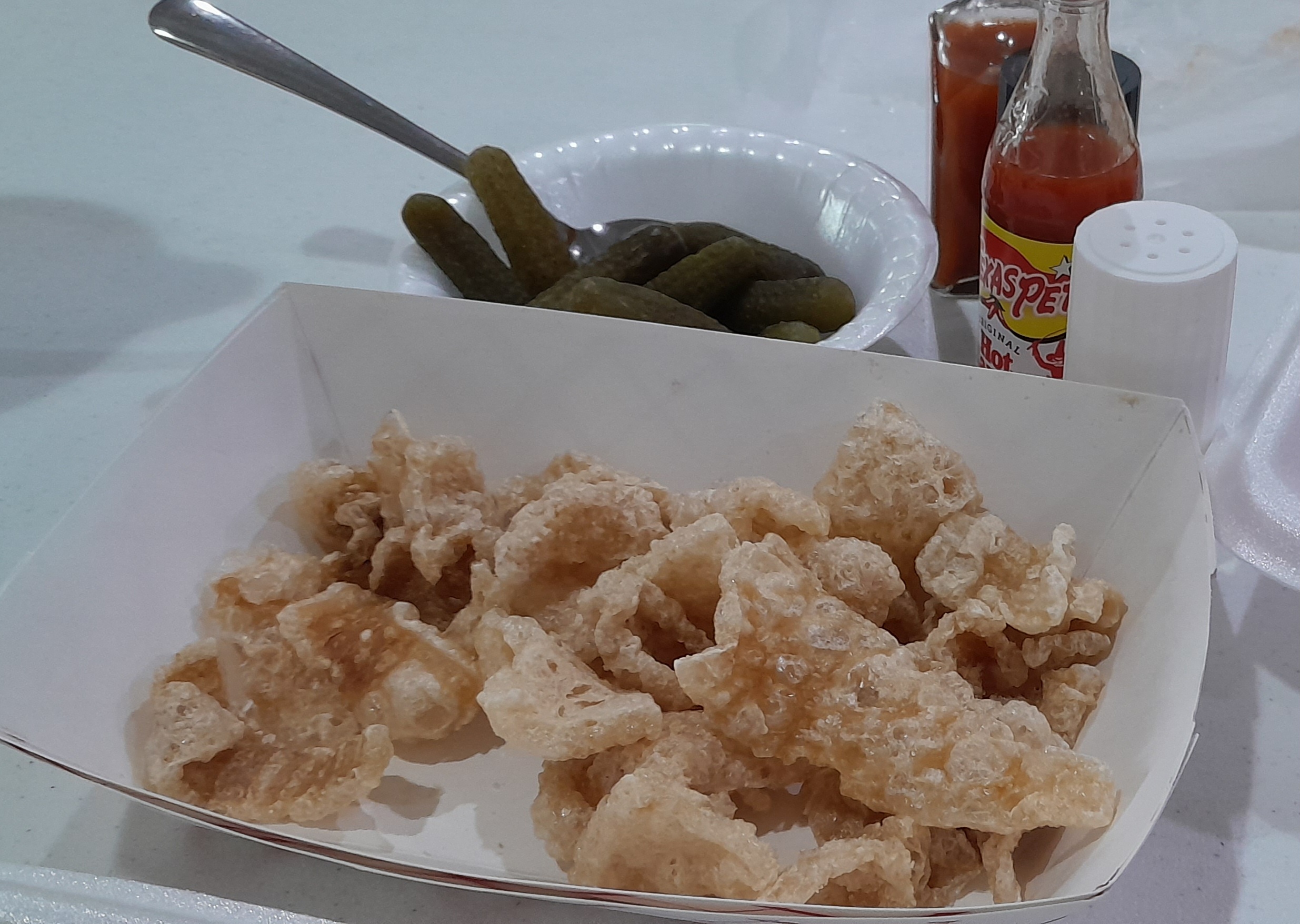
The church serves its barbecue, potatoes, coleslaw, and hushpuppies in a clamshell box, and runners carry the boxes to tables as people arrive. (There is no standing in line.) Tea (sweet) and water are the beverages. Homemade desserts (pies and cakes) available by the slice are on another table. To-go plates can also be bought as well as containers of barbecue and freshly made pork skins. 

The efficient kitchen crew prepares the clamshell boxes quickly.

Until recently, the barbecue dinner was served family style. After paying at the door, people were seated at tables where bowls of barbecue, coleslaw, potatoes, and hushpuppies were placed, and they were joined by other community members. Everyone could eat as much as they liked.

Runners carry the clamshell boxes to tables as customers arrive.

Preparing barbecue plates has been a tradition at the church for several generations. Every April and November, the church’s members renew their long-standing ritual. However, the church was 122 years old before it began contributing annually to the region’s barbecue culture. 

The dessert table adds an extra sweetness to the day.

This Methodist congregation was established in 1812. Holland’s Church quickly became the center of a community in southern Wake County that was generally isolated from other pockets of population and the evolving city of Raleigh (established as the county seat and state capital only a few years earlier in 1792). This location was being settled before railroads were built in the area.

The eat-in area begins to fill up when the serving line opens at 11 a.m.

In fact, the church predates two major railroads built in the state. The North Carolina Railroad, which connected cities in the Piedmont to those on the Atlantic coast, was chartered in 1849 by the state legislature and opened for operation in 1851. The Chatham Railroad, connecting Chatham County (west of Wake) to Raleigh, opened in 1869.

Trays of pork skins are available at each table.

The church is named for William Holland, who was born in Chester, England, in 1750 and immigrated to Wake County. Before dying on December 4, 1809, the former English schoolmaster had prepared a will that provided $400 “to build a good Methodist Meeting House, that may have a partition at one end thereof for a classroom.” Holland is buried in the church’s cemetery.

The to-go line stays busy throughout the day.

The church was used as a school, a tribute to Holland’s desire that the church include an “educational enterprise.” Believed to be the first school in the county outside the city of Raleigh, this use signified “its established position in the life of the community,” according to the historical text “Early Methodist Meeting Houses in Wake County, North Carolina” by G. Franklin Grill, a church historian. 

Hushpuppy batter is ready for frying at the prep area outside the church.

Nothing in historical records indicates when Holland’s Church also became the center of barbecue excellence. To celebrate the 90th anniversary, the church offered a free plate to anyone who was 90 or older. Imagine being 90 years old and having been part of this barbecue tradition for decades. It would be a life worth living.

Saturday, November 3, 2018

Revisiting Hemingway, SC

So much has happened concerning the appreciation of Scott’s Bar-B-Que in Hemingway, SC, since I visited four years ago. It still occupies the old variety store in a town of fewer than 600 residents. The business begun by Roosevelt Scott, when he was 30, continues the family tradition of cooking whole hogs and serving the area’s favorite pork barbecue sauced with peppery vinegar.

A new sign was added after my visit in 2014.

However, Scott’s son, Rodney, has gone on to fame and fortune far beyond that ever imagined by his parents. This second-generation pitmaster has branched out from his family’s business in rural South Carolina and launched his own eponymous restaurant in busy downtown Charleston, only 80 miles away.

Scott's Bar-B-Que is now a certified heritage site.

The contrast between the two locations couldn’t be greater. Because I had just visited Rodney Scott’s Bar-B-Que in Charleston, I wanted to see what changes had been made in Hemingway at the family business. Fortunately for me, the only significant changes were a marker designating the store as a certified heritage site in eastern South Carolina and a new metal structure that encloses the pits.

The relationship of Scott's Bar-B-Que to South Carolina barbecue culture and the four regional sauces (or "mops") is explained in a new sign by the pits.

A simple menu board still hangs above the serving windows, the menu is as limited as ever, the lineup of customers wanting to take home their next meals never ends, and the whiff of smoked barbecue permeates the country variety store as before.

Although a menu board is above the serving window, most customers know what they want to order before they enter.

When I ordered a barbecue dinner to go, I was pleased to see that it is still served in a Styrofoam clamshell and comes with sliced white bread. I also appreciated coleslaw and baked beans as sides with the barbecue; however, the expansion of sides to the level of Rodney’s restaurant in Charleston clearly hasn’t been considered even with all of the success in the big city.

My plate of pulled pork (and sauce in the lower left corner) came with coleslaw and beans in a Styrofoam clamshell.

After son Rodney has been profiled in national publications such as Time magazine and The New York Times and received the award as Best Chef: Southeast from the prestigious James Beard Foundation, it’s reassuring that the family business continues with few changes, unaffected by all the glitter and publicity. The residents of Hemingway would be shocked if Scott’s Bar-B-Que wasn’t still preparing and serving barbecue like it has for the past four decades, and the out-of-town visitors would be disappointed if the trip back to nostalgia ever ended.

A new metal structure now encloses the pit area.


Note: This post fittingly is the 100th one that I have added to this blog. The barbecue journey that I’ve been on couldn’t have timed a better return to Hemingway, SC, to appreciate the work and legacy of the Scott family.

Friday, November 14, 2014

In the Tradition Appreciated by a Community and Beyond

A trip to Hemingway, SC, has been a goal of mine for some time. The destination is Scott’s Variety Store and Bar-B-Que. This business has been a local community favorite for more than four decades because the barbecue that the Scott family serves has no equal. More recently, it has won national acclaim for the “cut, chop, cook” style — cut the wood, chop it up, and slow-smoke whole hogs all night — embraced by Rodney Scott, pitmaster for the family’s business.

The Scott family opened its business in 1972; the weathered church pew out front is used frequently by customers.

The tin-roofed store, which opened in 1972, once focused on dry goods and included a pool hall before the business swung decidedly to barbecue. Initially, whole hogs were smoked on only Thursdays. My, how times have changed. Selling the area’s best barbecue is now the goal, although the variety store still has a few items on its shelves. Some shelves are empty, but customers rarely notice because they are here for barbecue.

The menu board lists barbecue from a sandwich to a whole hog.

Scott is admired for his skills in the pits. However, before cooking the hogs, he also cuts all the wood himself with a chainsaw. With smoldering oak and hickory coals burning brightly in each pit, Scott monitors hogs weighing up to 150 pounds as they are smoked and mops them with peppery vinegar. The master of the pits has been cooking whole hogs since he was 11.

The cut hardwood behind the store is ready to be chopped; the telltale sign of smoke lets you know that the burn barrels are active.

Lots of customers take orders to go by the half pound and more. The to-go business is easy to understand. There’s no place inside to sit and eat. A weathered church pew on the front porch is about the only place someone can sit and eat on the premises. That’s where I sat and enjoyed pulled pork served with two slices of bread in a Styrofoam clamshell. The simplicity of the container matches the simplicity of the pulled pork barbecue prepared so deliciously.

Hardwood breaks down into coals as it's burned in five-foot barrels.

While I was there, I was able to visit the pits, which consist of two long concrete bunkers. Each one is fed hot coals from the burn barrels to cook hogs suspended above the heat by chicken wire. No other customers seemed interested in checking out the pits, a sign that they were locals and considered the pit area so functional with nothing to admire. However, the salvaged industrial piping and junked truck axles in the burn barrels seemed to me as artistic as any treasured folk art.

The pit area constantly stays busy.

The customers also seemed unimpressed to be ordering barbecue prepared by someone who has received so much attention. In July 2011, Time magazine heralded Scott for personifying “everything people admire about barbecue.”

Grocery items are still on the shelves for sale but more space is being taken over to document the recognition of Rodney Scott's pitmaster skills.

Two year earlier, on June 9, 2009, The New York Times exposed Scott, then 37, to the world in an article by John T. Edge, a food writer and director of the Southern Foodways Alliance. In the following year, SFA produced the documentary “Chop/Cut/Smoke” about Scott’s approach to whole hog cooking. Edge also extended the recognition of Scott in an article for Saveur on how barbecue is being preserved as an art form.

A plaque commemorates the initial showing of the "Cut/Chop/Cook" documentary by the Southern Foodways Alliance.

Rumors that Scott is planning a “city” restaurant in Charleston with his barbecue have started to circulate. I can’t imagine it would ever compete with the charm of the family’s variety store in Hemingway. Let’s hope that the barbecue and the approach for preparing it don’t change either.

Hot coals are added to the pits regularly as hogs are smoked.